Yes, you can absolutely teach your bird to dance, and no, you don't need to force anything or wait for a "musical" bird to magically figure it out. Dancing is a real, trainable behavior built from small, observable movements like head bobs, stepping in place, and foot lifts, chained together into a routine your bird performs on cue. The whole process uses the same positive reinforcement approach you'd use to teach any trick, and it's one of the most rewarding things you can work on because it builds directly on the bond you already have. If you are comparing related options, how to teach your bird to spin is another approach worth considering.
How to Teach a Bird to Dance: Step-by-Step Training
Maya Harris
18 Apr 2026
What "dancing" actually means in training terms
Before you can teach it, you need to define it. "Dancing" is not a single behavior. It's a chain of smaller, measurable actions that, when performed in sequence, look like dancing to us. In training terms, each component needs to be broken down so your bird knows exactly what earns a reward. The most common building blocks for a bird dance routine are:
- Head bob: the bird moves its head up and down within a set time window after a cue
- Head turn: the bird moves its head left or right toward a target or cue
- Step in place: the bird alternates feet while staying on the perch, without walking away
- Foot lift: the bird raises one foot on cue, a separate behavior from stepping
- Wing raise or spread: a more advanced movement, trained separately and added later
Each of these is its own discrete behavior with its own criteria. A head-bob with the beak touching a target is a different behavior from a foot stepping onto a target. This distinction matters because you'll train them one at a time and only chain them together once each piece is reliable on its own. Skipping this step is the most common reason a "dance" routine falls apart.
Some birds, especially parrots, cockatoos, and budgies, already bob or sway spontaneously in response to music or excitement. If your bird does this naturally, that's a huge shortcut: you can capture that behavior (mark and reward it the moment it happens) rather than shaping it from scratch. We'll cover both approaches below.
Set up for success before you start
The training environment matters more than most people realize. A bird that's nervous, distracted, or in an unfamiliar space will not engage with training, no matter how good your treats are. Get this foundation right first.
Safety basics
- Train in a quiet room with no ceiling fans running, no other pets present, and no sudden loud noises
- Make sure windows and doors are closed if your bird is out of the cage
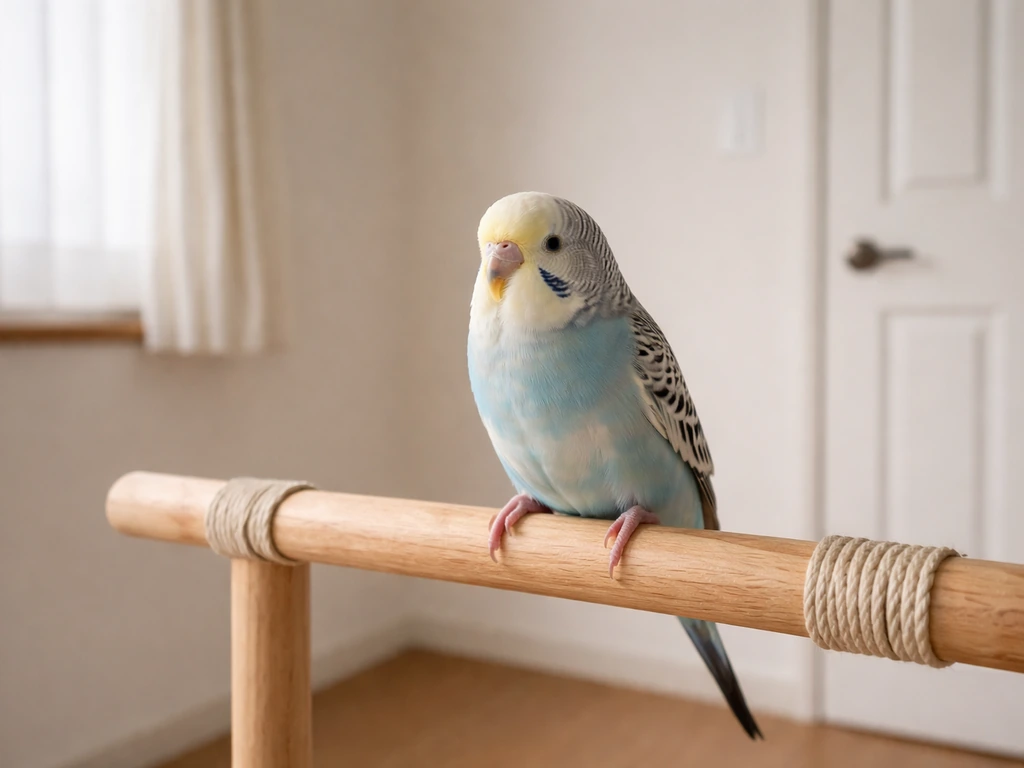
- Use a stable, familiar perch or play stand as your "training station" — the bird should know this spot as safe and comfortable
- Keep training tools (clicker, target stick, treats) within easy reach so you're not fumbling during the session
- Never train near mirrors or highly reflective surfaces, which can cause territorial behavior in some birds
Bonding and readiness
Your bird needs to be comfortable enough with you to take food from your hand or near your hand before you begin dance training. If that's not happening yet, focus on trust-building first: sit near the cage, offer high-value treats through the bars, and let the bird set the pace of approach. Rushing into trick training before a solid bond exists will produce a stressed, resistant bird, not a dancing one. A bird that willingly stations on a perch near you and takes treats calmly is ready to start.
Your training station
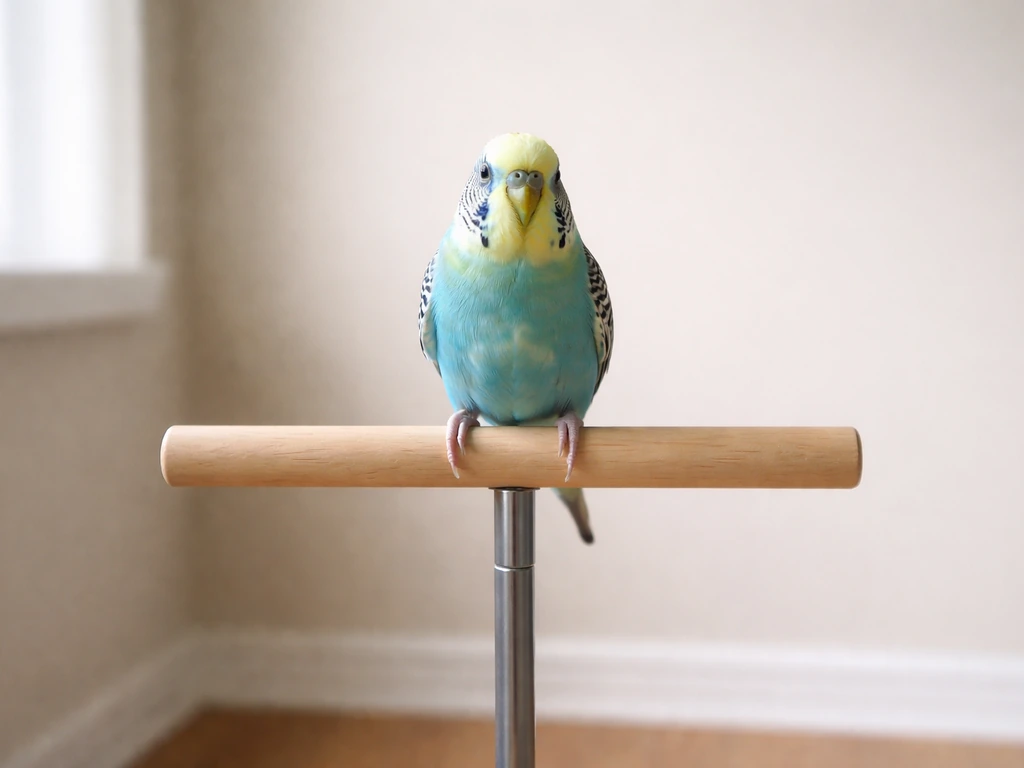
Station training is the structural foundation for dancing. Teach your bird to go to a specific perch on cue and stay there. This gives you a defined space where dance behaviors happen, which makes the whole routine more predictable for the bird and easier for you to reinforce precisely. Once your bird reliably goes to and stays on the training perch, you have a consistent context in which to build each dance movement.
Choosing your reinforcement and your marker
You need two tools: a marker and a reinforcer. The marker tells your bird the exact moment it did the right thing. The reinforcer is what makes doing the right thing worth repeating. Both need to be chosen before your first session.
Markers
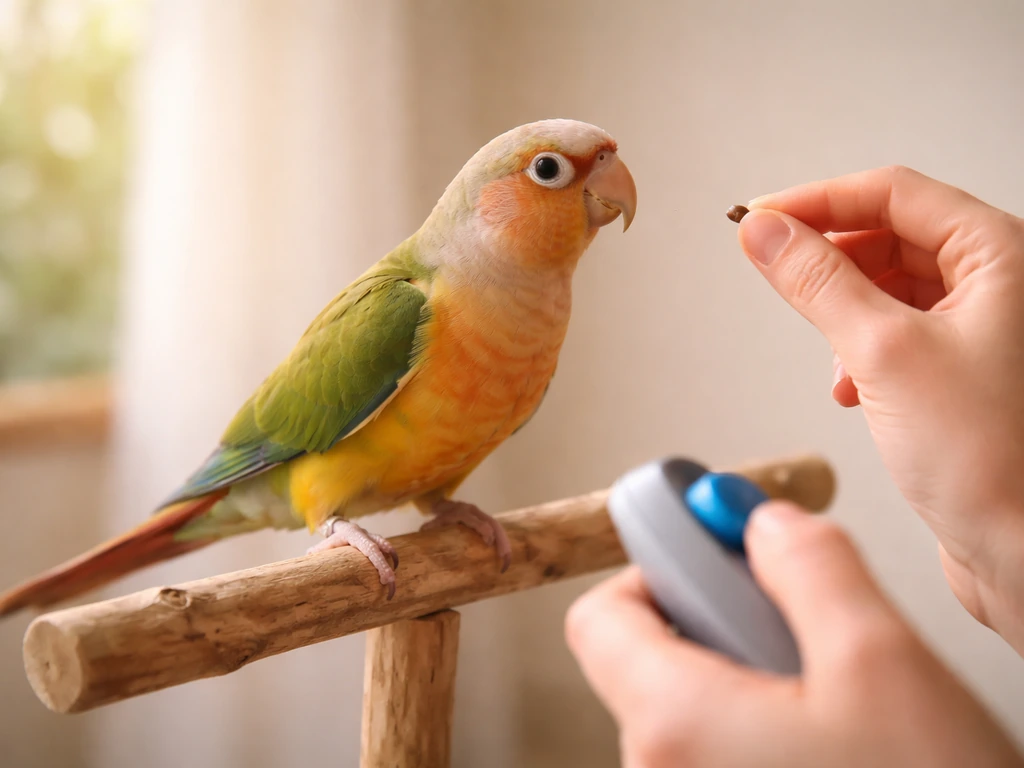
A clicker is the most precise marker available and works well for most pet birds. The click happens instantly and sounds the same every time, which means your bird always knows exactly which movement earned the reward. If your bird is sound-sensitive or startles at the clicker, a short, consistent word like "yes" used at the same volume every time works as a verbal marker. Whatever you choose, stick with it. Switching mid-training confuses the process.
Reinforcers
Find out what your bird is most motivated by. For many parrots, this is a small piece of a high-value food: a sliver of almond, a pine nut, a small piece of nutriberri, or a bit of fruit. The treat should be small enough that your bird eats it in one second and is immediately ready for the next repetition. If the treat takes 30 seconds to eat, your session drags and your bird loses focus. Praise and head scratches can supplement food reinforcement once the behavior is established, but food is usually the most reliable driver in early training.
Session length and structure
Keep sessions short: 5 to 10 minutes for beginners, and no more than 15 to 20 minutes even for an experienced bird working on a new behavior. End every session while the bird is still engaged and performing well, not after interest has already dropped off. Ending on a win keeps the bird motivated to come back. Plan two to three short sessions per day rather than one long one. Consistent, short repetitions build behavior faster than marathon sessions.
Step-by-step: shaping a dance routine from scratch
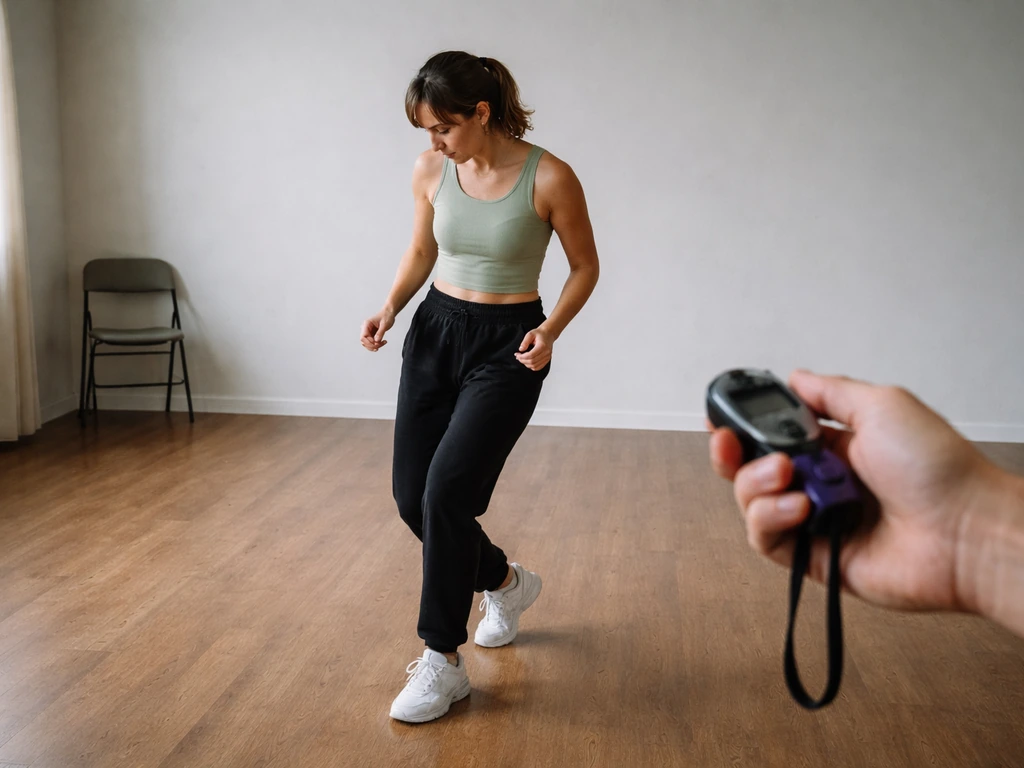
Here's how to build a basic dance routine from zero. For more detailed steps and progression ideas, see how to make your bird dance. You can apply the same positive-reinforcement, target-based shaping approach to teach your bird to lay on its back safely and reliably. This sequence works for budgies, cockatiels, conures, lovebirds, and most parrot species. Adjust the pace based on how quickly your individual bird responds.
- Load your marker: click (or say your verbal marker) and immediately give a treat 10 to 15 times in a row with no behavior requirement. You're teaching your bird that the marker predicts a treat. Do this in one short session before any other training.
- Introduce target training: hold a target stick (or the tip of your finger) near the bird's beak. The moment the bird touches it with its beak, mark and reward. Repeat until the bird is reliably touching the target on presentation. This is your foundational control tool.
- Shape a head bob: hold the target slightly above the bird's natural head position so it has to move its head upward to touch it. Mark the upward movement. Over several repetitions, begin to move the target down slightly before the bird touches, so the head has to come back down too. You're capturing the up-down motion. Gradually fade the target so the head bob happens in response to your hand cue (a gentle downward nod or a finger wave) rather than the target stick.
- Shape stepping in place: while the bird is stationed, hold the target low near one foot. Mark and reward any foot lift. Gradually require the foot to touch the target before marking. Then alternate: target near left foot, mark lift, reward; target near right foot, mark lift, reward. Build the rhythm slowly. Add a consistent cue word or gesture like 'step' before presenting the target.
- Add a cue word and/or music: once head bobs and stepping are each happening reliably on their own cues, begin pairing both with a short music clip or a consistent spoken cue like 'dance.' Present the music or cue, then prompt each behavior in sequence. Mark and reward each component at first, then gradually shift to rewarding the sequence as a whole.
- Chain the behaviors: ask for the head bob, mark and reward; ask for the stepping, mark and reward; then run the sequence together and reward at the end. This is behavior chaining. Build the chain gradually, adding only one new link at a time.
- Fade prompts: once the chain is reliable, slowly reduce your physical prompting (target stick, hand gestures) until the music or the single cue word triggers the whole routine on its own.
Progressing from first movements to a real routine
The jump from 'my bird bobs once when I cue it' to 'my bird performs a dance routine' is all about criteria management. You raise the bar deliberately, one small step at a time, and only after the current criteria is met consistently. A good rule: if your bird is succeeding 80 percent of the time or more, it's ready for the next step. If success drops below that, go back to the previous criteria and rebuild.
| Stage | What the bird does | What you mark and reward | When to advance |
|---|---|---|---|
| Stage 1: Foundation | Touches target with beak on presentation | Any beak-to-target contact | When contact is immediate and consistent across 5+ reps |
| Stage 2: Head bob component | Moves head up and down toward target | The up-down motion within 3 seconds of cue | When bob happens reliably without target present |
| Stage 3: Step in place component | Lifts one foot when target is near foot | Any foot lift toward target | When bird alternates both feet on cue |
| Stage 4: Combined on cue | Both bob and step happen in sequence on a single cue | The full sequence, rewarded at the end | When sequence completes without prompting 4 out of 5 tries |
| Stage 5: Routine with music | Sustains the sequence through a short music clip (15–30 seconds) | Completion of the full clip | When bird sustains the routine consistently across multiple sessions |
Once a routine is reliable, shift to intermittent reinforcement: reward every other successful routine, then every third, then randomly. This makes the behavior more durable over time and prevents it from falling apart the moment you skip a reward. You don't have to feed a treat every single time forever; the behavior will actually hold better once the bird learns that rewards come unpredictably but reliably.
If you want to expand beyond head bobs and stepping, the same method applies to more complex moves. Once your bird has mastered the building blocks of training on cue, you can use the same chaining and target skills to teach it to play basketball. Wing raises, spins, and bowing can each be shaped as separate behaviors using target training and then added to the chain. The sibling skill of spinning and rolling over follows the exact same shaping logic, so once you can roll reliably, you can strengthen it into your routine spins, and bowing. The sibling skills of spinning and rolling over follow the exact same shaping logic and can be introduced after your bird has a solid dance foundation. Once your bird can roll over reliably, you can keep generalizing that movement and even blend it into the same cue-based routine rolling over.
When things aren't working: troubleshooting
The bird shows no interest
First, check whether your bird is actually hungry enough to be food-motivated. Training right before a regular meal works better than training right after. Second, try different treats: some birds are indifferent to seeds but go wild for a specific fruit or nut. Third, shorten your sessions. A bird that seems bored after two minutes is telling you five minutes is already too long for now. Start with two-minute sessions and build from there.
The bird seems afraid or won't approach
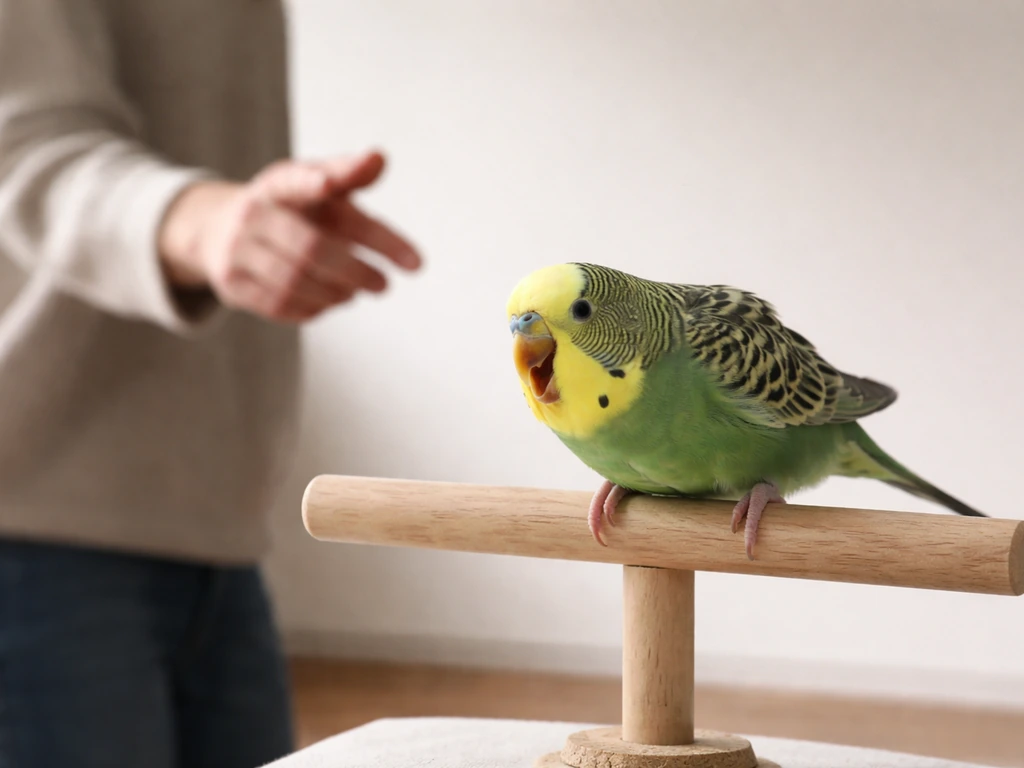
Fear during training shows up as feather fluffing, crouching, leaning away, rapid eye-pinning, open-mouth breathing, or repeated attempts to move off the perch. If you see any of these, you've gone too fast. Stop the session, give the bird space, and in the next session, go back two or three steps to something the bird is already confident with. Never push through fear signs. The bird needs to feel safe and in control of the interaction for training to work, and for your relationship to stay intact.
The bird is biting or suddenly more aggressive
Biting during training is almost always communicating discomfort, overstimulation, or fear. If your bird's biting has increased suddenly and wasn't a problem before, rule out pain or illness first: a vet check is genuinely worth doing before you continue training. A bird that's hurting will defend itself. If the bird is healthy but biting during sessions, you're likely pushing too hard or too long. End the session, assess what triggered the bite, and adjust your approach.
The bird was doing well but suddenly stopped responding
This is very common and usually signals one of three things: the criteria jumped too fast, the treats lost their value (the bird is bored of that reward), or the bird is distracted by something in the environment. Rotate your treat options, check whether anything changed in the room, and drop back to an earlier stage of the chain that the bird was confident with. Rebuild from there. Consistency is more important than speed.
Timing problems: marking too late or too early
Clicker timing is a skill that takes practice. If you're marking a half-second after the behavior, you're reinforcing the wrong thing, often the bird looking at the treat container or turning away. Practice clicking at the exact peak of a head bob or at the moment of foot contact. Record yourself on your phone and watch it back. You'll quickly see where your timing slips. This single fix often makes a plateau disappear.
Welfare, handling, and the pet vs. wild bird distinction
Everything in this guide assumes you're working with a pet bird that is already acclimated to human presence and chooses to interact with you. The training is consent-based: the bird can leave (within the safe training environment), can refuse to engage, and is never physically forced into position. The American Veterinary Society of Animal Behavior (AVSAB) provides humane, welfare-focused guidance on training approaches and clarifies its position on humane reward-based training The training is consent-based: the bird can leave (within the safe training environment), can refuse to engage, and is never physically forced into position.. That's not just ethically correct, it's also what makes the training actually work. A bird that feels coerced won't generalize behaviors or retain them reliably.
If you work in wildlife rehabilitation, the calculus is completely different. Wild or rehabilitated birds should not be trained for performance routines. Their welfare depends on maintaining natural behaviors and minimizing habituation to humans. Any handling in a rehab context should focus on reducing fear and stress, not building trick behaviors. Avian veterinarians and rehab specialists use many of the same low-stress handling principles described here, but toward the goal of health assessment and release, not routine performance. If you’re ready to expand beyond dancing, the same trust-first, positive-reinforcement approach can also be used for teaching your bird to play dead trick behaviors.
For pet bird owners, there are still welfare guardrails to keep in mind. Keep sessions short, read your bird's body language every single minute, and never train a bird that is molting heavily, recovering from illness, or showing any signs of stress in its daily life. Dance training should be fun for both of you. If it starts feeling like work for your bird, it's not enrichment anymore.
Handling ethics also matter even with pet birds. Use positive reinforcement to return your bird to its enclosure after training, rather than physical restraint. Teaching the bird to go back to its cage on a cue (paired with a reward) is both a welfare practice and a practical skill that makes daily life easier.
Your simple starting plan and what to track
Here's a concrete plan you can start today. It takes about two weeks of consistent short sessions to get from zero to a bird reliably performing a two-component dance on a single cue, assuming the bird already has a solid trust baseline.
| Days | Focus | Goal for the period | What to log |
|---|---|---|---|
| Days 1–2 | Marker loading and target introduction | Bird touches target reliably in 5+ consecutive reps | Whether bird approaches willingly; how many reps per session |
| Days 3–5 | Head bob shaping | Bird bobs head on hand cue without target present | Number of bobs per session; how quickly bird responds to cue |
| Days 6–8 | Stepping in place shaping | Bird lifts alternating feet on cue | Which foot responds first; any hesitation or avoidance |
| Days 9–11 | Combining both behaviors | Bird performs bob then step in sequence on one cue | Success rate across reps (aim for 80% before advancing) |
| Days 12–14 | Adding music or extending duration | Bird sustains routine through a 15-second music clip | Duration held; any stress signs; treat value maintenance |
Track your sessions in a simple notebook or phone note. Write down: what behavior you worked on, how many successful reps, any stress signs you noticed, and what treat you used. This doesn't need to be elaborate. Even three lines per session will show you patterns across days, like a consistent drop in performance in afternoon sessions (which might mean your bird is tired then), or that a particular treat stopped working after three days.
One useful metric to track as you advance is response latency: how long does it take from the moment you give the cue to the moment your bird starts the behavior? A shorter, more immediate response means the behavior is becoming fluent. If latency is getting longer over sessions, that's a sign the criteria is too hard or motivation is dropping.
Once your bird has a reliable two-component routine, the natural next steps are adding duration, adding variety (a wing raise, a spin, or a bow), or building a longer chain. Each of those is its own shaping project, but every one of them builds directly on the same foundation you're setting up now. Start small, build deliberately, and let your bird show you the pace.
FAQ
Should I add a cue right away, or wait until my bird already bobs and steps on its own?
Use the cue only after the behavior is already happening reliably, then pair the cue with reinforcement every time at first. If you introduce the cue too early, you will accidentally reinforce “waiting for treats” instead of the dance components.
How do I pick the right perch or training spot for dancing so the routine stays consistent?
Choose a perch that gives the bird stable footing, enough space to lift a foot or shift weight, and easy access for you to deliver the treat near the target. If the perch is slippery or too high, the bird may avoid the area, making the routine look inconsistent even when the behavior is trained.
When exactly should I end a dance session if my bird is still trying but interest is fading?
Let the bird earn the next rep, then stop before it is no longer interested. Practically, you can end as soon as you see engagement drop (slower responses, turning away, or looking past the target), even if you still had time left in the session. This prevents the bird from learning that dancing becomes “the thing you do until you get bored”.
My bird is starting to show fear signs mid-training. What should I do in the next session and how far should I roll back?
If you see stress signals, reduce difficulty immediately by reverting to the most recent criteria the bird could do confidently, and use the same cue or no cue at all for a couple reps. Also check for session-specific triggers like noise, a new person in the room, or the target being placed in a different spot.
What if my bird keeps getting less excited about treats even though I’m using the same target and steps?
Treat value can drop even when the bird is still “food motivated.” Try rotating between two or three high-value options, keep portions tiny, and store treats the same way to avoid changes in smell. If latency increases and the bird approaches more slowly, it often signals the treat stopped being reinforcing, not that dancing got harder.
How can I get my bird to dance on cue in more than one place or time of day?
Generalization usually requires retraining the routine in new contexts. Once the two-component chain works on the training perch, practice for a few short reps on the same perch but at a different time of day, then in a slightly different room layout. Avoid changing too many variables at once, like new perch plus new cue plus new treat.
My bird bobs reliably, but the stepping or foot-lift part falls apart. How do I troubleshoot that component?
If the bird hesitates at foot-lift steps, verify that you are reinforcing the foot contact you want (for example, foot on target) rather than the moment the foot is raised. Adjust the target height and distance to match the bird’s natural stance, and train that component longer before chaining it into the full sequence.
When should I switch from rewarding every rep to intermittent reinforcement, and how do I keep the routine from collapsing?
When you need to make rewards less predictable without losing the routine, start intermittent reinforcement only after the full chain is fluent. A practical approach is reward every rep for several sessions, then switch to every other rep for a week while keeping sessions short, then move to every third and only later to random.
How should I respond if biting increases suddenly during dance training?
A bird that suddenly bites more should trigger a health and welfare check first, especially if behavior changes are abrupt. If a vet rules out pain or illness, treat biting as a training-time signal: shorten sessions, reduce arousal, remove the cue for a few reps, and return to an easier criterion so the bird regains control.
What do response latency changes tell me, and how should I adjust training based on them?
Use response latency as a decision tool: if the bird takes longer than usual to start, the criteria may be too high or motivation too low. In that case, lower the requirement (reward the last correct step sooner), and use shorter sessions to rebuild fluent responding before increasing difficulty again.
Can I teach the dance without a clicker, and what if my bird startles at the click?
Yes, but only if the bird is already comfortable with any sound. If the click startles, switch to a verbal marker at the same volume and distance every time, or use a marker the bird can feel visually (like a consistent gesture) if appropriate. The key is that whatever marker you use must be perfectly consistent and timed at the moment of the target behavior.
What’s the safest way to expand the routine, like adding wing raises or making it longer, without overwhelming my bird?
If you want a smoother routine, add components gradually in the direction the bird can perform naturally, then use duration or sequence consistency. Avoid jumping straight to “dance for a long time” because that teaches fatigue-based behavior. Instead, increase the number of correct components per cue before adding any added time or complexity.
Next Articles
How to Teach Your Bird to Play Dead Safely Step by Step
Step-by-step, welfare-first plan to train your bird to play dead safely with timing, cues, proofing, and troubleshooting
How to Teach a Bird to Fetch Step by Step Guide
Humane, step-by-step training to teach your bird to fetch safely, with targets, rewards, troubleshooting, and gradual re
How to Teach Your Bird: Calm, Positive Training Steps
Step-by-step humane training to bond, reduce stress, and teach behaviors with positive reinforcement for parrots and sma