Yes, you can teach your bird to say 'peekaboo,' and plenty of birds pick it up faster than you'd expect. The key is matching your method to your specific bird, keeping sessions short, and rewarding the right moments. This guide walks you through every step, from checking whether your bird is likely to mimic at all, to setting up the training space, to turning 'peekaboo' into a reliable game your bird plays on cue.
How to Teach Your Bird to Say Peekaboo Step by Step
Maya Harris
22 Mar 2026
Is Your Bird Actually Going to Learn This?
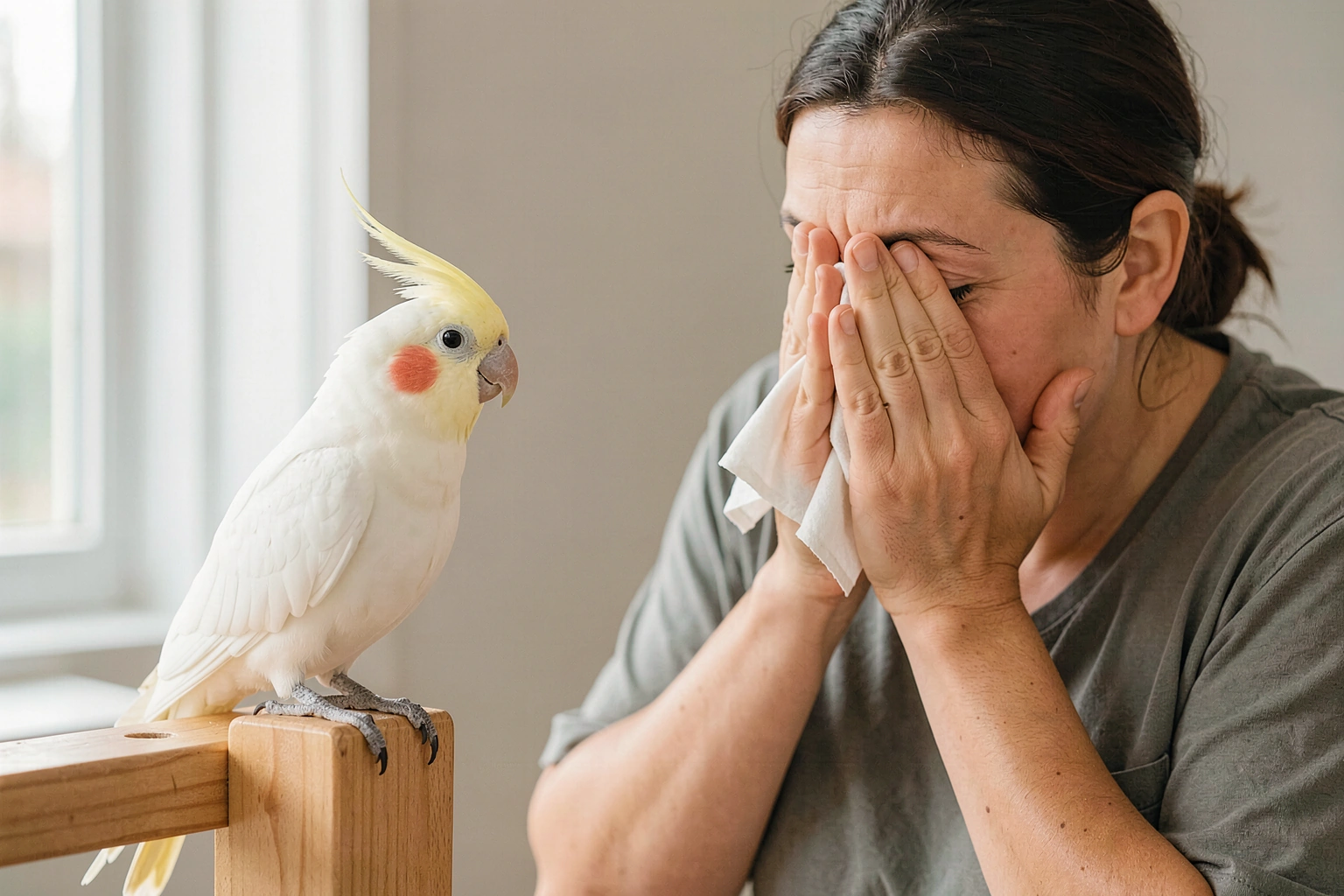
Before you spend weeks frustrated, it's worth being honest about your bird's mimicry potential. Species matters a lot. African greys, Amazon parrots, and Indian ringnecks are famously good talkers. Budgies and cockatiels can learn words but tend toward simpler sounds. Canaries and finches typically don't mimic human speech at all, so if that's your bird, this particular goal probably isn't realistic.
But species is only half the picture. A 2022 survey of 877 companion parrots found that mimicry repertoire size varied significantly not just between species but between individual birds, with age and social interaction both playing predictive roles. The same dataset includes repertoire-size variables and metadata for 877 companion parrots, and it is available on figshare 877 companion parrots found that mimicry repertoire size varied significantly. A 2025 study reinforced this, noting that individual variation within species was large. What that means practically: even within a 'good talking' species, some birds just take to it more readily than others. Your bird's individual personality and history with you shapes the outcome as much as its species does.
Signs your bird is a good candidate right now: it already vocalizes frequently and seems to react to your speech, it's comfortable around you and not chronically stressed, and it engages with you during interaction rather than retreating. Signs you may need to build more foundation first: it's newly homed and still settling in, it's shy or fearful around you, or it rarely vocalizes at all. If your bird isn't talking yet and you want a broader starting point, working through basic talking training first will give you a stronger base before targeting a specific phrase like 'peekaboo. If you want a broader starting point before targeting a specific phrase like 'peekaboo,' working through basic talking training first can also help you understand the practice routines behind how to make your bird sing. '
Setting Up the Training Environment
The environment does more work than most people realize. Vocal learning in birds is closely tied to attention and low stress. Research on avian vocal learning shows that birds in high-stress or distracting conditions simply don't encode new vocal templates as effectively. If you want the quickest start on how to teach your bird to talk, focus first on creating calm, low-stress training conditions before you practice any specific words how to teach my bird to talk. If you're looking for more detailed guidance, check out how to teach mynah bird to talk next. These same attention-and-low-stress principles are the foundation for how to teach a bird to sing. So the first job is creating the right conditions before you say a how to teach Martinez bird to talk.
Noise, timing, and location
Train in the quietest room you have, at the same time each day. Birds track routine, and a predictable schedule helps them arrive at a session in a calm, receptive state. Morning sessions work well for many birds because they're naturally more vocal and alert after waking. Avoid training when there's a TV on in the background, when other pets are active nearby, or when you're distracted. Your bird notices all of it.
Keep sessions to 5 minutes when you're just starting out, and don't push past 15 minutes even once the bird is experienced. PangoVet recommends around 20 to 30 minutes of total daily exposure, but that includes passive repetition, not just active training time. A veterinary training reference recommends 10 to 15 minutes per day in a quiet area to maintain the bird's undivided attention. Short and consistent beats long and sporadic every time.
Your voice as the model
Use your own voice, not a recording, as the primary model during active sessions. Birds learn better from a socially bonded person than from a speaker playing in an empty room. Say 'peekaboo' clearly, at a normal conversational volume, with genuine enthusiasm. Don't shout. Don't whisper. Just speak to your bird the way you'd speak to someone you're excited to see. You can use short audio recordings as a supplement between sessions, but don't leave them playing all day; that produces habituation, not learning.
Pick one cue and stick to it
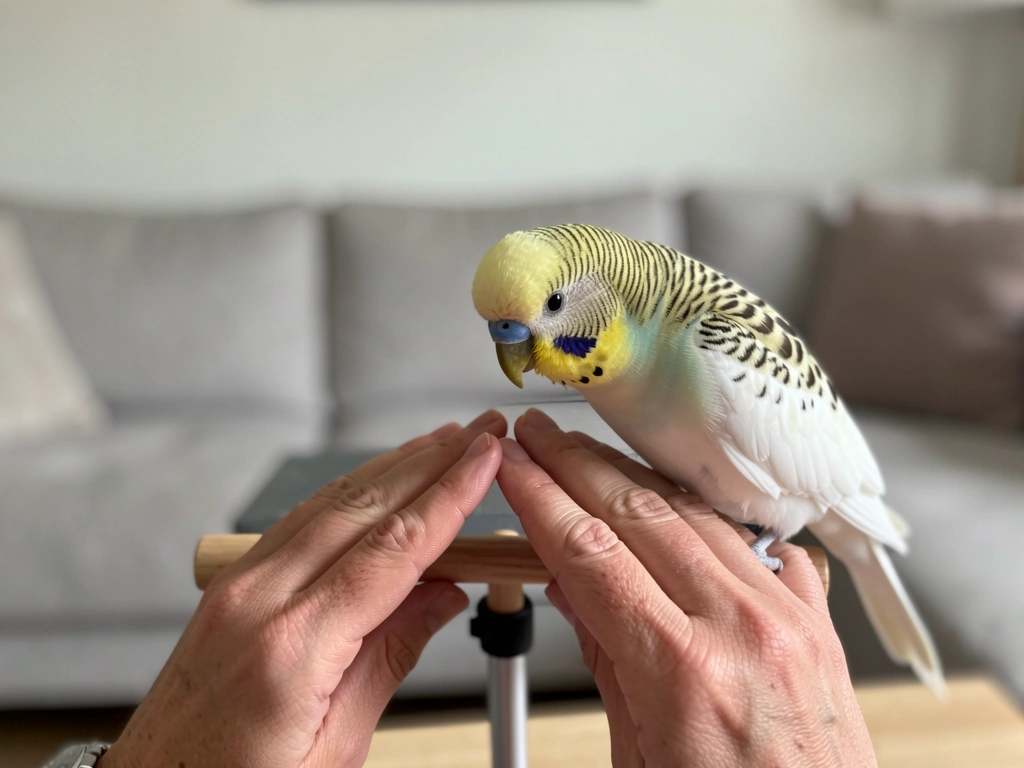
Decide on a consistent physical cue that will always accompany the word. For 'peekaboo,' the natural choice is hiding your face behind your hands (or a small object or a cloth) and then revealing it as you say the word. This pairing is important because it gives your bird a predictable trigger to associate with the phrase, which is what eventually turns 'peekaboo' from a random mimicry into something your bird says on purpose. Use the same gesture, the same position, and the same word every single session.
Step-by-Step: Teaching 'Peekaboo'
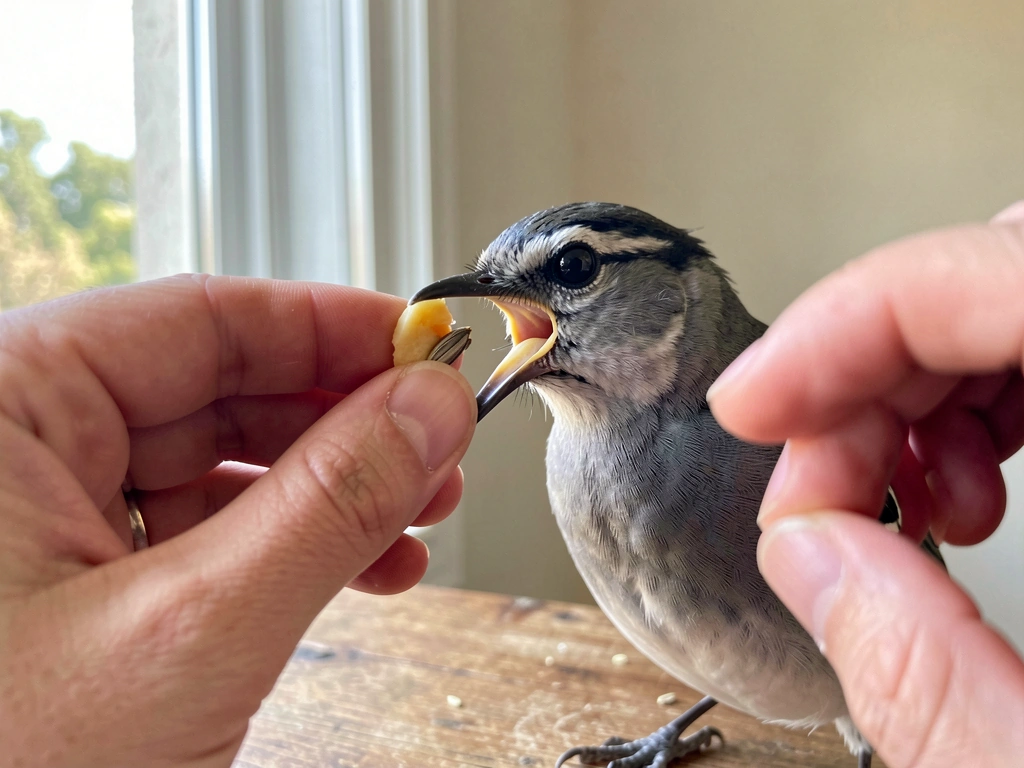
This method builds the behavior in stages, moving from exposure to approximation to reliable production. Don't rush between steps. Move on only when the current step is solid.
- Start with pure exposure. For the first few sessions, simply say 'peekaboo' clearly while doing the hide-and-reveal gesture, 10 to 20 times per session. Watch for any reaction: head tilting, feather changes, beak movement, soft vocalizations. You're building the auditory template at this stage. Don't expect mimicry yet.
- Add enthusiasm and eye contact. Make the reveal feel like an event. Birds respond to emotional tone, and the hide-and-reveal moment should be genuinely playful. The more your bird perceives this as social interaction rather than a drill, the more motivated it will be to participate.
- Wait for approximations. After several sessions (sometimes a few days, sometimes a couple of weeks), your bird may start making sounds that resemble 'peekaboo.' These approximations might be just the 'peek' part, a similar vowel sound, or a garbled version. That's exactly what you want.
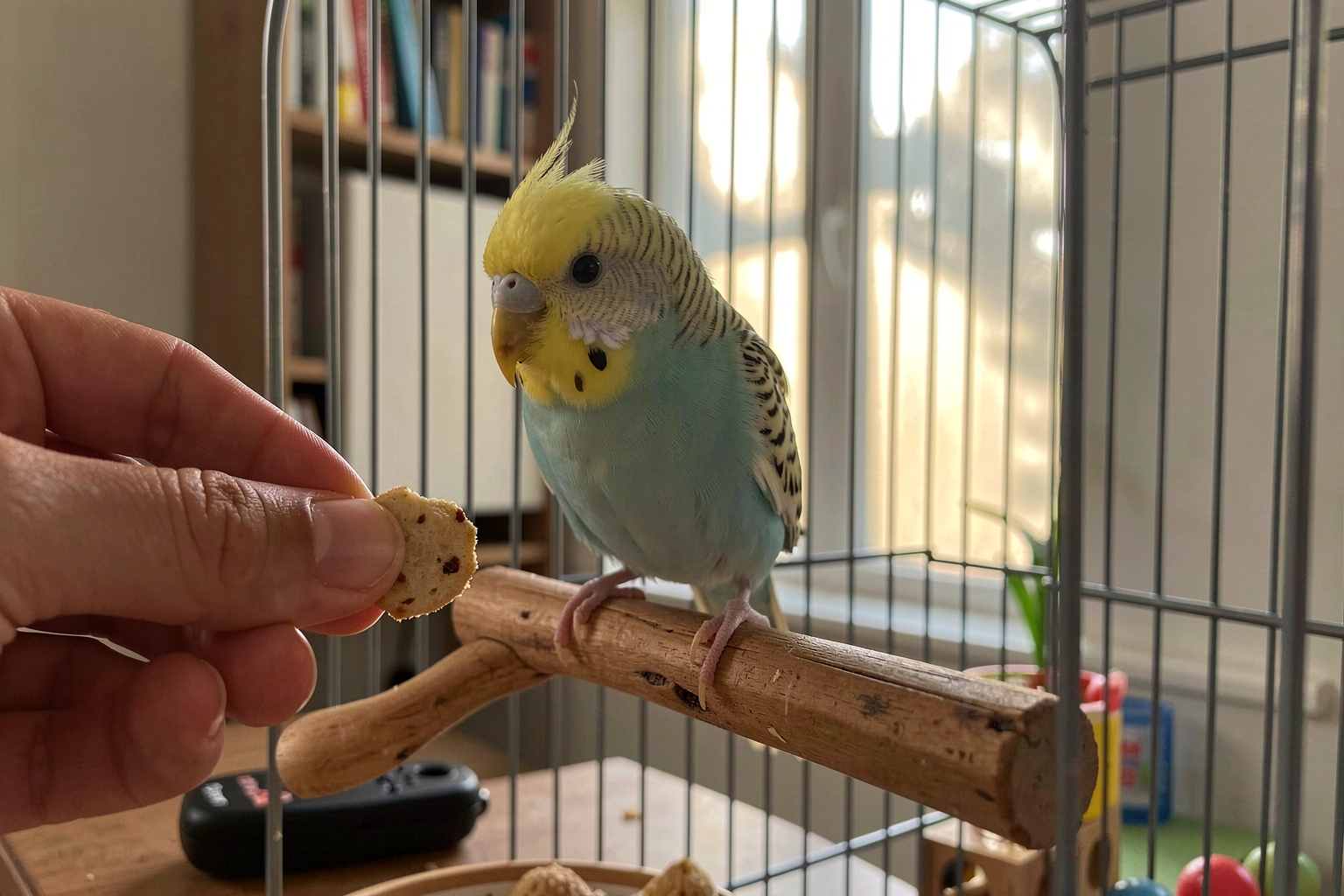
- Mark and reward every approximation immediately. The moment your bird makes any sound that resembles 'peekaboo,' respond with enthusiastic praise ('good bird!'), offer a small treat it loves, or both. Timing is everything here. A marker word like 'good' said the instant the sound occurs helps your bird understand precisely what it did right. If you wait even a few seconds, the connection blurs.
- Raise the standard gradually. Once your bird is producing consistent approximations, start rewarding only the ones that sound closer to the actual word. This is shaping: you're progressively nudging the bird toward greater accuracy by withholding the reward for approximations that are further off and giving it for ones that are closer.
- Pair the cue explicitly. Once the bird is saying something close to 'peekaboo' with some regularity, tighten the association: do the gesture first, pause for a beat, and then say the word softly (or not at all). See if your bird fills in the phrase. When it does, reward that heavily.
- Fade the vocal prompt. Your end goal is the bird saying 'peekaboo' when you do the gesture alone, without you saying it first. Gradually reduce how much you say during the cue until the gesture is doing the work on its own.
Timing, Repetition, and Rewards
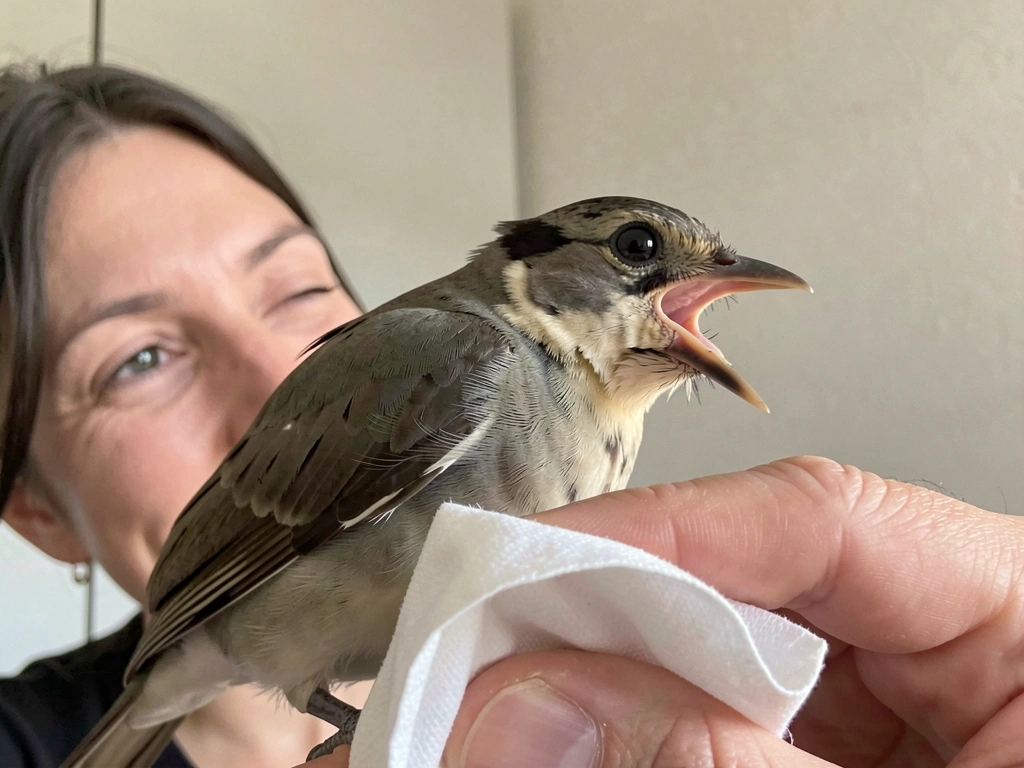
Repetition is the engine of vocal learning, but repetition without good timing is just noise. Research on vocal imitation in birds shows a two-phase process: a passive phase where the bird builds an auditory memory of the target sound, and an active phase where it selectively engages to match that memory. Your job is to make the passive phase rich with clear, consistent exposure, and the active phase rewarding enough that the bird is motivated to keep refining.
Aim for 10 to 20 repetitions of the word per active session. That's enough to reinforce the template without fatiguing your bird's attention. Clicker training research suggests the most effective sessions are just 3 to 5 minutes, using one marker per reward so the reinforcement is precise. A published review of clicker and marker training hypotheses discusses reinforcing versus bridging and marking explanations and links marker use to operant conditioning mechanisms Clicker training research suggests the most effective sessions are just 3 to 5 minutes, using one marker per reward so the reinforcement is precise.. You don't need a clicker for this, but you do need that same precision with a consistent verbal marker.
For treats, find out what your bird actually values. Some birds go wild for a small piece of their favorite fruit. Others prefer sunflower seeds, millet spray, or a scratch behind the head. The reward only works if the bird finds it genuinely motivating, so experiment. Use whatever your bird works hardest for during training, and save it exclusively for training so it stays special.
Keep sessions consistent across the week. Daily practice, even if short, outperforms longer sessions done occasionally. If you can do two short sessions a day (morning and early evening, for example), you'll often see faster progress than one longer session.
When Things Aren't Working: Common Problems and Fixes
The bird isn't mimicking anything
First, rule out the obvious: is the bird healthy, comfortable, and bonded enough to engage with you? A stressed or unwell bird won't train. If everything checks out, increase the social warmth of your sessions rather than the duration. Sit closer, make more eye contact, and let the bird set the pace. Some birds need weeks of exposure before they make their first attempt. Keep going.
Also check your model clarity. Record yourself saying 'peekaboo' and listen back. Is it clear? Is it consistent in tone and pace? Birds are sensitive to subtle acoustic variation. If your delivery is inconsistent session to session, the bird is trying to match a moving target.
The bird says partial or garbled versions
This is actually a good sign. It means the bird is attempting mimicry; it just hasn't landed the full word yet. Don't stop rewarding. Continue reinforcing the approximation while slightly increasing the standard over time. If the bird is consistently saying 'peek' but not 'peekaboo,' try emphasizing the second syllable more in your model, or slow down the word just slightly when you say it. Some birds pick up rhythmic words better when the trainer separates the syllables slightly during early training: 'peek... a... boo.'
The bird keeps saying the wrong word or a different phrase
If your bird learned other words first and keeps defaulting to those, you're competing with a stronger existing behavior. Stop rewarding any production of the other phrase during training sessions, and only reward attempts at 'peekaboo.' You can also try doing sessions at a different time of day or in a different room to break the association with the other word.
The bird gets distracted or refuses to engage
Shorten your sessions dramatically. If your bird is checking out after two minutes, that's your real session length right now. End on a positive moment (even a small one) rather than pushing through disengagement. Over time, as training becomes a positive routine, attention spans typically grow. Also review what's in the environment: even subtle distractions like a window with movement outside can pull a bird's focus completely.
The bird has gone quiet overall
Sometimes a bird that was making good progress goes silent for a period. This can be normal, especially around molts, seasonal hormonal shifts, or environmental changes. Don't push harder. Keep doing short, low-pressure sessions with no expectation of output, just positive social time with the hide-and-reveal game. Often the bird will start producing the sound again spontaneously once the quiet phase passes.
Turning 'Peekaboo' into an Actual Game
Once your bird says 'peekaboo' consistently in response to your gesture, the fun part begins: building it into a real interactive routine. This is where the word stops being a trained behavior and starts feeling like something your bird genuinely enjoys doing with you.
The game structure is simple. You hide your face, pause for a beat, then reveal yourself. At that moment, your bird should say 'peekaboo.' When it does, respond with visible delight (your excitement is part of the reward), offer the treat, and immediately set up the next round. Keep rounds quick and playful, 3 to 5 per game. End while the bird is still engaged, not after it's lost interest.
Over time, you can extend this by initiating the game from different positions, from slightly farther away, or by using different objects to hide behind. This generalization makes the behavior more robust. A behavior that only works in one specific spot in one specific room is fragile. A behavior your bird performs across different contexts is solid.
You can also add your bird's name or a personal phrase to the routine. Some owners teach the bird to say 'peekaboo' when the bird itself hides behind a toy or food dish and then comes out. The structure is the same: the reveal moment triggers the word. Building that association is an extension of exactly the same cue-training logic used in other gesture-based cue training.
How Long This Actually Takes (and How to Keep It Going)
Be realistic: teaching a bird to say a specific word reliably on cue typically takes weeks to months, not days. The range depends on species, individual aptitude, your consistency, and how much social time your bird gets with you overall. A highly motivated African grey with an engaged owner might get there in two or three weeks. A less vocal species or a bird that's newer to training might take two to three months of consistent work.
The most useful thing you can do is track your progress simply. Keep a short note after each session: what you practiced, what the bird produced, and whether engagement was high, medium, or low. You don't need a spreadsheet. Even a few words in a phone note helps you spot patterns, like noticing that morning sessions produce better approximations than evening ones, or that treats work better than praise as a reward.
| Training Stage | What to Expect | Typical Timeline |
|---|---|---|
| Pure exposure | No mimicry yet; bird may show curiosity or ignore the word | Days 1 to 14 |
| First approximations | Partial sounds, similar vowels, or garbled versions | Weeks 2 to 6 |
| Consistent approximations | Bird reliably attempts the word during sessions | Weeks 3 to 8 |
| On-cue production | Bird says 'peekaboo' in response to the gesture | Weeks 4 to 12 |
| Generalized game behavior | Bird plays the game in multiple contexts with enthusiasm | Months 2 to 4+ |
Once your bird has the word down, maintenance is easy. Play the peekaboo game a few times a day as part of your normal interaction. You don't need formal training sessions anymore at that point. Just keep the game alive by playing it, and the word will stay sharp. If you notice the bird's production getting sloppy or less frequent, return to a week or two of more structured daily sessions with rewards to sharpen it back up.
The birds that lose learned words almost always lose them because the behavior stopped being reinforced. If you play the game regularly and your bird keeps getting that joyful response from you every time it says 'peekaboo,' there's no reason for it to fade. That social reward, your genuine delight when the bird nails it, is often the most powerful motivator of all.
FAQ
My bird mimics sounds but refuses to say “peekaboo.” What’s the most common reason?
Usually the bird knows the sound pattern but the training timing is off. If you reward too late (after the reveal) or without a clear link to the exact moment you hide and reappear, the bird can’t associate the phrase with the cue. Reward immediately at the first correct approximation during the reveal pause.
Should I teach “peekaboo” as one word or split it into syllables?
If your bird is consistently saying only part of the phrase, try syllable shaping by briefly separating timing (for example, say “peek” during the hide, pause, then emphasize “a boo” right at the reveal). Return to the full phrase once the bird reliably produces the missing syllable on cue.
How do I know if my bird is stressed enough that training won’t work?
Watch for withdrawal behaviors like turning away, crouching, frantic pacing, feather fluffs held tight, open-mouth panting, or avoiding your approach during the session. In those cases, stop the word goal for a few days and focus on low-pressure social time plus short, non-demand hide-and-reveal interactions.
Can I use a clicker or a verbal marker instead of treats?
You can, but precision matters. If you use a marker, use one consistent marker sound and deliver it at the exact moment the bird attempts the target during the reveal. If you eliminate treats entirely, make sure you replace them with a reinforcer your bird truly values (some birds need food for vocal learning even if they enjoy attention generally).
My bird only says “peekaboo” when it’s hungry or excited. Is that okay?
It can be okay temporarily, but if the bird says it only when motivated by food, you may be accidentally training hunger rather than the cue. To avoid this, schedule training when the bird is normally calm, keep rewards small, and use the same hide-and-reveal cue every time so the word becomes tied to the gesture, not just appetite.
What if my bird says other words right when I’m doing the peekaboo gesture?
Don’t reinforce the “wrong” word. During training, only deliver treats and visible enthusiasm for attempts that sound like “peekaboo” or get closer to it. If your bird is strongly driven by an established phrase, shorten sessions and move training to a calmer time so the target behavior can compete.
Should I stop training if I don’t see progress after a week?
Not automatically. Some birds take weeks to show their first clear approximation. However, if there is zero vocalizing at all and engagement stays low, reassess three things first: model clarity (record and compare), room distractions, and reward value. Then reduce pressure by shortening sessions and focusing on consistent exposure plus the hide-and-reveal timing.
Can I play a recording all day to speed up learning?
It usually backfires. Leaving recordings on encourages habituation rather than active matching. If you use audio, limit it to brief gaps between sessions, and always do the live, socially bonded practice as the main learning input.
How many times per day should I do the game once my bird starts saying it?
Keep it short and frequent. A practical target is 2 to 3 mini-rounds throughout the day (each round being a few hide-and-reveal cycles). End while the bird is still engaged, and avoid turning it into a long “performance,” which can reduce attention and spontaneous motivation.
Will the behavior stay if I stop formal sessions?
Yes, as long as you keep reinforcing the social payoff. Maintenance works best when you still initiate the peekaboo game on a regular schedule. If you notice the sound getting weaker, go back to daily short sessions for 7 to 14 days with the same cue and high-value treats to refresh the association.
My bird does the hide behind objects but doesn’t say the word. Should I prompt verbally or wait?
Wait and reward any attempt toward the target. If you prompt by repeating “peekaboo” repeatedly during the reveal, you can accidentally teach the bird to vocalize without the timing link. Instead, keep your verbal model consistent, hold the reveal pause, and reward approximations only at the correct reveal moment.
Next Articles
How to Teach Your Bird to Whistle: Step by Step Guide
Step-by-step method to teach your bird to whistle, choose cues and rewards, shape sounds, troubleshoot, and track progre
How to Teach My Bird to Talk: Step-by-Step Training
Step-by-step training to teach your bird to talk on cue with word choice, positive reinforcement, timing, and troublesho
How to Make Your Bird Sing: Steps, Causes, and Fixes
Practical steps to make your bird sing, optimize routine, enrichment, training, and troubleshoot health and stress issue