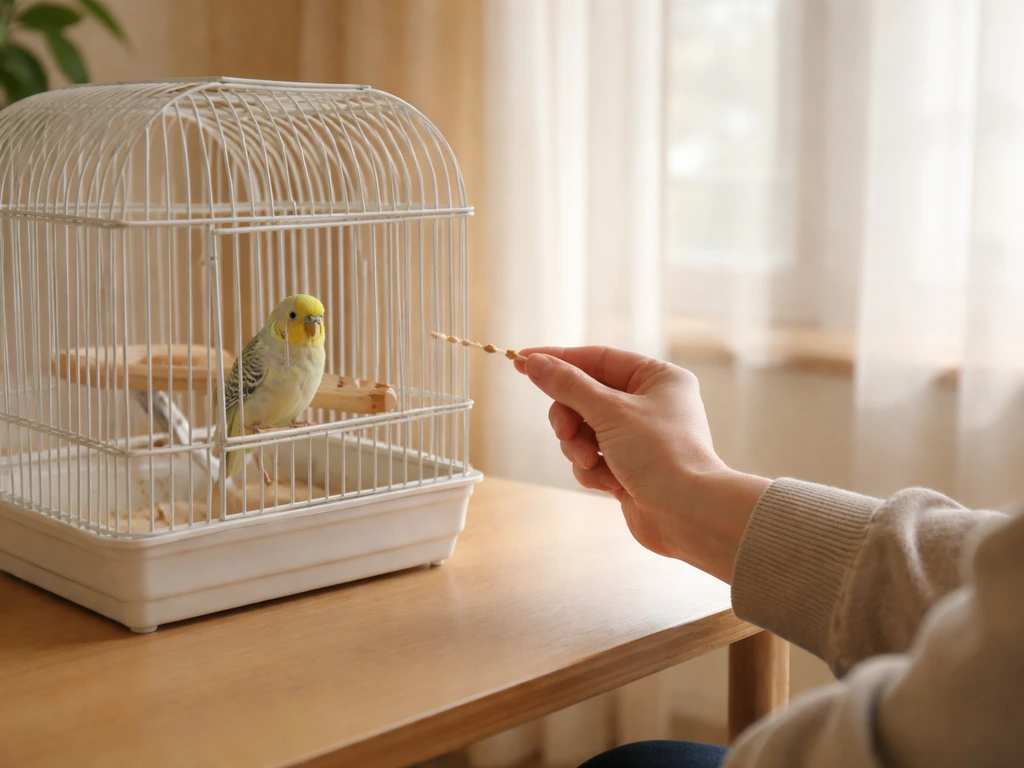
You can help a scared bird feel safe around you by slowing everything down: move quietly, sit near the cage without reaching in, offer high-value treats at a distance, and let the bird make the first move toward you. Consistency and patience do most of the work. Most pet birds, including parrots, budgies, cockatiels, and lovebirds, can go from bolting at the sight of you to stepping onto your hand willingly, but the timeline depends on the bird's history, species temperament, and how systematically you approach it. This guide gives you a practical, step-by-step routine you can start today.
How to Make Your Bird Not Scared of You: Step-by-Step Plan
Maya Harris
27 Apr 2026
Why your bird is scared of you
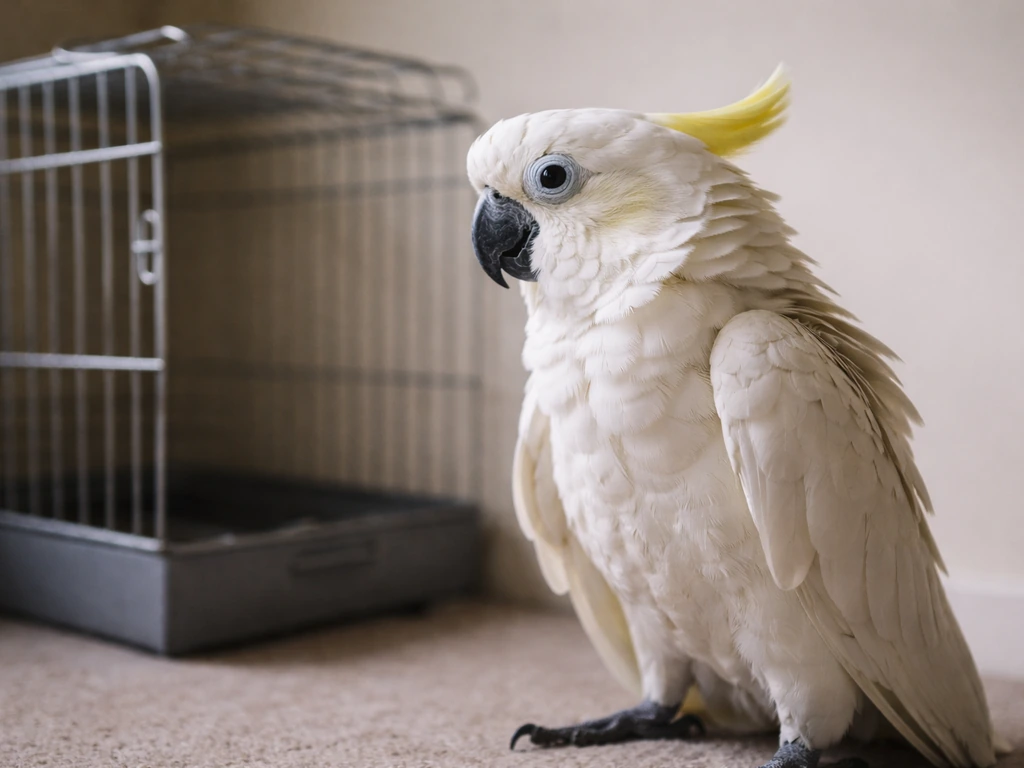
Every bird is a prey animal at heart. Even a hand-raised parrot that has lived with people its whole life carries instincts that make sudden movements, looming figures, and direct eye contact feel threatening. Understanding the actual cause of your bird's fear is the most important first step, because the fix is different depending on the root.
Here are the most common triggers and causes:
- Rough or forceful handling in the past, even once, can create lasting wariness toward hands or certain people
- Sudden loud noises, fast movements, or startling events near the cage (a dropped pan, a dog barking, a child running past)
- A new person, new pet, or new object in the home that the bird hasn't had time to accept
- Poor cage placement, such as against a busy wall, near a drafty window, or in a room with unpredictable foot traffic
- Inadequate sleep (birds generally need 10 to 12 hours of darkness and quiet) and irregular daily routines
- Insufficient light or a poor diet that keeps the bird in a low-energy, stressed state
- Direct, sustained eye contact, which many birds interpret as a predator staring them down
- Species temperament: some birds, like certain caiques or rescued cockatiels, are naturally more reactive than others
- A new bird that was never properly socialized or tamed before coming to you
One thing that catches a lot of owners off guard: fear can develop suddenly even in a previously tame bird. If your bird became fearful quickly and without an obvious trigger, don't assume it's a training problem. Sudden or worsening fearfulness can be a sign that the bird is unwell. Birds are famously good at hiding illness, and a scared-looking, withdrawn bird may actually be a sick bird. Rule out health issues before you start any training protocol.
Read the fear signs: what your bird is telling you
Before you change anything about how you interact with your bird, spend a few days just watching. A bird that feels safe looks relaxed and loose-feathered. A bird that's afraid shows it clearly once you know what to look for.
- Feathers held tight and flat against the body (the opposite of the relaxed, slightly puffed look of a content bird)
- A crouched, horizontal posture with the body low and tense rather than upright and alert
- Leaning or edging away from you, even subtly, when you approach
- Freezing in place, which is often mistaken for calmness but is actually a fear-freeze response
- Wide eyes with visible whites showing (sometimes called 'whale-eye'), often with a wrinkled brow area
- Screaming or alarm-calling when you enter the room or reach toward the cage
- Biting or lunging when you get too close, which is almost always a fear response rather than true aggression
- Hiding in a corner, behind a toy, or low in the cage when you approach
- Refusing treats from your hand even when the bird is clearly hungry
Any of these signals means the bird is over its comfort threshold. The rule is simple: if you see these signs, you're too close, moving too fast, or doing too much. Back up, slow down, and let the bird reset. Ignoring fear signals and pushing through them is one of the most common mistakes owners make, and it almost always makes the fear worse.
Set up a calmer environment and training routine
Your bird's environment shapes its baseline stress level every single day. A bird that's already anxious from poor sleep, a bad cage location, or constant unpredictable noise is going to be much harder to work with than one that feels basically safe in its space. The Association of Avian Veterinarians notes that adequate sleep is essential for bird health and recommends discussing the appropriate hours of quiet, dark, uninterrupted sleep with an avian veterinarian. Fix the environment before you try to fix the fear.
Cage placement and setup
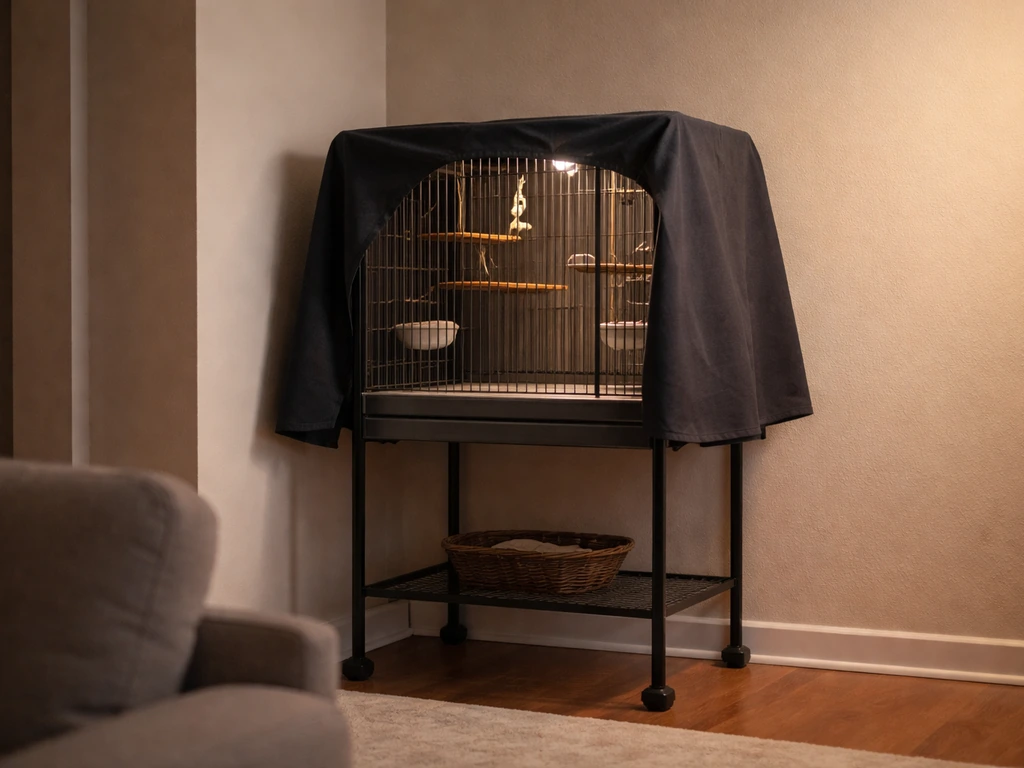
- Place the cage against a solid wall (ideally a corner) so the bird has a protected back and feels less exposed
- Keep the cage elevated so the bird can be at or near your eye level when you're seated, which is less threatening than towering over it
- Include at least one high perch in a back corner of the cage so the bird can retreat to a secure spot when stressed
- Partially cover the cage with a light cloth on the sides and back to create a sheltered area, leaving the front open so the bird can still see out
- Move the cage away from high-traffic areas, TVs turned up loud, kitchen noise, and anywhere a pet dog or cat can stare at it
Sleep and daily routine
- Cover the cage fully at night and give the bird 10 to 12 hours of uninterrupted darkness and quiet
- Keep feeding, uncovering, and interaction times consistent every day so the bird can predict what's coming
- Avoid rushing in and out of the room or doing things near the cage that vary wildly day to day
A simple daily training schedule
Short, predictable sessions work far better than long, irregular ones. Here's a realistic daily structure for a beginner working with a fearful bird:
| Time of day | Activity | Duration |
|---|---|---|
| Morning (after uncovering) | Sit quietly near cage, talk softly, no interaction pressure | 5 to 10 minutes |
| Mid-morning | Offer a high-value treat through cage bars or just outside door | 3 to 5 minutes |
| Afternoon | Active training session (desensitization/targeting) | 5 to 10 minutes max |
| Evening | Calm presence near cage, gentle talking or reading aloud | 5 to 10 minutes |
| Night | Cover cage, reduce noise and light in the room | Until morning |
Stop any session the moment the bird shows stress signals. Five minutes of successful, calm interaction beats 20 minutes of pushing too hard every single time.
Humane trust-building: approach, treat, and timing basics
The foundation of working with a fearful bird is this: the bird must always feel like it has a choice. You're not trapping it or forcing it to tolerate you. You're creating a situation where being near you consistently predicts good things (food, calm energy, no sudden moves), and where the bird can choose to engage. Over time, voluntary engagement builds into real trust.
How to approach a scared bird
- Move slowly and deliberately whenever you're near the cage. No sudden reaches, no big gestures.
- Approach from the side rather than head-on. Direct frontal approaches feel more threatening to prey animals.
- Avoid sustained direct eye contact at first. Look slightly to the side of the bird, or use a sideways glance rather than a hard stare.
- Talk softly and consistently as you approach so the bird knows you're coming. Silence followed by sudden closeness is startling.
- Stop when you see the first hint of a stress signal, wait for the bird to relax slightly, then retreat. Never advance toward a bird that is actively fleeing or in a panic response.
Using treats effectively
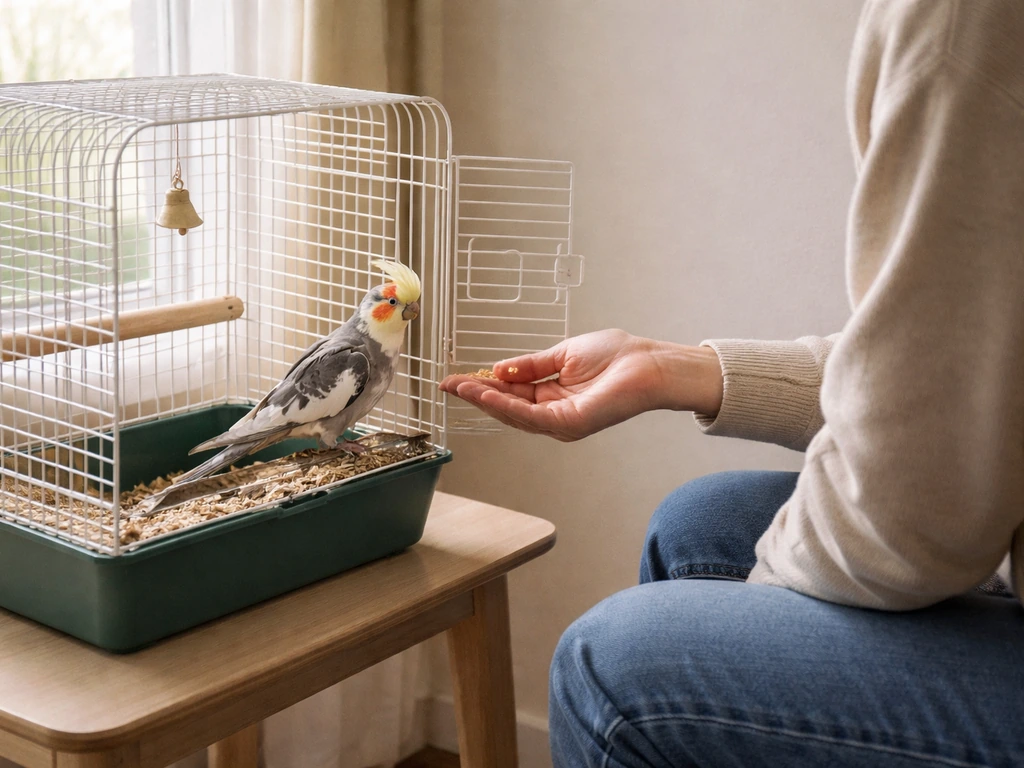
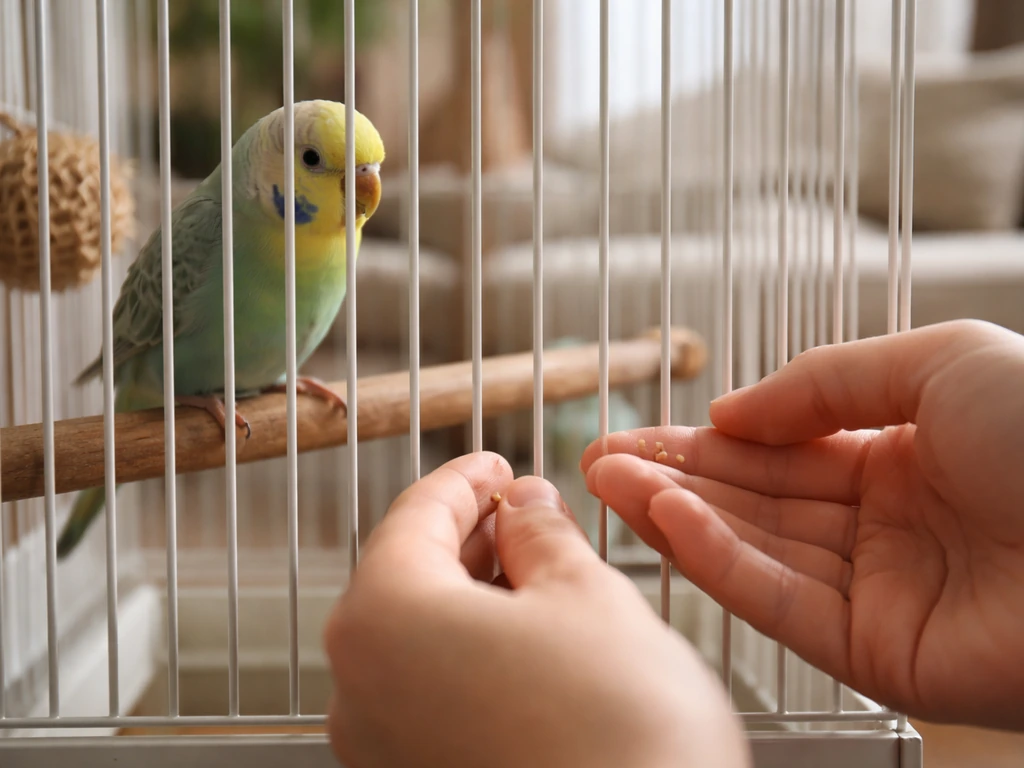
Treats are your most powerful tool, but only if the bird is calm enough to eat. A bird in full panic will not take food. Figure out your bird's highest-value treat first (millet spray for budgies and cockatiels, a small piece of almond or walnut for parrots, a sunflower seed for a nervous rescue). Start by dropping treats into the food dish while standing at a non-threatening distance. Graduate to offering through the cage bars, then from your open palm held still just outside the cage door. The goal is always to let the bird reach toward you, not for you to reach toward the bird.
Timing matters enormously here. Reward the moment the bird moves toward you or takes the treat calmly, not after it has already retreated. If you're too slow with the reward, you accidentally reinforce backing away instead of approaching. This is a detail that makes a real difference, especially in the early stages.
Desensitization and counterconditioning: the step-by-step process
Desensitization means slowly exposing the bird to the thing it fears at a low enough intensity that it doesn't panic. Counterconditioning means pairing that thing with something the bird loves (usually food) so the bird's emotional response changes from fear to something neutral or positive. You use both techniques at the same time.
The key rule: you always work just below the bird's fear threshold. If the bird is showing stress signals, you've already gone too far. Drop back to an easier step and rebuild from there. There is no shortcut here. Rushing always costs you more time in the long run.
Phase 1: Your presence is safe
- Sit in the same room as the cage without making any moves toward it. Read, work quietly, or watch TV at low volume.
- Do this for several sessions until the bird resumes normal behavior (eating, preening, vocalizing) while you're in the room.
- Gradually move your chair a little closer over multiple sessions, stopping if the bird tenses up.
Phase 2: Your hand is safe
- Once the bird is relaxed with you nearby, begin showing your hand near (not inside) the cage. Hold it still with a treat visible in your palm.
- Let the bird investigate from a distance. Don't move the hand toward the bird.
- Over multiple sessions, gradually bring the hand closer to the cage, always staying at the level where the bird stays calm.
- Graduate to offering a treat through the bars, then just inside the open cage door with your hand stationary.
Phase 3: Target training
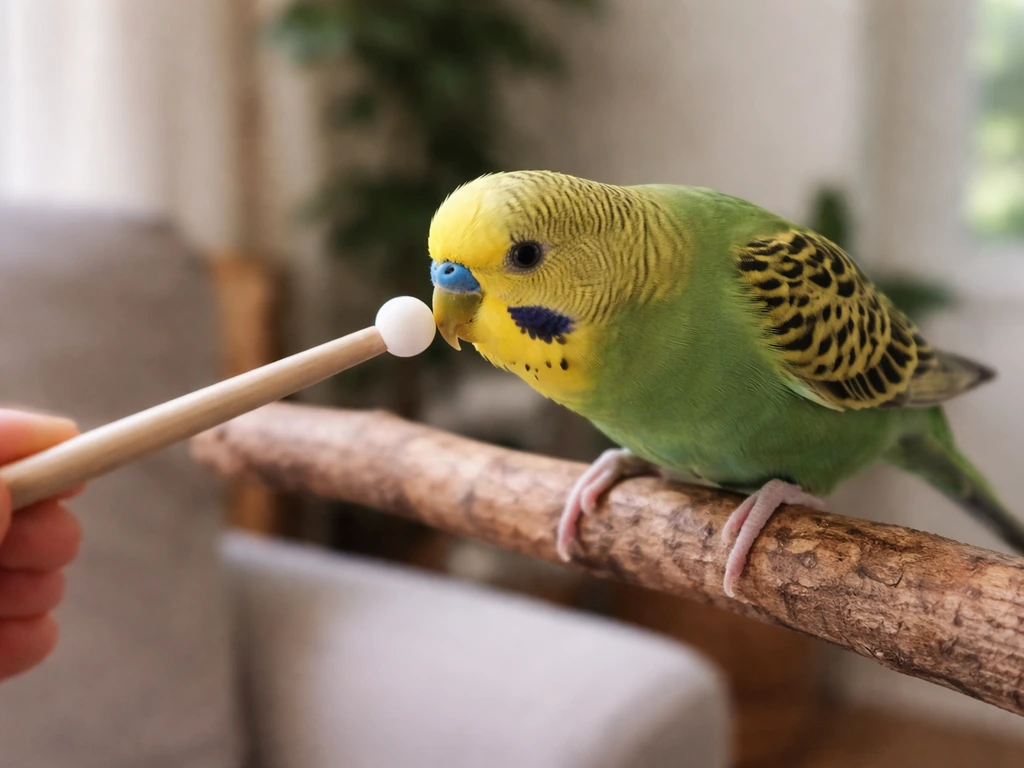
Target training is one of the best tools for fearful birds because it gives the bird a clear, achievable task and puts it in control. The concept is simple: you teach the bird to touch its beak to a target (a chopstick, the eraser end of a pencil, or a commercial target stick). Every touch earns a treat.
- Hold the target just a few centimeters from the bird's beak and wait. Even a slight lean toward it gets a treat immediately.
- Gradually require the bird to actually touch the target before the reward lands.
- Once the bird understands the game, you can use the target to guide it toward your hand, toward a perch, or eventually toward a step-up position.
- Keep sessions to five minutes or fewer. End on a success every time, even if that means making the last step really easy.
Target training is especially useful for birds that won't come near hands at all, because the bird focuses on the target rather than the scary hand holding it. It's a way to build the association between hands and good outcomes without forcing physical contact.
Progression to handling: from sitting nearby to step-ups
Handling comes after trust, not before. A lot of people try to skip to step-ups too quickly and undo weeks of progress in one session. Here's a realistic progression:
Before you attempt a step-up
- The bird should reliably take treats from your open palm without flinching or backing away
- The bird should tolerate your hand being stationary near or just inside the cage door without showing stress signals
- Ideally the bird has shown curiosity toward your hand (sniffing, leaning in, gentle nibbling) rather than avoidance
Introducing a hand perch first
Before asking the bird to step onto your bare hand, introduce a handheld perch (a short wooden dowel works well). Desensitize the bird to the perch the same way you did with your hand: present it slowly, reward calm interest, and let the bird choose to step on at its own pace. Once the bird steps onto the perch confidently, transitioning to your hand or forearm is a much smaller leap.
Teaching the step-up
- Position your finger or hand just below the bird's chest, slightly above the feet. The bird needs to step up slightly to get on.
- Use a calm, firm cue word like 'up' each time. Say it once, don't repeat it nervously.
- Hold a treat just above and behind your hand so the bird has to step onto your hand to reach it.
- The moment a foot touches your hand, deliver the treat. Don't wait for the full step-up at first.
- Gradually require more of the behavior before rewarding: one foot, then both feet, then a full step-up and brief balance before the treat arrives.
- Keep early sessions inside the cage where the bird feels safer, then eventually practice near the open cage door, and finally outside the cage.
If the bird flinches when your hand gets close, you've moved too fast. Go back to the previous phase for a few more sessions. There's no shame in this. The birds that get the most reliable step-up behavior are the ones whose owners were willing to go slowly.
Troubleshooting panic, biting, hiding, and refusing treats
Even with the best approach, you'll hit snags. Here's how to handle the most common ones without losing ground.
The bird panics and thrashes when you approach
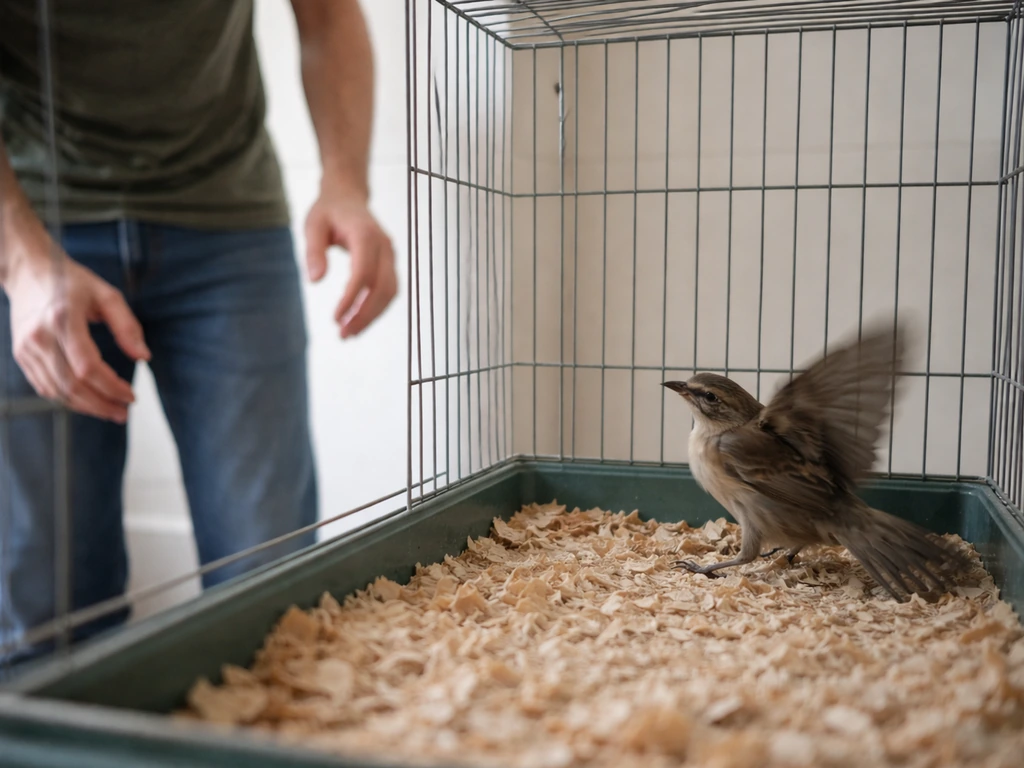
Back away immediately and give the bird time to calm down completely before you do anything else. Don't speak loudly, don't try to comfort it by reaching in, and don't linger near the cage watching it. Leave the room for a few minutes. When you return, sit at your baseline distance (wherever the bird was previously calm) and just be present. You've likely moved too fast in the progression. Drop back two phases and rebuild more slowly.
The bird bites or lunges at your hand
Almost all biting in fearful birds is a communication failure: the bird tried telling you it was uncomfortable (posture, leaning away, feather-tightening) and you either missed the signals or kept going. Don't pull your hand away sharply, as that triggers a bite-and-hold response. Don't yell or react dramatically. Just slowly, calmly withdraw your hand. Take a break, then come back at a less threatening distance. Never punish a bite, because the bird was scared and punishment will destroy what little trust you've built. The fix is almost always to slow down and work at a lower intensity.
The bird hides and won't come out
Some birds, especially newly rehomed ones, will stay low or tucked in a corner for days. Don't force interaction. Continue your calm presence routine, offer treats through the bars at a non-threatening distance, and let the bird set the pace. A bird that feels it has control over the situation will gradually get curious. Covering three sides of the cage can actually help here because it reduces the exposed, vulnerable feeling the bird has inside a fully open cage.
The bird refuses treats from your hand
A few possibilities: the bird isn't hungry enough (try offering treats before the main meal, not after), the treat isn't high-value enough (experiment with different options), or your hand is still too scary. If the bird takes food from a spoon or tongs but not from your hand, start there and very gradually transition to your palm. Some birds also do better when you hold the treat with two fingers rather than a full open palm, because a smaller profile is less intimidating.
The bird was fine yesterday and is scared again today
Fear progress is not a straight line. Setbacks happen after stressful events, changes in routine, or just bad days. Don't interpret a regression as failure. Go back to whatever level the bird is comfortable at and rebuild. If regression is frequent and not linked to any obvious cause, review your environment setup and consider whether the bird's sleep and diet are where they should be. PetMD also notes that increased biting and sudden behavior changes can be signs of stress, fear, or an underlying medical issue, and should prompt a veterinary exam to rule out illness If regression is frequent and not linked to any obvious cause.
Safety and welfare: protecting you and your bird
Working with a fearful bird does carry some risk, both to the bird and to you. Here's how to keep both of you safe throughout the process.
Protecting yourself from bites
- If you're working with a large parrot (macaw, cockatoo, African grey, Amazon), wear a light leather glove when first introducing your hand, but only until the bird accepts treats calmly. Gloves can reduce your dexterity and sensitivity, so phase them out as trust builds.
- Never use gloves as a way to force handling on a bird that's clearly terrified. That approach sets back trust significantly.
- Read all the warning signs (crouching, feather-tightening, dilated pupils in parrots, beak-opening) before a bite happens, not after.
- Keep your face at a safe distance when working with large hookbills. A bird bite to the face or eye is a medical emergency.
Protecting your bird
- Never chase a bird around a cage or room to catch it. This is traumatic and can cause injury from flying into walls or cage bars.
- Avoid toweling a fearful bird except in genuine medical emergencies. Forced towel-wrapping on a bird that isn't used to it can spike stress dramatically and undo weeks of trust work.
- If the bird injures itself during a panic (cracked beak, broken blood feather, bleeding), treat the immediate injury and give the bird several days of very low-key, no-pressure interaction before resuming training.
When to call an avian vet or behavior specialist
Some situations go beyond what a training protocol alone can fix. Contact an avian vet promptly if you notice any of the following:
- Fearfulness came on suddenly with no obvious environmental cause, especially if paired with changes in droppings, appetite, or activity level
- The bird is feather-destructing, self-mutilating, or injuring itself during panic episodes
- Fear behavior is rapidly worsening despite consistent, patient effort on your part
- The bird cannot be safely handled or examined at home and needs medical attention
- Biting or aggression escalated suddenly in a bird that was previously tame (this can signal hormonal changes, pain, or illness)
A behavioral consultation with an avian veterinarian or certified avian behavior specialist is also worth pursuing if you've been working consistently for several weeks and aren't seeing any improvement. Behavior problems and medical conditions frequently overlap in birds, and an expert can help untangle which is driving which. For rehabilitators working with wild birds, the same principles apply but with the added complexity of minimizing human imprinting and following any applicable wildlife regulations in your area.
Building trust with a scared bird is genuinely one of the most rewarding things you can do as a bird owner. The process of helping a bird go from bolting at the sight of you to choosing to step onto your hand is slow, but every small step forward is real. If you want a more specific walkthrough for how to get a bird used to you, build on this same slow, choice-based progress and reward calm steps. If you are wondering exactly how to make a bird trust you, focus on small, consistent choice-based steps and reward calm behavior right away build trust. Wild birds can learn to trust you too, but the process should focus on minimizing imprinting and using choice-based steps and safe distance so the bird gradually comes closer how to make a wild bird like you. You can also follow this practical guide on how to build trust with a bird to keep your training calm, consistent, and choice-based. Stay consistent, read your bird carefully, and let it set the pace. If you want to go deeper into any part of this process, topics like getting a bird to trust you, building trust over time with a new bird, or species-specific approaches for lovebirds and wild birds all connect directly to what you've started here. With the same approach, you can also learn how to get a bird to like you by focusing on calm, choice-based trust building and the right pace for your bird.
FAQ
What should I do if my bird seems fine one day and terrified the next, even with the same routine?
If your bird only acts afraid during certain times, start by checking the pattern instead of changing your training. Many birds fear people more when they are sleepy, hungry, after a loud household event, or during light changes (early morning sun, sudden room lights). Match sessions to calmer windows, and always stop at the first stress signal, then resume later when the bird is already relaxed.
My bird freezes and won’t eat treats when I’m near. How do I keep going without making it worse?
Do not switch from treats to forced step-ups. If your bird is not taking food, lower the intensity, increase distance, and pair your presence with treat delivery into the bowl, not toward the bird. You can also try a higher-value treat and shorten the session to 1 to 2 minutes, ending while the bird is still calm so it learns that proximity leads to good outcomes.
Do I need to change how I hold my body or make eye contact to help my bird feel safer?
Yes, but adjust your body mechanics. Wear calm, non-flashy clothing, keep your shoulders turned slightly away (less looming), and avoid sudden hand movement above the bird’s head. If your bird is alarmed by direct eye contact, glance at the bird intermittently and keep your hand lower and slower so the bird perceives you as less threatening.
What’s the right response if my bird bites, and should I correct it?
Never punish, and don’t try to “teach a lesson” after a bite. Instead, immediately stop the attempt, withdraw slowly, leave the room or increase distance until the bird is fully calm, then restart at an earlier training step the next time. If biting keeps happening at the same stage, you are likely above the bird’s current threshold and need to rebuild (often moving back from hand to target training or a handheld perch).
How can I progress from target training to step-ups without triggering fear?
Choose perches and step-up targets based on comfort and grip. A short, stable dowel in a consistent location helps because it reduces wobbling and gives the bird a predictable landing surface. When you transition to your hand, start with a flat, steady forearm angle or a very low hand position, then gradually raise only after the bird steps on willingly without flinching.
What are the most common mistakes that cause slow or backsliding trust progress?
Rushing often comes from timing and proximity. If the bird approaches, retreats, or stares tense, you likely rewarded too late or got too close. Use a simple rule: reward the first sign of calm or approach at the moment it happens, then pause and reset before the bird escalates. If you want to speed things up, speed up in small increments, not in steps size.
How do I make sure my training actually gives my bird a choice, not pressure?
A “choice” plan can help. Offer your presence through a predictable routine, then wait. For example, present the perch or your hand at a comfortable distance, give the bird 5 to 10 seconds to decide, and only move closer if the bird shows calm curiosity. If it turns away, tuck your hands away and revert to treats from a distance so the bird learns it can avoid pressure without losing access to good things.
When covering the cage to reduce fear, what are the safe limits I should watch for?
Covering three sides can help for some birds, but only as long as the bird still has access to space and normal safety behaviors. Avoid fully hiding the cage in a way that traps the bird or cuts off airflow. Also check that lights, noise, and household activity are stable, since a bird can become more anxious if it feels isolated and cannot predict what’s happening.
How should my approach change for a recently rehomed bird that is scared of me?
If you are working with a bird that is newly rehomed or recently stressed, expect fear to peak for a short period and then fluctuate. Focus on distance and predictable food routines for the first week, then introduce small, low-intensity sessions (like treat delivery into the bowl and brief target touches). Avoid handling immediately, even if the bird seems calm some moments, because fear can reappear quickly with unexpected contact.
At what point should I stop training and involve an avian vet?
If there is no improvement after several weeks of careful, low-threshold practice, or fear is escalating rapidly, rule out medical causes first. Birds can hide illness, and discomfort can look exactly like “fear training failure.” A vet exam is especially important if you see changes in droppings, breathing, appetite, posture, or unusual sleepiness, or if the bird seems painful when moving.
Next Article
How to Build Trust With a Bird Step by Step Guide
Step-by-step, low-stress trust building with pet or wild birds using routine, safe handling, positive reinforcement, and