Training a bird of prey safely comes down to three things: being legal, being patient, and letting the bird set the pace. Whether you're working with a red-tailed hawk, a kestrel, or a peregrine falcon, the core process is the same: earn the bird's tolerance first, build positive associations second, and only then layer in practical skills like glove work, perching, and recall. Most beginners rush this. Don't. A raptor that trusts you will progress faster in two calm weeks than a stressed bird will in two months of forced handling.
How to Train a Bird of Prey: Humane Step-by-Step Guide
Maya Harris
17 May 2026
Before you start: legality, permits, and welfare rules
This is the part people want to skip, but it matters enormously and in most countries it's non-negotiable. Raptors are protected wildlife, and keeping or training one without the right paperwork is a criminal offense almost everywhere.
United States
In the US, training a bird of prey for falconry is regulated under 50 CFR § 21. 82. You must hold a falconry permit issued by your state, tribe, or territory. Hawaii is the only state where falconry is prohibited outright.
If you're a beginner, you start at the Apprentice Falconer level, which requires you to find a General or Master Falconer sponsor, pass a written exam, and have your facilities inspected before you can acquire a bird. The apprentice period involves documented hands-on experience: you need to maintain, train, fly, and hunt with your raptor over a specified timeframe before advancing.
California adds an extra layer, requiring both a valid falconry license and a valid hunting license plus any applicable stamps. Check with your state fish and wildlife agency first, and budget time for the process. It typically takes several months to get fully permitted.
United Kingdom and EU
In England and Wales, birds of prey listed on Schedule 4 of the Wildlife and Countryside Act 1981 must be registered with the Animal and Plant Health Agency (APHA). [Many birds also need to be ringed or microchipped, and certain commercial uses require an Article 10 certificate. ](https://www. gov.
uk/bird-registration/) The Animal Welfare Act 2006 sets the baseline welfare standards you must meet. The Hawk Board's Code of Welfare and Husbandry is the go-to practical guide for UK falconers, and it explicitly covers ownership, registration, and CITES compliance.
In the EU, Council Regulation (EC) No 338/97 governs the import, export, and internal trade of protected species, so if you're acquiring a bird across borders, you need to verify CITES documentation before the bird ever arrives.
Wherever you are, source your bird from a licensed breeder or registered rehabilitator. Never take a wild raptor without specific legal authorization. Captive-bred birds are almost always the better starting point for training because they haven't developed full wild-prey fear responses, though they still need careful handling.
Choose the right bird and set up your space
For a first bird, smaller and more forgiving species are genuinely easier. Doves have very different instincts and training needs than birds of prey, so you should follow dove-specific handling and reinforcement guidance. If you specifically want to learn how to train a robin bird, focus first on getting the basics right with a calmer, easier species before moving on small and more forgiving species.
American kestrels, Harris's hawks, and red-tailed hawks are the most common starting points in North America for good reason: they're relatively tolerant of handling mistakes and respond well to food-based motivation. Harris's hawks in particular are social by nature, which makes them unusually handler-friendly. In the UK, common buzzards and Harris's hawks are popular beginner choices. Avoid eagles and large falcons like peregrines as your first bird.
They're more reactive, harder to read, and less forgiving of early handling errors.
Housing and mews setup
Your bird's living space is called a mews. It needs to be secure, weatherproof, and large enough for the bird to spread and flap its wings freely. Minimum dimensions vary by species, but for a bird like a red-tailed hawk, 8 feet wide by 8 feet deep by 6 feet high is a workable starting point. The mews should have natural light but also shaded areas, good ventilation without drafts, and perches at multiple heights made from materials that won't damage the bird's feet (sisal-wrapped wood or astroturf are common choices). Avoid anything slippery.
Essential equipment
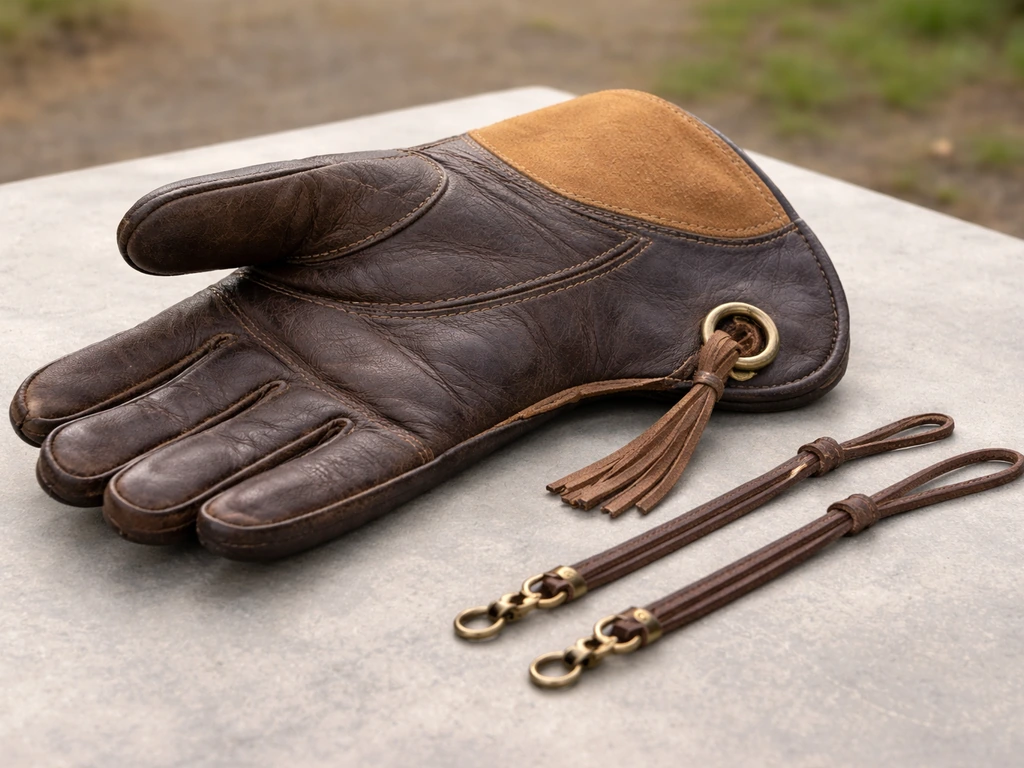
- A well-fitted falconry glove (thick leather, ideally 16 inches long for beginners): the glove protects your hand and gives the bird a consistent landing surface
- Jesses: soft leather or synthetic anklets that attach to the bird's legs and connect to a leash or swivel
- A swivel and leash: connects the jesses to a perch or your glove to prevent tangling
- A block perch (for falcons) or bow/ring perch (for hawks and buzzards)
- A weighing scale accurate to at least 2 grams: daily weighing is essential for safe weight management
- A lure: a padded leather pouch swung on a cord, used for flight training
- A hood (species-specific fit): used to calm the bird during transport or stressful situations
- A telemetry/tracking transmitter: non-negotiable for any free-flight work
Do not scrimp on the scale or the telemetry unit. Weight management is how you gauge the bird's motivation and health. Telemetry is how you find your bird if something goes wrong during free flight.
Baseline handling and trust-building: imprinting vs. habituation
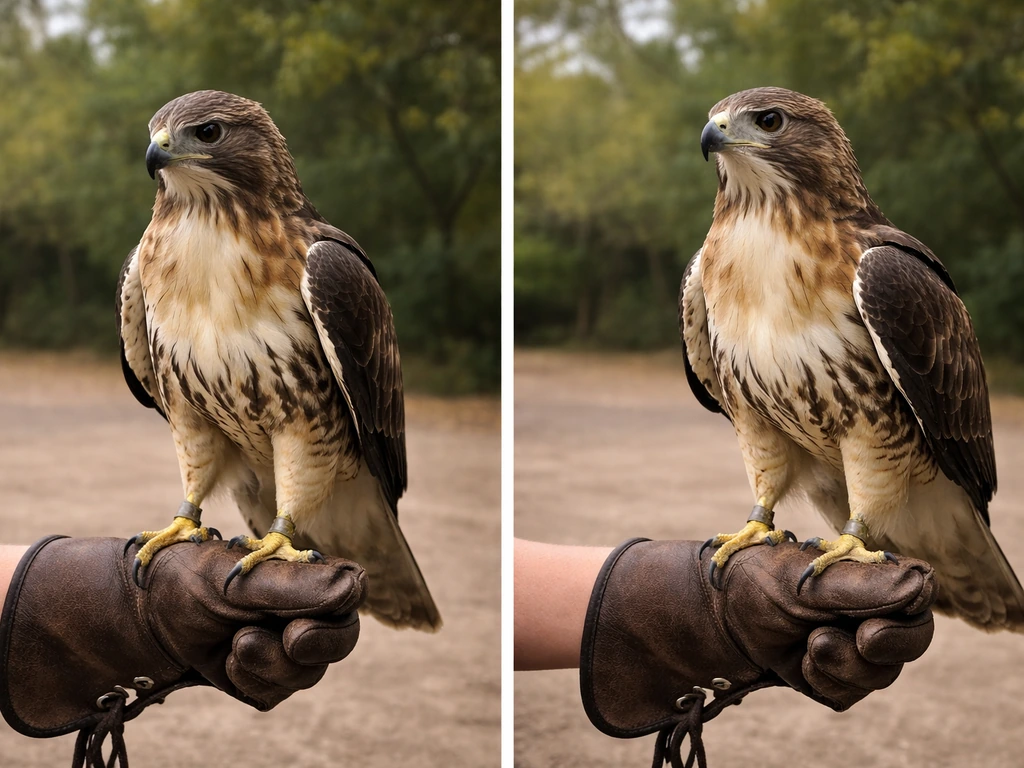
Before you train anything, you need to understand what kind of bird you're working with. This shapes every decision you make.
An imprinted bird was raised by humans from a very young age, before it had the chance to fully identify with its own species. Imprinted raptors are often easier to handle but come with serious complications: they may be sexually imprinted on humans (causing aggression during breeding season), they may scream constantly for attention, and they can develop behavioral problems that are very hard to reverse. Imprinted birds are not the ideal training subject for most falconers. If you're working with one, expect more nuanced behavioral management and get guidance from an experienced mentor.
A parent-reared or wild-caught bird (legally obtained) has not imprinted on humans and needs to go through habituation: the process of gradually becoming comfortable with human presence and handling through repeated, calm, low-stress exposure. This takes longer, but produces a more stable bird long-term. The process of manning, which is the traditional falconry term for habituation to the handler and human environments, is the foundation of everything else you'll do.
Manning starts simply: sit quietly near the bird's perch, in view, without making direct eye contact or sudden movements. Do this for short sessions of 10 to 20 minutes, multiple times a day. The goal is for the bird to stay calm and relaxed, not bating (flapping off the perch in panic) when you're nearby. Once the bird is consistently calm at your presence, you can begin offering food from your gloved hand.
Taming steps: building association, target training, and positive reinforcement
Raptor training is almost entirely built on one principle: the bird does something, something good happens (food). Raptors are highly food-motivated, and that's your primary tool. Physical force, punishment, or domination-based methods cause stress, damage trust, and can injure the bird. Don't use them.
Step 1: association with the handler
You want the bird to connect your presence with the arrival of food. Start by delivering all meals yourself, slowly and calmly. Wear the same clothing if possible so you're visually predictable. Speak quietly and consistently before offering food, so the bird begins to pair your voice with a positive outcome. This is classical conditioning in its simplest form, and it works powerfully with raptors.
Step 2: glove introduction and the step-up
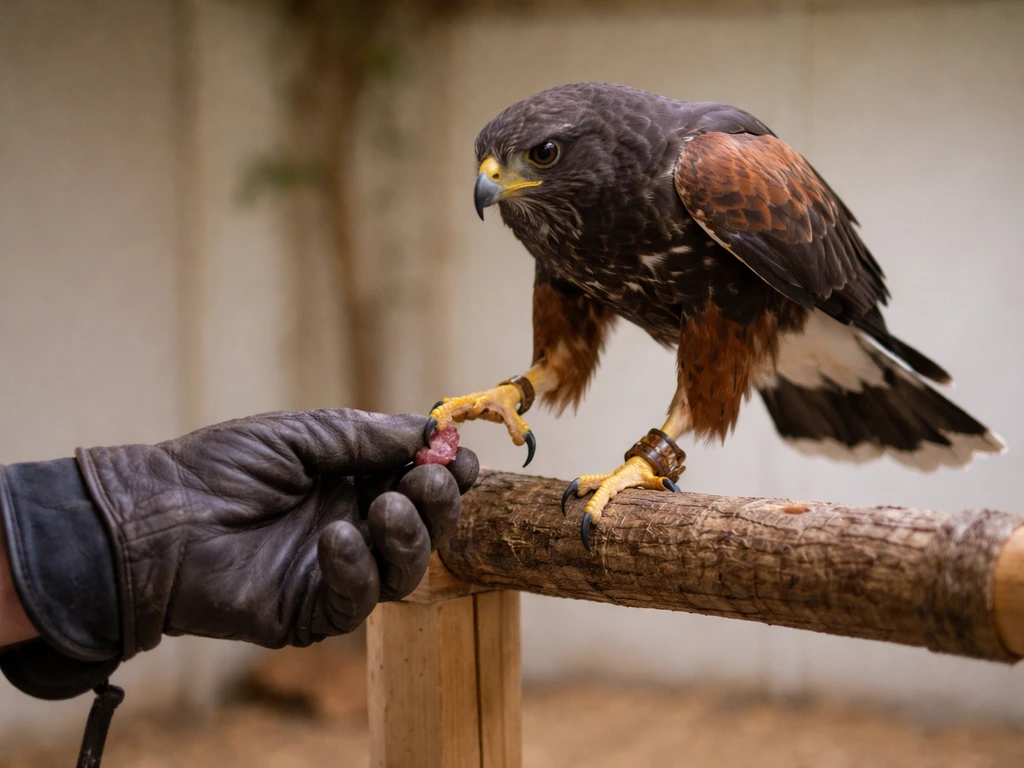
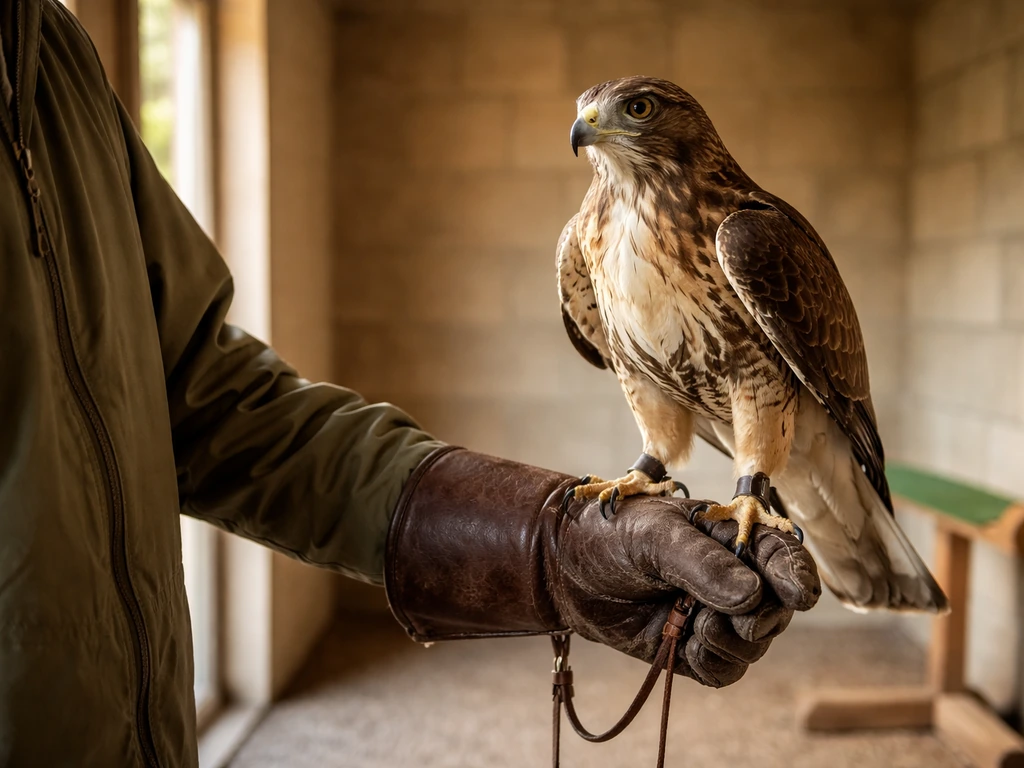
Once the bird is eating calmly from your gloved hand while on its perch, the next step is getting it to step voluntarily onto the glove. Hold a small piece of food (a bit of day-old chick, quail, or appropriate prey) on the glove and position the glove just below the bird's feet. Most birds will step forward and up to reach the food. The moment a foot touches the glove, reward immediately. Don't move too fast or try to lift the bird before it's placed both feet. Keep early sessions to just a few step-ups, then end on a positive note.
Step 3: target training
Target training is useful for raptors and is more common now than it was in traditional falconry. You introduce a target object, typically a brightly colored ball or the end of a stick, and reward the bird every time it touches or approaches it. Over repetitions, the bird learns that touching the target produces food. You can then use the target to guide the bird to different locations, which is helpful for introducing perches, moving between spots, or encouraging the bird toward the glove. It's a low-stress way to build communication and gives the bird a clear way to earn rewards.
Weight management and motivation
Here's the part that surprises many beginners: raptors train best when they're slightly under their full-crop weight, because that's when they're motivated by food. This does not mean starving the bird. It means working with flying weight, which is a lean but healthy body condition determined by your daily weigh-ins and the bird's behavior and health. Your sponsor or an experienced falconer should help you establish your specific bird's flying weight range. A bird that's too heavy simply won't be interested in the food rewards that drive training. A bird that's too light is stressed and at risk. Getting this balance right is one of the core skills of falconry.
Flight and recall training: perching, glove work, and stepwise progression
Free flight is the most exciting part of working with a bird of prey, and also the point of greatest risk. Build toward it methodically. Don't rush to free flight just because the bird seems calm on the glove.
- Perch-to-glove at close range: With the bird on a perch and you standing 1 to 2 feet away, call the bird to your gloved fist with food visible. Reward immediately on landing. Repeat until 100% reliable.
- Extend the distance gradually: Move back in small increments, 1 to 2 feet at a time, over multiple sessions. Never increase distance until the bird is fully reliable at the current distance.
- Use a creance line: A creance is a long, lightweight cord attached to the bird's jesses. It allows the bird to fly longer distances to you while preventing it from flying off entirely. This is essential for recall training before free flight.
- Introduce the lure: Swing the lure in a wide arc and let the bird strike it, then reward with food on the lure. This builds the muscle memory of responding to the lure, which is your emergency recall tool if the bird doesn't come to the fist.
- First free flights in a safe area: Once the bird is 100% reliable on a creance at 50 to 100 yards, you can begin short free flights in an open area with good visibility, low wind, and no obstacles. Always have telemetry on the bird. Always.
- Build flight endurance slowly: Start with short recall flights and add distance and duration over weeks. Don't push for long flights before the bird's fitness and recall are both solid.
Weather matters more than people expect. Avoid training on very windy days early on. Strong winds make the bird harder to control and easier to lose. Once the bird is experienced and reliable, wind becomes less of an issue, but in early training keep conditions calm.
Species-specific notes and troubleshooting common problems
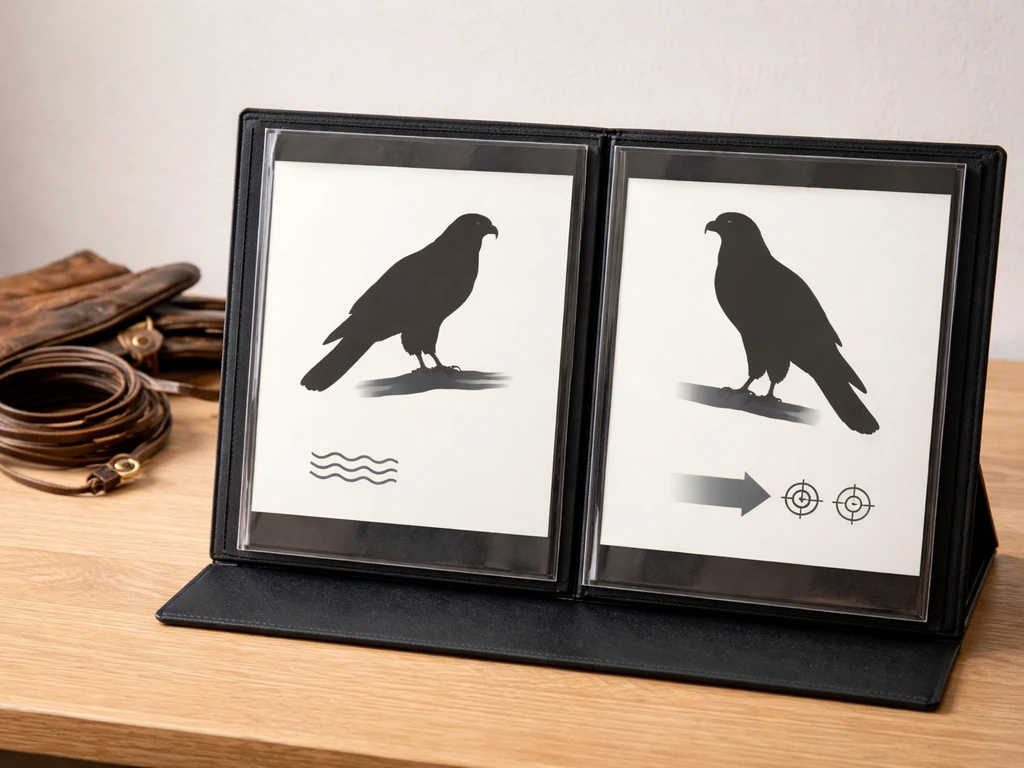
Species differences to know
| Species | Temperament | Best for | Key notes |
|---|---|---|---|
| Harris's Hawk | Social, tolerant, forgiving | Beginners | Can be flown in groups; bonds strongly with handler; vocal |
| Red-tailed Hawk | Calm but can be stubborn | Beginners | Robust and adaptable; wide availability in North America |
| American Kestrel | Curious, active, sensitive | Beginners wanting a small bird | Requires lighter handling; more sensitive to weight fluctuations |
| Common Buzzard | Variable temperament | Beginners (UK) | Slower to man than Harris's hawks; patience required |
| Peregrine Falcon | Highly reactive, fast | Intermediate to advanced | Needs experienced handler; exceptional flight capabilities |
| Golden Eagle | Powerful, complex | Advanced only | Requires specialized facilities and deep experience; not for beginners |
Troubleshooting: biting
Biting is almost always a communication signal, not aggression for its own sake. The bird is telling you it's uncomfortable. The most common causes are moving too fast in training, handling when the bird is full-cropped and not motivated, or approaching from an angle the bird finds threatening (directly head-on is more alarming than a 45-degree approach). If a bird bites repeatedly, slow down. Go back a step in the training sequence and rebuild confidence at that level before moving forward. Never punish a bite. React calmly, move slowly, and end the session if the bird is clearly stressed.
Troubleshooting: refusal to step up
If a bird that previously stepped up reliably starts refusing, check three things first: weight (is the bird too heavy and simply not motivated?), health (is it lethargic, fluffed, or showing any signs of illness?), and recent stress (did something happen in the last 24 to 48 hours that unsettled the bird?). If weight and health are fine, go back to shorter distances and higher-value food rewards. Sometimes a bird needs a reset, and that's normal. Don't treat a step-back as failure.
Troubleshooting: mantling and capture avoidance
Mantling, where a bird spreads its wings over food and lowers its head protectively, is a normal food-guarding instinct. It's not a training problem on its own. It becomes a problem if the bird consistently mantles when you approach with the glove, which signals that it doesn't yet associate you with positive outcomes reliably. Slow down the approach, make sure you're always coming in with visible food, and avoid grabbing at the bird when it mantles. Let it settle, then offer the food. If the bird consistently tries to avoid being picked up, revisit the association-building stage and go more slowly.
Troubleshooting: stress and flightiness
A bird that bates constantly (throws itself off the perch repeatedly), won't settle on the glove, or is constantly alert and scanning is stressed. Common causes are a mews that's too exposed to foot traffic or noise, handling sessions that are too long, or being moved through too many unfamiliar environments too quickly. Shorten sessions to 5 to 10 minutes, reduce distractions in the environment, and give the bird more time to settle between sessions. Consistency and predictability are calming. A stressed bird cannot learn effectively.
A note on rehabilitation birds
If you're a licensed rehabilitator working with an injured or orphaned raptor, the goal is almost always release back into the wild, not long-term training. In this context, you want the bird to be as unhabituated to humans as possible. Minimize handling, use visual barriers when providing food, and avoid letting the bird associate you with positive experiences. This is the opposite of the falconry approach, and it's important to be clear about which mode you're in before you start working with any bird.
Where to go from here
The single best investment you can make as a new raptor trainer is finding an experienced mentor. In the US, your state falconry association can connect you with sponsors. In the UK, the British Falconers' Club and regional clubs do the same. Books like 'Falconry and Hawking' by Phillip Glasier and 'A Falconry Manual' by Frank Beebe are solid foundational references. Online communities can also be helpful, but treat advice from strangers online with more caution than advice from a licensed, experienced falconer who can observe your bird directly.
Raptor training is genuinely one of the most rewarding things you can do with a bird, but it requires consistent daily commitment. These birds aren't low-maintenance pets. They need daily handling, daily feeding, regular health checks, and a handler who pays close attention to small behavioral signals. If that sounds like something you're ready for, take the legal steps, find a mentor, and start with a beginner-appropriate species.
A messenger bird training plan follows the same fundamentals as other raptors, but you will shape behavior with targeted association and step-by-step recall work beginner-appropriate species. If you want a step-by-step roadmap, follow a dedicated guide on how to train a love bird from the very first sessions through recall practice. The process is slower than most people expect and more satisfying than most people imagine.
FAQ
How can I tell if my bird is truly ready to move on to glove work or step-ups?
Watch for calm, consistent behavior during your presence sessions, the bird stays relaxed on the perch and accepts meals without flaring, and it remains on the perch when you pause before offering food. If it bates, repeatedly looks for an escape, or only tolerates you for a second or two, extend manning first and keep early glove sessions very short.
Should I train my bird at the same time of day each session?
Yes, consistency helps pair your routine with safety and food arrival. Aim for the same general time window daily, and avoid changing too many variables at once (lighting, clothing, handling location) because raptors learn patterns faster than they learn random changes.
Do I need to keep the bird slightly underweight every day to keep training working?
No. The goal is a controlled flying weight, not daily hunger. Your sponsor or mentor should define a target range and you should follow daily weigh-ins and behavior, if the bird shows stress signs or reduced responsiveness, adjust with guidance rather than trying to “push through” low motivation.
What should I do if the bird refuses the glove but still takes food on the perch?
Treat it as a specific association gap, not a general training failure. Make the glove offer closer to the bird’s usual comfort zone, reduce the distance and session length, use higher-value food, and keep the bird’s feet placement simple (reward the first correct step, don’t lift early).
Is it okay to use different clothing or gloves each day?
Try to keep them consistent during the early association phase. Visual predictability reduces threat responses, especially when birds are newly learning that your approach predicts food. If you must change clothing, introduce it gradually by first pairing the new look with meals on the perch.
How do I prevent my bird from “learning” to bite or guard resources during training?
Don’t turn biting into a game or a negotiation. Slow down, reduce approach intensity, avoid grabbing when the bird mantles, and end sessions when stress signals rise. Keep rewards immediate for calm steps and hand-contact attempts, so the bird learns the calm behavior, not the bite, gets the outcome.
Can I train perching and recall before I start any free-flight work?
Yes, and it’s often safer to build communication first. Use targets to guide movement between perches, then reinforce voluntary step-ups and calm positioning. Save free-flight introductions for when step-ups and settling are reliable under typical distractions and you have a safe plan for retrieval.
What are the biggest mistakes beginners make when handling raptors for the first time?
Common errors include rushing from tolerance to lifting, training too long in one session, changing multiple variables at once (clothes, location, handling pattern), ignoring weight and health checks, and using force or punishment when the bird shows discomfort. Another frequent mistake is starting free-flight too early because the bird looks calm on the glove.
How should I respond if my bird suddenly becomes more defensive than it was the day before?
Do a quick reset diagnosis: check flying weight and visible health, consider whether the environment changed, and review the last 24 to 48 hours for anything that could have stressed the bird. If those are fine, go back to shorter, lower-demand steps at higher reward value and rebuild confidence rather than repeating the same escalation attempt.
What should I do about bating, constant scanning, or refusing to settle?
Shorten sessions, reduce noise and foot traffic, and add more predictable routines between actions (quiet time, then brief food-based work). If the mews is highly exposed, make it calmer before intensifying training, and ensure breaks are long enough that the bird can decompress between short sessions.
If my bird mantles when I approach with the glove, does that mean it hates me?
Not necessarily. Mantling often means food guarding or uncertainty. The fix is usually slower approach with visible food, no grabbing during the protective posture, and giving the bird time to settle before you ask for the step-up. If mantling persists consistently, return to association work first.
Is it safe to train in windy or bad weather to “get practice in”?
Not early on. Wind can make control harder and increase the chance of a loss during free-flight and even during glove and step-up confidence building. If weather is bad, switch to low-risk work like short manning sessions and target-based reinforcement from the perch.
Do I need to worry about the bird’s metabolism and feeding schedule during training?
Yes. Keep meals tied to training goals, and avoid unpredictable feeding times that break the food association. Also, don’t change food types or prey sizes suddenly without mentor guidance, because it can affect motivation and how quickly the bird returns to baseline behavior.
If I’m working with a rehabilitated raptor, how do I make sure I’m not accidentally habituating it for training?
Use rehabilitation-focused boundaries: minimize handling, reduce one-on-one engagement, use barriers during feeding, and keep interactions as functional rather than habit-forming. Clarify your plan with the treating facility so your sessions support release goals instead of building stronger human preference.
How do I choose a beginner-appropriate species if I live outside North America or the UK?
Base the choice on local availability of legal, captive-bred birds and on how demanding common species are in your region. In general, start with smaller, more tolerant species when possible, avoid the most reactive raptors first, and get mentorship from a local falconry or raptor organization so training methods match local regulations and husbandry expectations.