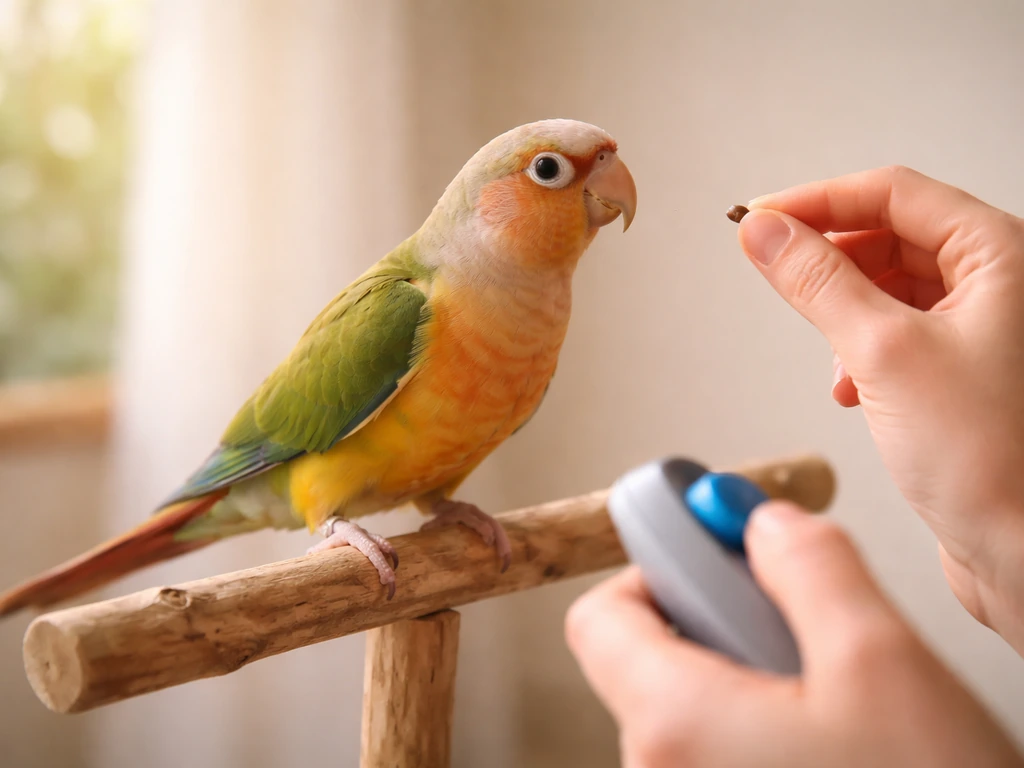
Teaching your bird to spin is one of the most satisfying beginner tricks you can train, and it is genuinely achievable for most hand-tame pet birds in just a few short sessions. The spin (also called "turn around") is a full 360-degree rotation on the perch, performed on cue. It looks impressive, it builds your bird's focus and confidence, and it lays great groundwork for more complex tricks. Here is exactly how to get there, step by step.
How to Teach Your Bird to Spin: Step-by-Step Guide
Maya Harris
20 Apr 2026
What "spin" actually means behaviorally
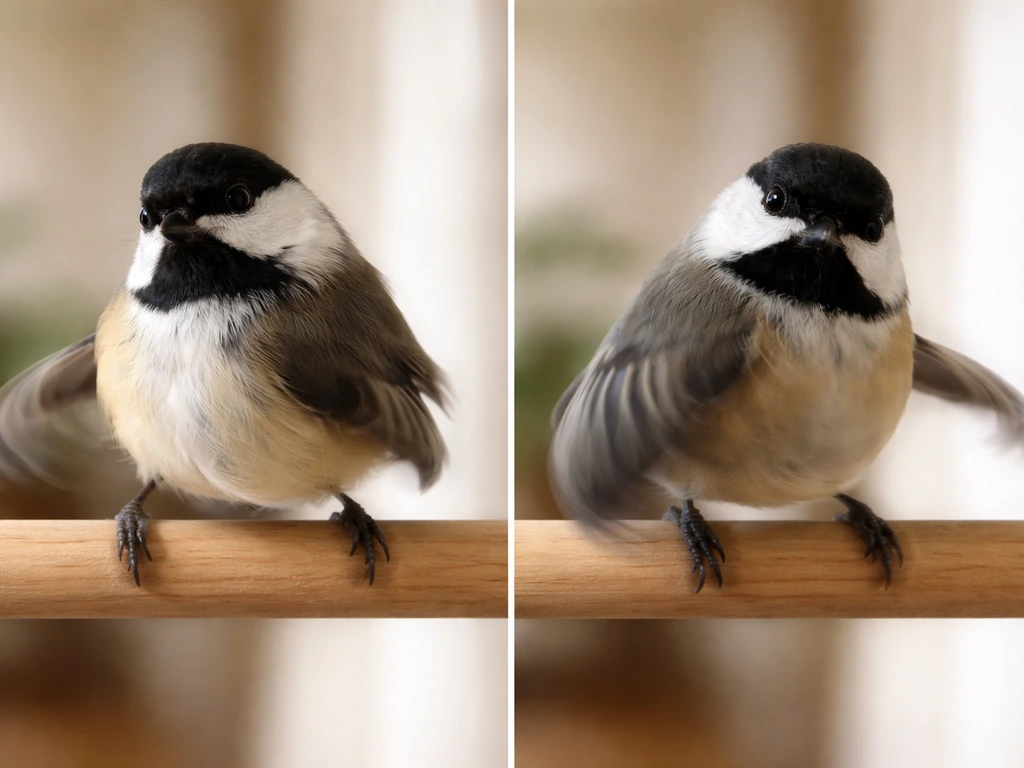
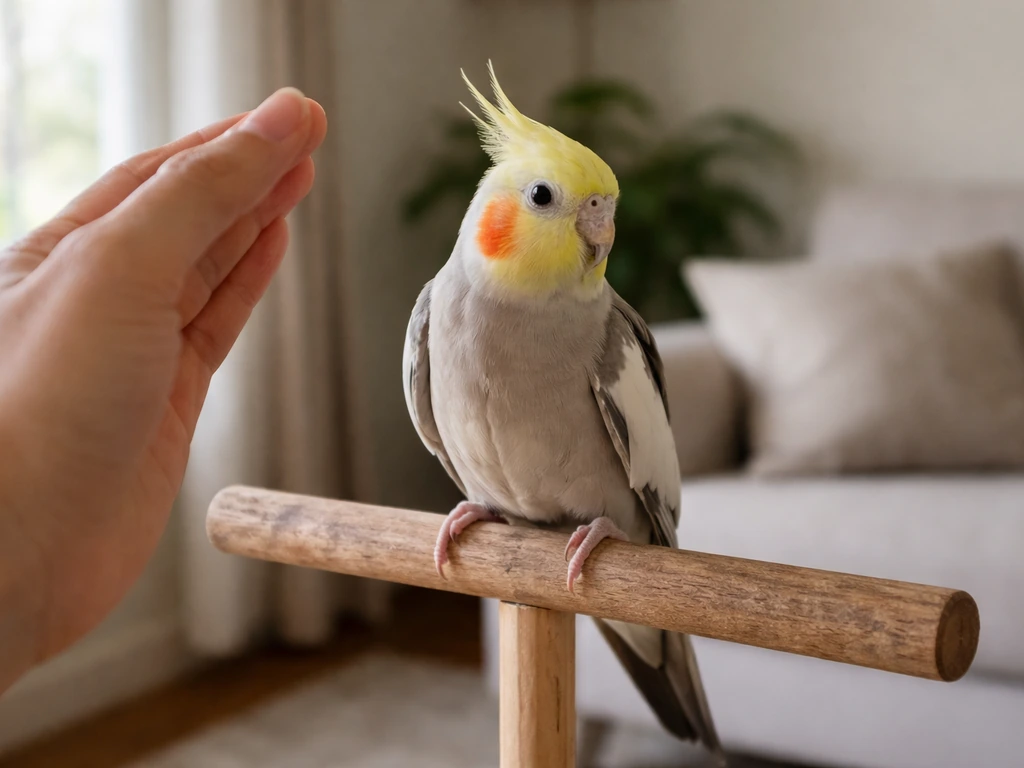
Before you start, be clear on what you are training. A spin is a complete 360-degree pivot in place: the bird turns its body and feet in a full circle on the perch and ends up facing the same direction it started. It is not a hop, a step sideways, or a partial head turn. The bird stays roughly on the same spot on the perch; it just rotates around that spot. Some trainers call this "turn around," others call it "spin" or "twirl" depending on the species and community, but the physical behavior is the same.
You can train this in one direction only (say, always turning to the bird's left), or eventually in both directions with different cues. For beginners, start with one direction. Adding a second direction comes later once the first is solid. The bird can spin in either direction physically, so choose whichever direction your bird naturally drifts toward first and build on that.
This behavior works well for parrots of all sizes (African greys, amazons, conures, cockatiels, budgies), and with some patience it can even be adapted for corvids or softbills that are food-motivated. Very small birds like finches or canaries are harder to train for this specific behavior because contact-based luring is not usually part of their training, but it is not impossible if they are target-trained. For most readers, this guide assumes a hand-tame parrot or cockatiel-type bird.
Set up a safe, comfortable training space first
Where you train matters as much as how you train. A distracted, uncomfortable bird will not learn anything. Pick a quiet room with no TV blaring, no other pets roaming around, and good lighting. Short sessions work best: 3 to 5 minutes maximum, ideally two or three times a day. Birds tire quickly of repetition, and a bored or over-trained bird starts making mistakes and refusing to engage.
Choose a stable training perch that gives your bird a confident grip. Perch diameter matters here: if your bird's foot wraps too far around (more than about three-quarters of the way), the perch is too thin; if the foot barely bends at all, it is too thick. A non-slip surface helps significantly for spin training because the bird needs to shuffle its feet around without slipping. Sisal-wrapped perches offer great grip. Avoid smooth dowel perches for this exercise if your bird seems unsteady.
Set the training perch at a height that is comfortable for you to work at without hovering over the bird. Birds are sensitive to looming, and bending down awkwardly puts you off your timing. If you are training near the bird's usual cage, make sure the cage is not an easy bail-out option that the bird dives for the second things get mildly challenging. A free-standing training perch in an open area works best.
- Quiet room, minimal distractions
- Non-slip perch at a comfortable working height
- Perch diameter matched to the bird's foot size
- Sessions of 3 to 5 minutes, two to three times daily
- Train before a regular meal so your bird is motivated but not frantic
Markers, treats, and timing: the basics before you start
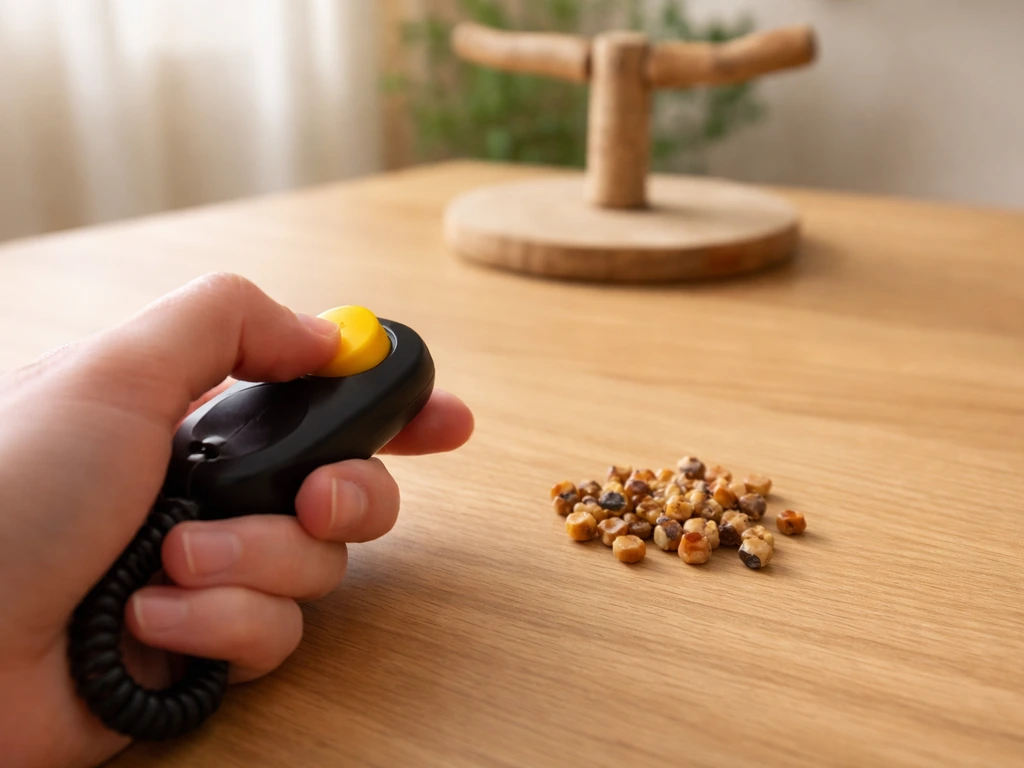
If you are new to marker training, here is the core idea: [a marker is a sharp, clear signal](https://pmc. ncbi. nlm. nih.
gov/articles/PMC6151118/) (a click from a clicker, or a short spoken word like "yes" or "good") that tells the bird the exact moment it did the right thing. The marker is always followed immediately by a reward, usually a small food treat. The marker and the treat are separate events: the marker comes first, then the treat follows within a second or two.
Fear Free Happy Homes recommends that the treat follow the marker within about 1 second of the marked behavior within a second or two. Over repetition, the bird learns that the marker predicts the treat, which means the marker itself becomes highly meaningful.
A clicker works well for precision timing and is the tool of choice for many trainers. But a clear, consistent verbal marker like "yes" works just as effectively, especially if you do not want to hold a clicker and manage treats and a lure all at once. Whatever you choose, be consistent: do not switch between "yes," "good," and "nice" randomly. Pick one and stick to it.
Treat selection is personal to your bird. Small pieces of a high-value food work best: a pinch of nutriberry, a tiny almond sliver, a sunflower seed, or whatever your individual bird goes wild for. Treats should be tiny (a few seconds to eat at most) so the bird stays engaged and you can get multiple repetitions in a session. If your bird is not interested in treats at all, check whether you are training too close to a full meal or whether the treat is genuinely motivating. Some birds prefer praise or a favorite toy as a reward, and that works too.
Shape the spin step by step
Shaping means building a complex behavior out of tiny, rewarded steps. You are not going to get a full 360-degree spin from day one. You are going to mark and reward smaller and smaller approximations until the full behavior emerges. This is the cleanest way to teach spin, and it produces a reliable behavior much faster than trying to rush to the finished product.
Step 1: Get a small head or body turn
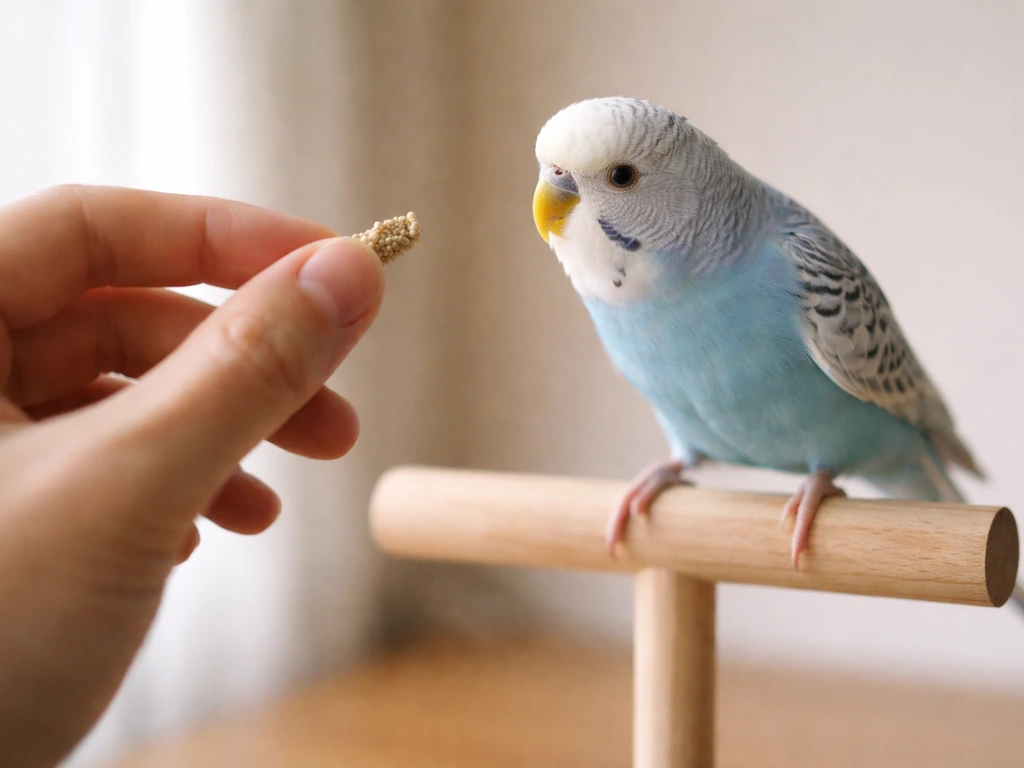
Hold a treat slightly to one side of your bird's body (not right in front of its face). If you are training to the bird's left, hold the treat to the left and slightly behind the bird's shoulder line. The bird will turn its head to follow the treat. The moment it turns its head even slightly in that direction, mark and reward. Do this 5 to 10 times until the bird is reliably turning its head toward that side.
Step 2: Require a body turn
Now withhold the mark slightly longer. Wait for the bird's body to start turning, not just its head. Move your hand a little further around the bird's side so it has to shift its feet slightly to follow. Mark and reward the moment the feet move in the right direction. Keep your hand movement smooth and unhurried. You are not dragging the bird around; you are inviting it to follow.
Step 3: Build to a quarter turn, then a half turn
Once the bird is confidently moving its feet, gradually move the treat hand further around the bird's body before marking. First mark at about a quarter turn (90 degrees), then after a few sessions push the criterion to a half turn (180 degrees). Go at whatever pace keeps the bird succeeding about 80 percent of the time. If success drops below that, back up to the previous step and do a few more repetitions there before pushing forward again.
Step 4: Complete the full 360-degree rotation
Now extend your hand movement all the way around so the bird completes the full circle and ends up facing forward again. Mark only when the full rotation is complete, not before. This timing is critical: if you mark at 270 degrees consistently, you will teach the bird to stop there. Wait for the full turn, then click and reward enthusiastically. Once the bird is completing the full spin reliably with a lure (about 8 out of 10 tries), you are ready to start fading the lure and adding a cue.
Adding cues: one direction first, then optionally both
A cue is the signal you give that tells the bird it is time to perform the spin. There are two types to consider: a hand signal and a verbal cue. You can use one or both. The hand signal often develops naturally from the luring motion: a circular hand gesture to the left becomes the "spin left" cue. A verbal cue like "spin" or "around" can be layered on top once the behavior is solid.
To introduce the verbal cue, say the word clearly just before you give the hand signal. Do this consistently for 10 to 20 repetitions. The bird will start to anticipate the spin when it hears the word. Eventually you can test whether the word alone (without the hand lure) produces the spin. Give the verbal cue, pause one second, and see if the bird starts to move. If it does, mark and reward big. If it does not, follow up with the hand signal as usual. Gradually fade the hand signal over sessions.
For training a second direction: wait until the first direction is clean and reliable (consistently performing on cue alone, 9 out of 10 times, across different locations). Then start the shaping process again from scratch for the opposite direction, using a different cue. A common pair is a clockwise hand circle for "spin" and a counterclockwise circle for "twirl," but use whatever is intuitive for you and clear to your bird. Keep training for each direction in separate sessions initially to avoid confusion.
| Stage | What to mark and reward | Typical sessions needed |
|---|---|---|
| Head/neck turn only | Any movement toward the target side | 1 to 2 |
| Quarter turn (90°) | Feet shifting in the right direction | 2 to 3 |
| Half turn (180°) | Body rotated halfway around | 2 to 4 |
| Three-quarter turn (270°) | Almost completing the circle | 1 to 3 |
| Full 360° spin | Bird returns to starting position | 3 to 5 |
| Spin on hand signal only | Full spin without lure | 3 to 6 |
| Spin on verbal cue alone | Full spin without hand signal | 5 to 10 |
When things go wrong: common problems and how to fix them
Almost every trainer runs into at least one of these issues. None of them mean your bird cannot learn the spin. They just mean you need to adjust your approach.
The bird will not turn at all
If your bird just stares at the treat or tries to grab it without turning, your treat hand is probably too close to the bird's face. Move it to the side and slightly back. Also check that your treat is genuinely motivating. If the bird is already full or the treat is boring to them, they will not work for it. Try a higher-value reward and train before the bird's regular meal.
The bird only does a partial spin and stops
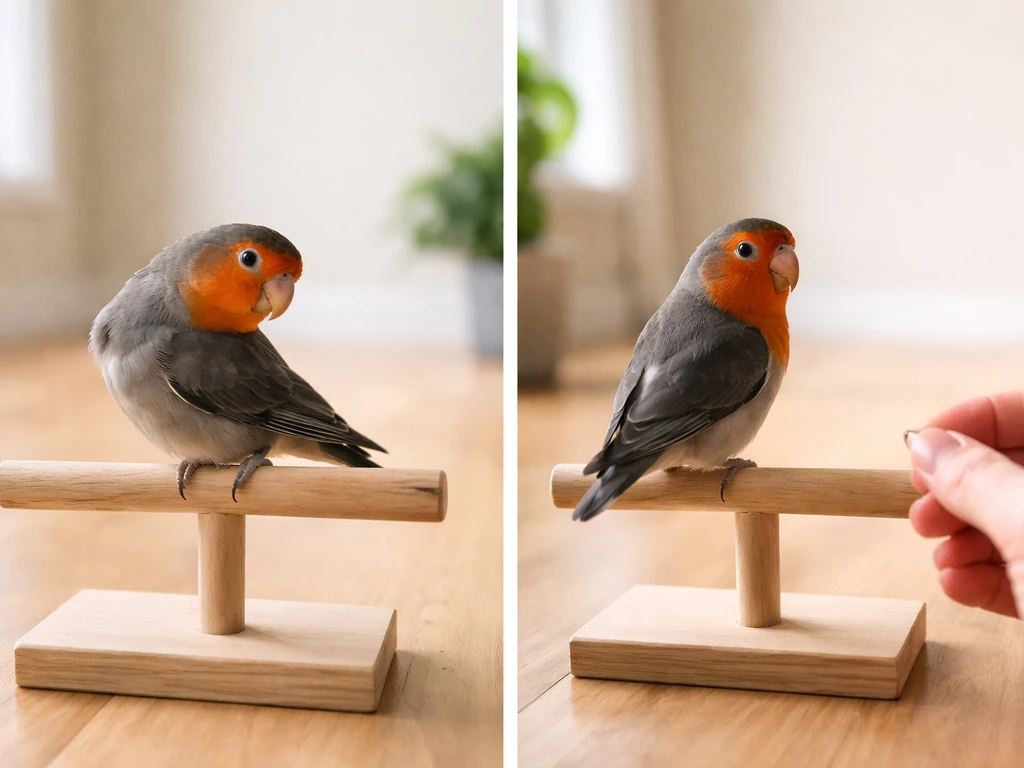
This usually means you pushed the criterion too fast. Go back one step (say, rewarding a half turn consistently) and build up more slowly. It can also mean you accidentally marked a partial spin at some point, which taught the bird that stopping early is acceptable. Re-establish the full 360 as the criterion by withholding the mark until the bird completes the whole rotation.
The bird gets distracted mid-spin
Distractions usually mean the environment is too stimulating or the session is too long. Move to a quieter space and cut your sessions shorter. Keep a brisk pace between repetitions so the bird stays engaged. Slow, meandering sessions invite distraction.
The bird bites or flinches when you move your hand around it
This is a trust and comfort issue, not a training failure. Do not push through biting or flinching. Back off completely and spend a few sessions on simple, confidence-building exercises (step-up, target training, or just hand-feeding without asking for anything). Only return to the spin once the bird is relaxed and comfortable with your hand near it. Rushing past fear responses always makes things worse.
The bird refuses to stay on the perch
Check the perch: is it stable? Is it slippery? A bird that feels unbalanced will step off rather than attempt footwork. Switch to a more secure, grippy perch. Also make sure the bird is not trying to climb toward you as a preferred destination. If the bird would rather sit on your hand than a stand, do a few short sessions building value for the training perch before you restart trick training.
Progress is painfully slow
Some birds are naturally slower learners, and some breeds (like timid cockatiels or naturally less food-motivated species) take longer than confident parrots like caiques or Amazon parrots. That is fine. Be patient, keep sessions short, and celebrate tiny wins. If the bird completed a half turn today for the first time, that is a real success. Slow progress is still progress.
Your practice plan and what comes next
A simple but effective practice structure looks like this: two to three sessions per day, 3 to 5 minutes each, with a short break between sessions. In each session, start with a few easy repetitions of something the bird already knows confidently (step-up, wave, or just hand-targeting) to get the bird warmed up and engaged. Then do 5 to 10 spin repetitions at your current training step. End on a success: always finish with something the bird can do well so the session ends positively.
- Warm-up with a known behavior (2 to 3 repetitions)
- Train the spin at your current step (5 to 10 repetitions)
- End on an easy success and give a big reward for the last rep
- Rest at least 30 minutes before the next session
- Track your progress loosely: note which step you are on and how consistent the bird is
Once your bird is spinning reliably in your usual training spot, start generalizing: practice in a different room, on a different perch, with a different person giving the cue. Birds do not automatically understand that a behavior learned in one place applies everywhere. Generalization takes intentional practice. Each new location or person is a small training challenge, and you may need to drop back to earlier steps temporarily while the bird adjusts.
When to switch gears: if your bird has been stuck on the same step for more than a week of consistent training, do not keep grinding. Change something. Try a different treat, a different time of day, a smaller step size, or a brief break from spin training altogether and return to it fresh in a week. Sometimes a break is the most productive thing you can do.
Once the spin is clean and reliable, it naturally connects to other movement-based tricks. If you want to go further, apply the same foundation to learn how to make your bird dance other movement-based tricks. Once your bird is comfortable with movement and cues, you can follow the same positive-reinforcement approach to teach it how to lay on its back.
Once your bird can spin reliably, you can use those same target and foot-movement skills to start teaching it to play basketball. Rolling over, playing dead, and dancing-style behaviors all build on the same body-awareness and foot-movement skills your bird is developing here. p48s3: Rolling over, dancing-style behaviors all build on the same body-awareness and foot-movement skills your bird is developing here.
Rolling over is another adjacent movement trick that you can build toward once your bird is comfortable with cues and body awareness. You may find that those related behaviors come much faster once the spin is established.
A note for wildlife rehabilitators
If you work with wild or rehabilitated birds, the spin training approach described here is designed for pet birds with established trust and human contact. It is not appropriate to apply lure-based or hand-contact training to wild birds in your care. For rehab birds, welfare priorities are minimizing stress, preserving natural behaviors, and preparing the bird for release rather than teaching it tricks.
Marker training can still be a useful welfare tool in rehab settings (for example, conditioning a bird to voluntarily enter a crate or approach a feeding station), but the goals and methods differ significantly from pet trick training. If you are rehabilitating birds and want to use positive reinforcement for husbandry purposes, consult with an avian vet or certified wildlife rehabilitator for guidance specific to your species and situation.
FAQ
How can I tell if my bird is doing the right “spin” instead of a hop or head-only turn?
A correct spin includes foot repositioning and a full 360-degree body rotation while the bird stays on the perch. If only the head follows the treat and the feet do not shift, slow down and go back to the step where you mark the first foot movement in the correct direction.
What if my bird keeps spinning the wrong direction or flips at the start?
If you are training one direction first, do not reshape while it turns the “other way.” Re-set by positioning the lure so it can only reach that direction comfortably, and keep criteria strict (mark only when the feet commit to the target direction). For persistent bias, choose the direction your bird naturally drifts toward and build the cue there first.
My bird reaches for the treat instead of turning. How do I fix that without increasing pressure?
Move the lure farther to the side and slightly behind the shoulder line, so the only way to get the treat is to pivot its body, not just lunge forward. Also use smaller, faster-to-eat treats so the bird has less opportunity to grab and stop working. If needed, train on a slightly firmer grip perch to reduce fidgeting.
How long should it take before my bird responds to the cue without the lure?
Expect it to happen gradually. A practical milestone is consistent spins without the lure in the exact training spot (around 8 to 10 successful tries). If the bird will only spin with the lure after several sessions, reduce the hand-signal fading rate (fade one element at a time) and keep cue introduction short and consistent.
Should I mark the instant the bird moves, or only after the full 360 is complete?
Use a two-phase rule. During early shaping, mark the smallest approximation that you are working on (for example, first head turn, then first foot movement, then quarter turn). At the full behavior stage, withhold the marker until the full rotation finishes, so the bird learns the stopping point is “after 360,” not at 90, 180, or 270.
My bird gets worse after a few good sessions. Is that a normal training issue?
Yes, it can be a sign of overtraining or criteria drift. Shorten the session, return to an easier approximation for a few repetitions, and keep the success rate near about 80 percent. Also check whether you accidentally rewarded a partial stop earlier, since that can teach the bird to end early.
What if my bird is afraid of the lure hand getting closer during footwork?
Back off a step and rebuild comfort with hand proximity using confidence exercises (step-up, simple targeting, or reward for calm contact). Resume spin only when the bird accepts your hand being near its body without flinching. Rushing fear makes it more likely the bird will refuse to turn in the future.
Do I need a special perch, and how do perch size and grip affect progress?
Yes, grip and stability matter. If the perch is too thin or too slippery, the bird cannot comfortably shuffle feet during the rotation, and it will step off instead. Aim for a non-slip surface and a diameter that allows the bird’s feet to wrap about three-quarters of the way, not fully or barely.
Can I teach spin to birds that are not very food motivated?
Often you can, but you may need to change rewards and timing. Use the bird’s highest-value item (favorite seed, a preferred micro-treat, or a brief toy interaction) and ensure you are training before full meals. If food rewards truly do not work at all, you can still use praise or play as the reinforcement, but keep the reinforcement immediate and consistent.
How do I generalize the spin to other locations and people without confusing the bird?
Generalize in small steps. Practice the cue in a new room first using the same perch type and similar lighting, then switch the perch later. When you change cue deliverer, start with easier criteria (for example, accept a quarter to half turn briefly) and then rebuild toward full 360 as the bird adjusts.
What should I do if my bird is stuck on the same step for more than a week?
Don’t keep repeating the same criteria. Adjust one variable at a time, such as using a smaller step size (mark at 60 to 90 degrees instead of jumping), switching to a higher-value reward, changing session length, or taking a short break from spin and returning later with fresh motivation.
Is it okay to train spin more than once a day, or will that slow learning?
More is not always better. Stick to very short sessions, about 3 to 5 minutes, and keep them separate so the bird stays engaged. If accuracy drops or the bird starts refusing, reduce frequency first, then reduce session length.
Can I teach both directions from the start?
It’s usually better not to. Training one direction until it is reliable on cue reduces confusion and prevents the bird from adopting “partial or random stopping” habits. Once the first direction is clean, start the second direction in separate sessions with a distinct cue.
Is lure-based spin training safe for wild birds or rehabilitated birds?
Generally no. For wild birds, lure-based or close hand-contact trick training can increase stress and is not appropriate. In rehab, the welfare goal is often conditioning for husbandry tasks (like crate entry or approaching a station), so methods and success criteria should be designed with an avian vet or certified rehabilitator for that species and situation.
Next Article
How to Teach a Bird to Dance: Step-by-Step Training
Step by step humane guide on how to teach a bird to dance with cues, rewards, safety checks, and troubleshooting.