You build a lovebird's trust the same way you build trust with any wary animal: you go slower than feels necessary, you let the bird make choices, and you make every interaction end on a good note. Most people stall because they move too fast or expect the bird to meet them halfway before it's ready. Done right, a newly adopted lovebird can go from panicking at your hand to stepping up voluntarily within two to four weeks of daily 10-15 minute sessions.
How to Make a Lovebird Trust You Step by Step
Maya Harris
14 May 2026
Understanding lovebird fear and trust signals
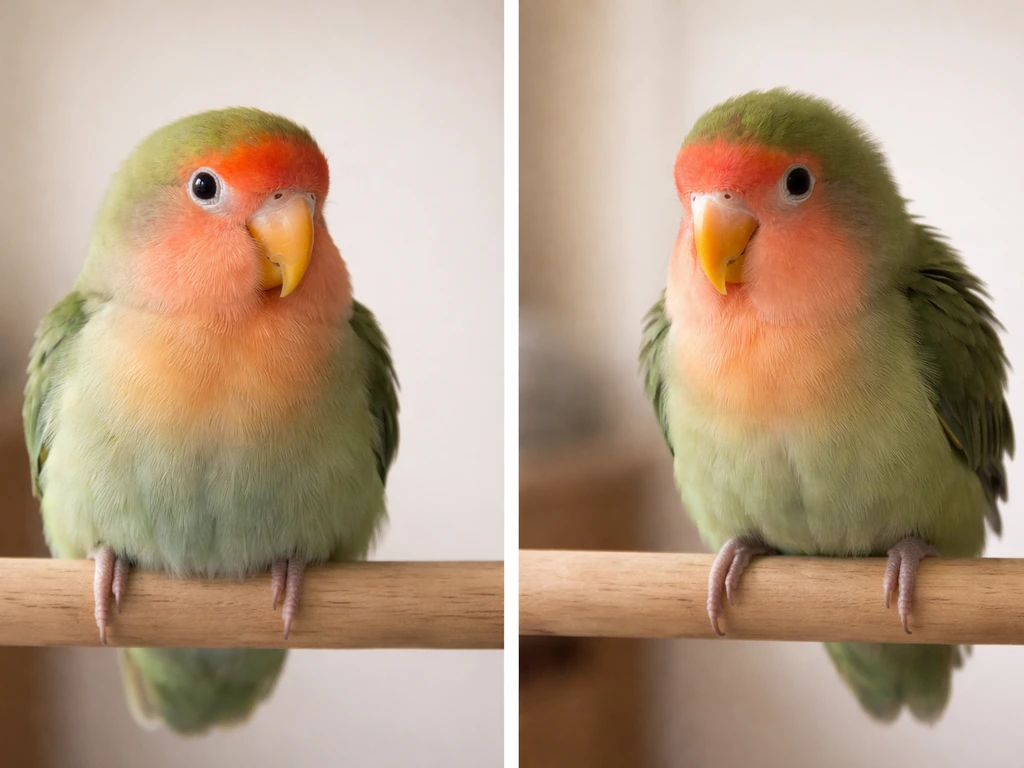
Before you do anything else, learn to read what your bird is actually telling you. Lovebirds are small parrots with big personalities and they telegraph their emotional state constantly. When a bird is scared or on edge, it will hold its feathers tight and flat against its body, making itself look thin and stiff. You might also see rapid, shallow breathing, wide pinned eyes, and a tail that fans or flares out sharply. That last one is a serious warning signal, not just annoyance. A flared tail plus a stiff body means the bird is at its limit and you need to stop and back off. In avian body-language guidance, fear or stress postures can include a “stiff, skinny” posture with feathers held flat against the body, and a flaring tail is treated as a serious warning signal a stiff body means the bird is at its limit.
On the flip side, a relaxed lovebird looks almost round. Feathers are slightly puffed and loose (not because the bird is sick, but because it's comfortable), the eyes are soft and blinking slowly, and the bird might grind its beak or produce a low chattering sound while you're nearby. These are green lights. When you see them, you're on the right track.
A lovebird that lunges at your hand the moment you reach into the cage isn't being aggressive for fun. It's scared and running out of options. Biting is a last resort, which means that if your bird is biting every time, something earlier in your approach is triggering it and you haven't caught the warning signals yet. Slowing down and watching closely will tell you exactly where things break down.
| Signal | What it means | What to do |
|---|---|---|
| Feathers flat, body stiff and thin | High fear or acute stress | Stop all approach, give the bird space, wait for relaxation before trying again |
| Tail flaring, wings slightly open | Serious warning, bite is coming | Immediately withdraw your hand and end the session |
| Rapid blinking, head bobbing away | Mild discomfort, not yet panicking | Pause movement, let the bird settle, then continue more slowly |
| Feathers slightly puffed, beak grinding | Relaxed and comfortable | Green light to continue at the same pace |
| Leaning toward you, neck stretched | Curious and interested | Offer a treat or slow hand movement as an invitation |
| Slow blinking, eyes half-closed near you | Calm trust, feels safe | Ideal moment for quiet, still presence or gentle touch |
Setting up a safe bonding environment and routine
Where and when you train matters as much as how. Lovebirds are prey animals, so unfamiliar spaces, sudden noises, and unpredictable schedules all add stress that works against bonding. The goal is to make your presence feel like the safest, most predictable thing in your bird's day.
Cage placement and setup
Put the cage at roughly chest height in a room where you spend regular time, like a living room or home office. Eye-level to slightly below eye-level is ideal because looming over a bird from above mimics predator behavior. Keep the cage away from exterior windows where sudden outdoor movement (a passing cat, a bird of prey flying over) can startle the bird repeatedly throughout the day. Make sure there are two or three hiding spots inside the cage (a nest box, a covered corner perch, some hanging toys) so the bird always has the option to retreat. A bird that has a safe retreat is actually easier to bond with because it doesn't feel trapped.
Building a daily schedule
Consistency is your single most powerful tool. Lovebirds are creatures of habit and a predictable schedule reduces background anxiety dramatically. Aim for two short sessions per day, roughly 10 to 15 minutes each, at the same times every day. Morning (shortly after uncovering the cage) and late afternoon tend to work well because the bird is alert and active but not overtired. Avoid sessions right before the bird's sleep time, when it's eating a main meal, or during molt when it may be extra sensitive.
- Keep the room quiet during sessions: turn off the TV, ask others to give you space
- Sit or crouch at the bird's level rather than standing over the cage
- Move slowly and predictably every time you approach
- Use a soft, consistent verbal cue like 'hi' or the bird's name before any interaction
- End every session before the bird shows stress signals, not after
Positive association training: voice, presence, and treats
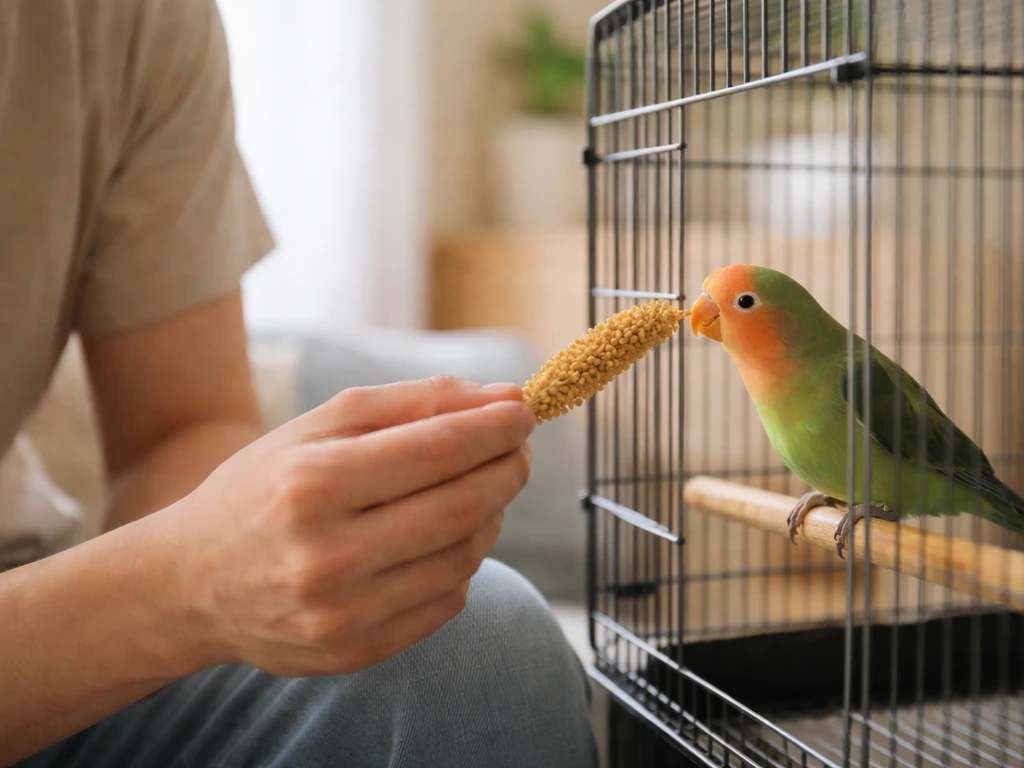
The foundation of trust-building is dead simple: make your presence predict good things. Before you ever try to touch your lovebird, spend three to five days just being near the cage without asking anything of the bird. Sit beside the cage, talk quietly, read a book out loud, eat a snack nearby. You want the bird to start associating your presence with calm and maybe with food, before any hands enter the picture.
Choosing the right treats
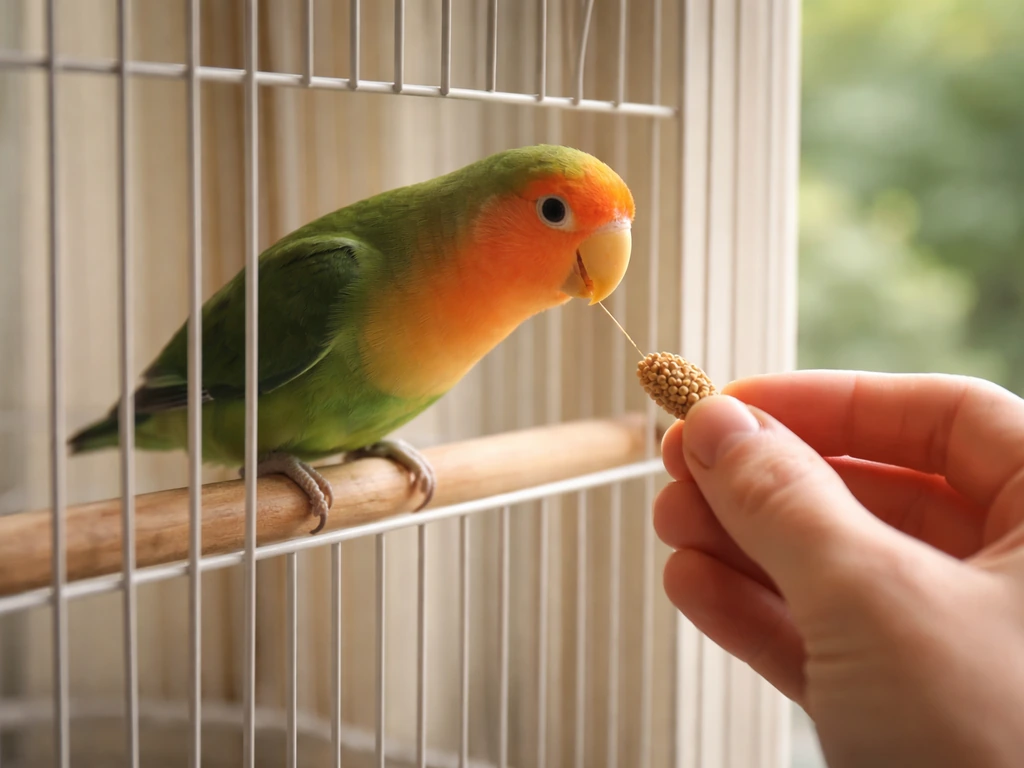
Millet spray is the gold standard for lovebird training treats. It's something almost every lovebird goes crazy for, it's easy to hold and extend through cage bars, and each individual millet seed is tiny enough to reward many small steps without filling the bird up. You can also use small slivers of apple, a piece of soft corn, or a pinch of egg food if your bird is indifferent to millet. The treat needs to be something the bird clearly wants more of, so if it ignores what you're offering, try something else. Withhold the special treat from the bird's regular diet so it stays motivating.
Voice pairing
Use a soft, calm, consistent tone every time you approach. You're pairing your voice with the arrival of good things so the bird learns your voice means 'something nice is coming.' Avoid high-pitched excited squealing around a nervous bird because it can be startling. A low, steady talking voice works better. Over the first week, the bird should start orienting toward you when it hears your voice rather than pressing itself against the far side of the cage.
Treat delivery progression
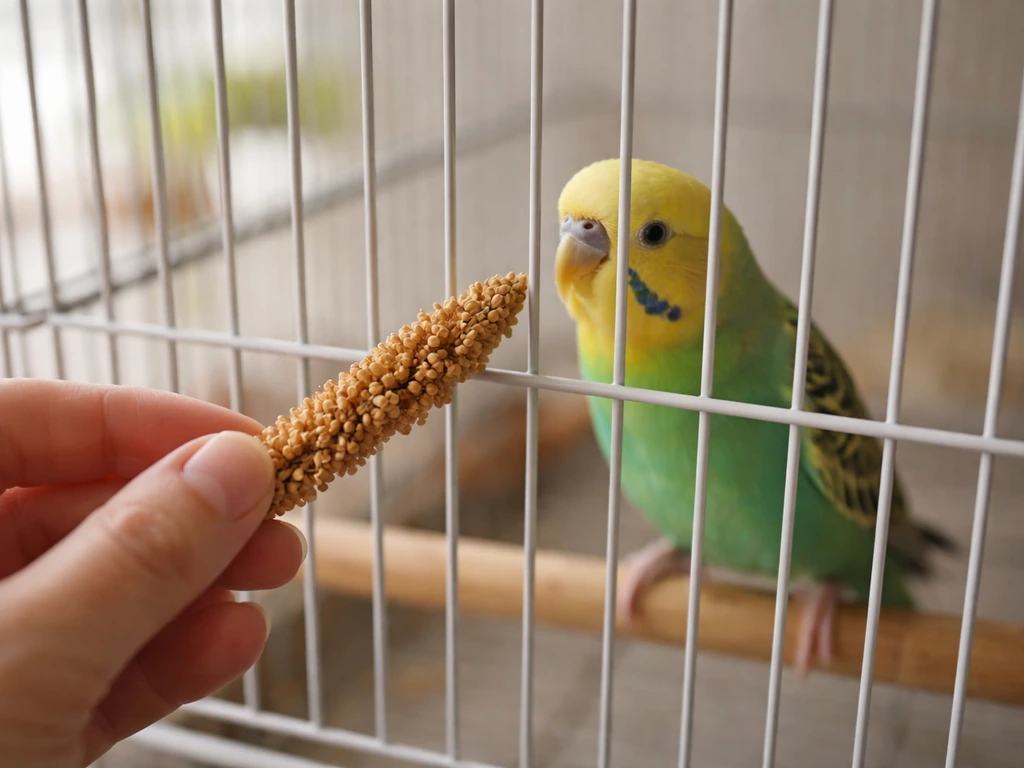
- Days 1-3: Drop treats into the food bowl from a distance while talking softly. Don't linger.
- Days 4-6: Hold a sprig of millet against the outside of the cage bars and let the bird approach on its own. Don't push it in; just hold it steady.
- Days 7-10: Hold the millet just inside the cage door so the bird has to come closer to you to get it. Keep your hand very still.
- Days 11-14: Hold the millet in your open palm inside the cage, at perch level, and wait. Let the bird land on your hand if it chooses.
Each step should feel easy before you move to the next one. If the bird is still hesitating at step two, that's fine. Stay there for another two to three days. Rushing the progression is the number one reason people get stuck.
Step-by-step taming: hand-feeding, approach, and touch on your terms
Once the bird is reliably coming to your hand for treats inside the cage, you're ready to work on physical contact. The principle here is always the same: the bird initiates, you don't force. Forcing contact might work in the short term but it builds compliance out of fear, not trust, and it almost always sets you back when the bird eventually fights back.
Getting the bird onto your hand voluntarily
Hold a treat in your closed fist and let the bird sniff and peck at your fingers to get it. This gets the bird used to the texture and smell of your hand without the pressure of an open palm. Once the bird is comfortable pecking at your closed hand, open your palm flat with the treat in the center and wait. Don't move the hand toward the bird. The bird moves to the hand. This distinction matters enormously.
First touch
When the bird is standing on your hand eating calmly, try very slowly raising one finger toward its chest. Don't go for the head yet. Touch the chest feathers lightly for one second and then stop. Watch the body language. If the bird keeps eating without stiffening, you've had a successful first touch. Do it once more and end the session on that win. Repetition over many sessions is what builds a bird that enjoys being touched, not a marathon session where you keep going until it tolerates you.
Adapting for baby vs adult birds
A hand-raised baby lovebird that was properly socialized by a good breeder will go through this progression much faster, sometimes in just a few days, because it already associates humans with safety and food. An adult bird that was cage-raised, flock-kept, or came from an uncertain background may need six to eight weeks or more. That's completely normal. For birds with suspected trauma or neglect history, assume you're starting from scratch regardless of what the previous owner told you, and plan for a longer runway. The methods are the same; the timeline is just longer.
Teaching core behaviors: step up, stationing, and calm handling
Once your lovebird is comfortable on your hand for treats, you can start teaching specific behaviors that make daily handling safe and stress-free for both of you. These aren't tricks for show. They're practical tools that let you move the bird, do health checks, and handle the bird in an emergency without triggering panic or biting.
The step-up cue
The RSPCA describes step-up training as an ask-step-reward cycle rather than a pushing motion. Here's how to do it in practice. Hold your index finger horizontally against the bird's lower chest, just above the feet, while saying 'up' in a calm, clear voice. The moment the bird shifts its weight forward onto your finger, reward with a treat and verbal praise. Repeat three to five times per session. Don't press your finger into the bird's belly to force the step. The light chest contact is just a cue; the treat is what motivates the movement. Most lovebirds learn a reliable step-up within one to two weeks of consistent practice.
Stationing
Stationing means teaching the bird to go to a specific spot (a perch, a mat, or a T-stand) and stay there calmly. It gives the bird a predictable 'home base' during out-of-cage time and reduces chasing and stress. Start by placing a treat on the target perch and letting the bird find it. Do that a few times, then begin luring the bird to the perch from your hand by moving your hand near it and waiting for the bird to step off. Mark the moment it lands with a treat. Over time, add a verbal cue like 'perch' or 'station' right before the bird steps onto it.
Calm handling and toweling (for health checks)
Teaching a bird to tolerate brief toweling is genuinely important because you'll need it for vet visits and wing or nail trims. Introduce a small, soft towel as a neutral object first. Leave it near the cage for a few days. Then drape it over your hand and offer treats from the towel-covered hand. Gradually work up to briefly wrapping the bird in the towel for one to two seconds, immediately followed by a treat and release. Keep sessions very short. The goal is 'towel equals treat' as a learned association, so the bird stays calmer at the vet.
Troubleshooting biting, panic, and stalled progress
Even with the best approach, you'll hit roadblocks. Here's how to handle the most common ones without losing ground.
The bird bites every time you reach in
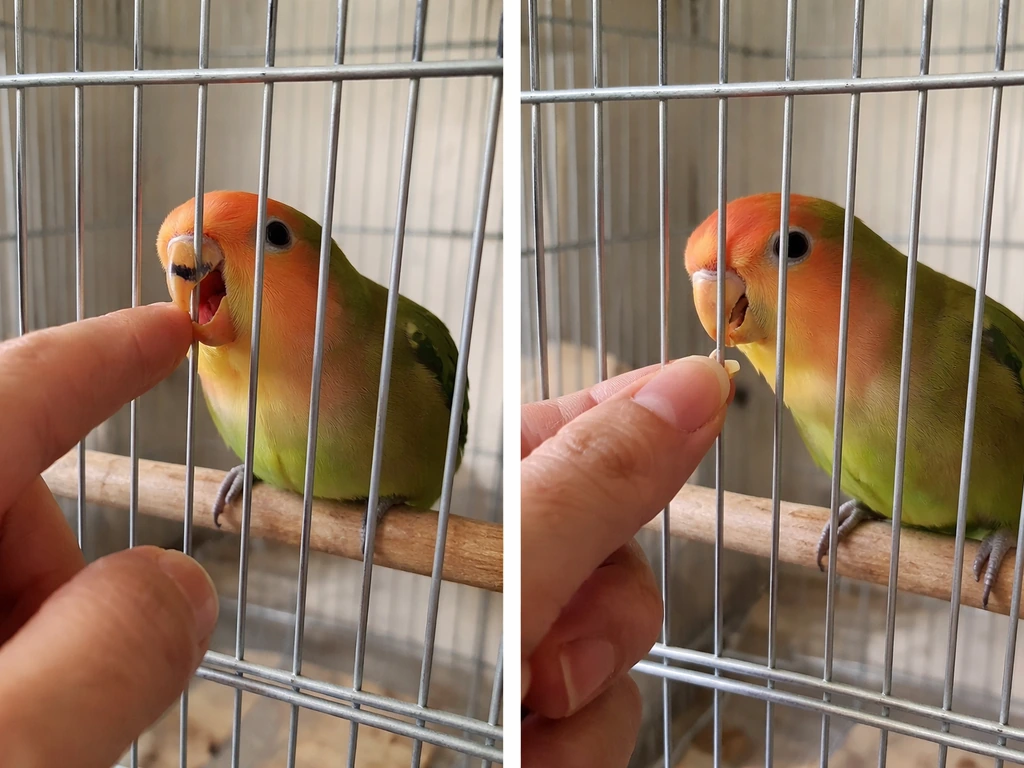
This usually means you're skipping steps. Go back to outside-the-cage treat delivery and spend more time at each stage of the progression before moving your hand inside the cage. If the bird bites when you try to step it up, it almost certainly means the step-up cue is being taught too forcefully. Remove all pressure from your finger and use the treat to lure the step rather than the touch. Also check whether biting happens more at certain times of day: lovebirds can be hormonal in spring and more nippy than usual. Reduce handling sessions during peak hormonal periods and keep interactions brief and treat-heavy.
The bird panics when you open the cage door
Practice opening and closing the cage door repeatedly without putting your hand inside and without any expectation of interaction. Drop a treat into the bowl each time you open it. You're pairing the door opening with 'nothing bad happens' and then with 'something good appears.' Do this five to ten times across the day for several days before you attempt reaching inside again.
Progress stalls for two weeks or more
First, check whether you've unintentionally changed something: a new piece of furniture near the cage, a schedule change, a different person in the home, a new smell. Lovebirds are extremely sensitive to environmental change. Second, try switching the training treat. Sometimes motivation drops and the bird simply needs something more exciting. Third, shorten your sessions to five minutes and increase the number of sessions per day to three or four. Smaller, more frequent wins often break a plateau faster than longer sessions.
The bird seems scared of hands specifically
Some birds have had a bad experience with hands: rough handling, accidental injury, or being grabbed forcefully. With these birds, desensitize hands as objects before you ever try to use them as a training tool. Leave your hand resting motionless outside the cage for several minutes while you ignore the bird and watch TV or read. Do this daily until the bird is completely uninterested in your hand being there. Then begin the treat-delivery progression from the beginning. It takes longer but it's the only approach that reliably works with hand-shy birds. With patient, step-by-step desensitization and consistent positive associations, a hand-shy bird can learn how to feel safe around you how to make your bird not scared of you.
Pet vs rehabilitated or wild birds: what changes and what the law says
Everything described in this guide applies to pet lovebirds, which are domestically bred parrots (almost always Agapornis species, most commonly Fischer's, peach-faced, or masked lovebirds). These birds are bred in captivity and can and should be tamed and socialized with humans. The process above is appropriate for them regardless of age or history.
Wild-caught lovebirds are a completely different situation. In most countries, capturing wild parrots is illegal under national wildlife protection laws, CITES regulations, and local ordinances. In the US, wild-caught lovebirds (which exist as feral populations in some states like Florida and California) are protected under state law in many jurisdictions. If you've found an injured or orphaned lovebird that appears to be a wild bird, contact a licensed wildlife rehabilitator rather than attempting to tame it yourself. Wild lovebirds that cannot be released due to injury may legally be held only by permitted facilities in most places.
If you're working with a rehabilitated pet lovebird (a domestic bird that was confiscated, neglected, or surrendered and placed with a rescue), the taming methods here apply fully. Just budget more time. Rehabilitation birds often arrive with behavioral baggage and may take two to three times as long as a bird with a clean history. That's not a failure; it's just the reality of trauma recovery. The welfare-first approach described here is exactly right for these birds.
One more distinction worth making: the general principles of reading bird body language, building positive associations, and using voluntary step-up training are broadly applicable across parrot species and even other bird types. The trust-building approaches discussed here share significant overlap with guidance on how to build trust with other pet birds, how to get a bird used to you, and how to reduce fear in birds generally. If you're looking for a broader step-by-step approach to how to get a bird to like you, these same trust-building principles will guide you. The lovebird-specific adjustments are mostly about their high energy, strong beak (they can bite hard for their size), and the fact that they're naturally flock-bonded, meaning they can become strongly attached to one person and reactive toward others. If you have multiple family members, involve everyone in treat-giving from day one so the bird doesn't bond exclusively to one person and become aggressive toward everyone else.
A practical trust-building schedule to follow
Here's a simple four-week plan to follow day by day. This assumes you're starting with a bird that's new to you or one that's fearful and untamed. Adjust the pace based on what you observe, going faster if the bird progresses quickly or holding a phase longer if it's not ready.
| Week | Daily Focus | What success looks like |
|---|---|---|
| Week 1 | Presence and passive association. Sit near the cage, talk softly, drop treats into the bowl from outside. No hand inside the cage. | Bird stops pressing to the far side of the cage when you sit nearby. Begins orienting toward you. |
| Week 2 | Treat through cage bars or just inside the door. Introduce your hand as a treat-holder without reaching in fully. Teach the bird your hand means food. | Bird approaches the cage bars or door to eat from your hand without significant hesitation. |
| Week 3 | Hand inside the cage at perch level with treat in open palm. Begin step-up attempts with light chest contact and verbal cue. | Bird steps onto your hand voluntarily at least once per session. Brief first touch without major stress response. |
| Week 4 | Step-up practice from inside cage and near the door. Begin short out-of-cage sessions on a stationing perch. Introduce towel desensitization. | Reliable step-up on cue. Bird sits calmly on hand for 30-60 seconds. Tolerates towel near the cage without panicking. |
Measuring progress is simple: track whether the bird is moving toward you or away from you during sessions. That's it. If the bird is orienting toward you, approaching, and eating calmly, you're making progress. If it's consistently moving away, hiding, or biting, something in your approach needs to change. Keep a quick daily note of which signals you saw and how far you got. It takes away the guesswork and helps you spot patterns.
The most important thing to remember is that trust with a lovebird is not a finish line you cross. With steady practice of the steps in this guide, you can work toward how to make a bird trust you in a safe, predictable way. It's a daily relationship you maintain. A bird that trusts you will still have off days, bad moods, and hormonal periods where it's nippy and reactive. That's normal. What changes with a well-bonded bird is that the baseline is calm and willing, and you both have the language to read each other. Once you have that, everything else, the handling, the vet visits, the out-of-cage time, gets genuinely easy.
FAQ
How long does it usually take to make a lovebird trust you if it was previously cage-raised and not hand-tamed?
Expect closer to 6 to 8 weeks, sometimes longer, if the bird is not already used to hands. The fastest gains usually come from staying consistent with the 10 to 15 minute sessions at predictable times, then only progressing when the bird is calmly eating from your hand inside the cage.
Can I speed things up if my lovebird seems calm some days?
Usually you should not. Go faster only by adding small, non-threatening steps, like improving treat delivery accuracy or increasing the length of time the bird willingly remains near you. If you miss the step on one session and the bird stiffens or flares its tail, you back up and repeat the last comfortable stage for several days.
What should I do if my lovebird bites me but then acts normal right after?
Treat it as a warning signal about a specific trigger, not as “random aggression.” Stop the interaction immediately on the bite, return to the last successful stage (often treat delivery with no touching), and reduce pressure from cues like finger placement. Also consider whether the bite happened during higher arousal moments like seasonal hormones or right when you approached the cage.
Is it okay to reach into the cage quickly to give the treat, or do I need to do it slowly every time?
Slow every time, especially early on. Quick movements mimic predator behavior and can collapse trust instantly even if the bird takes treats afterward. If you need to reach in, keep your arm movements minimal, keep your voice steady, and let the bird initiate contact with your hand for the treat.
Should I try to make my lovebird step up the first time it takes treats from my hand?
Not yet. Treat acceptance is a prerequisite for step-up, but step-up should begin only when the bird consistently eats without stiffening while your fingers are present. Use the chest cue with light contact, and reward the weight shift forward, if the bird retreats or leans back, you pause and return to in-cage treat work.
How do I handle it if my lovebird screams when I walk near the cage?
That indicates your presence is currently a stressor, not yet a reliable good cue. Go back to the earlier phase, sit near the cage for calm association (talk softly, no reach-ins), and avoid approaching during the bird’s most reactive times. Keep the sessions short but frequent, and reward only when the bird is calmer rather than when it is actively yelling.
What if my lovebird won’t take millet from my hand but is otherwise relaxed?
Switch motivation. Some lovebirds prefer specific treats like tiny slivers of soft apple, tiny pieces of egg food, or a preferred seed mix component. Also try offering the treat lower-stakes, like through the bars or by dropping it at the cage floor near you, then gradually move it closer to your fingers once the bird starts seeking it.
How can I tell the difference between fear biting and playful mouthing?
Fear bites are usually preceded by clear tension signs like stiff body posture, pinned or wide eyes, or tail flaring, and the bird typically jerks away after. Playful mouthing is more exploratory and less defensive, with looser body language and normal feeding behavior continuing. If you are unsure, assume fear and revert to the previous step for a few sessions.
My lovebird is bonded to one person, and bites other family members. What should we do?
Involve everyone from day one as treat providers. Have each person do the same calm near-cage routine and reward delivery, even if it feels awkward. If the bird already has a strong favorite, the non-bonded person should start with lower-pressure tasks like quiet presence and treat delivery from a consistent spot, before attempting step-up.
Do I need to train daily even if my lovebird has an off day?
Yes, but adjust the “dose.” On off days, you reduce handling and focus on easy wins, like calm talking near the cage and short treat delivery without touching. The goal is to protect the association that your presence predicts safety, rather than pushing through even when the bird is flared, stiff, or repeatedly moving away.
Can trust-building work if I only have time for short sessions, like five minutes?
Yes. The key is consistency and stopping while things are going well. If five minutes is all you can manage, increase to three or four brief sessions at predictable times rather than one long session, and keep the step progression small so the bird experiences more successes than stress.
What should I do before a vet visit if my lovebird tolerates handling but hates toweling?
Start towel desensitization earlier than you think you need it, and practice “one to two seconds, then treat and release” so the bird learns the wrap is brief and safe. For the actual visit, bring familiar treats and handle the bird calmly with minimal restraint time. If the bird panics during toweling, return to towel-as-neutral-object work for several more sessions.
Is it ever safe to hold a lovebird face to face to bond?
Usually not early on. Direct face-to-face contact can feel invasive for a prey animal, and it can increase defensive responses if the bird is already on edge. Prefer side-by-side proximity at first, then progress to touch only after the bird is voluntarily stepping onto your hand or calmly accepting chest contact while eating.
My bird flares its tail when I open the cage door. Does that mean I should stop training completely?
Not necessarily, but you should pause progression and fix the trigger. Practice door opens with treats for several days, open the door calmly and predictably, then only attempt in-cage work when the bird is eating normally. Tail flaring is a sign you are too fast or too stimulating right now, so you return to earlier stages until the bird can stay relaxed.
How do I know which stage my lovebird is ready for?
Use a simple checklist during each session. Ready for the next stage usually looks like relaxed posture, soft or blinking eyes, willingness to approach for treats, and no tail flaring or stiff freezing when your hand enters. If the bird is still consistently moving away or biting at the same point, you are not ready yet, stay at that stage longer and make the step smaller.
Next Article
How to Make a Wild Bird Like You: Humane Steps
Humane, step-by-step ways to gain a wild bird’s trust using food and routine, safely reading signals and progressing.