You can absolutely train a conure bird, even if you're starting from scratch today. Conures are smart, social, and genuinely eager to interact with you, which makes them some of the most rewarding parrots to work with. The key is using positive reinforcement from day one, reading your bird's body language so you know when to push forward and when to back off, and keeping sessions short enough that your conure stays curious instead of stressed. This guide walks you through everything, from your first interaction to a real weekly practice plan.
How to Train a Conure Bird: Step-by-Step Plan

Maya Harris
17 Apr 2026
Conure basics you need before you start training
Conures are not naturally tame just because they live with you. They're flock animals with big personalities, and they communicate constantly through posture, feather position, and sound. Before you pick up a target stick or offer a treat, you need to speak their language well enough to know when your bird is comfortable and when it's telling you to back off.
Reading your conure's body language
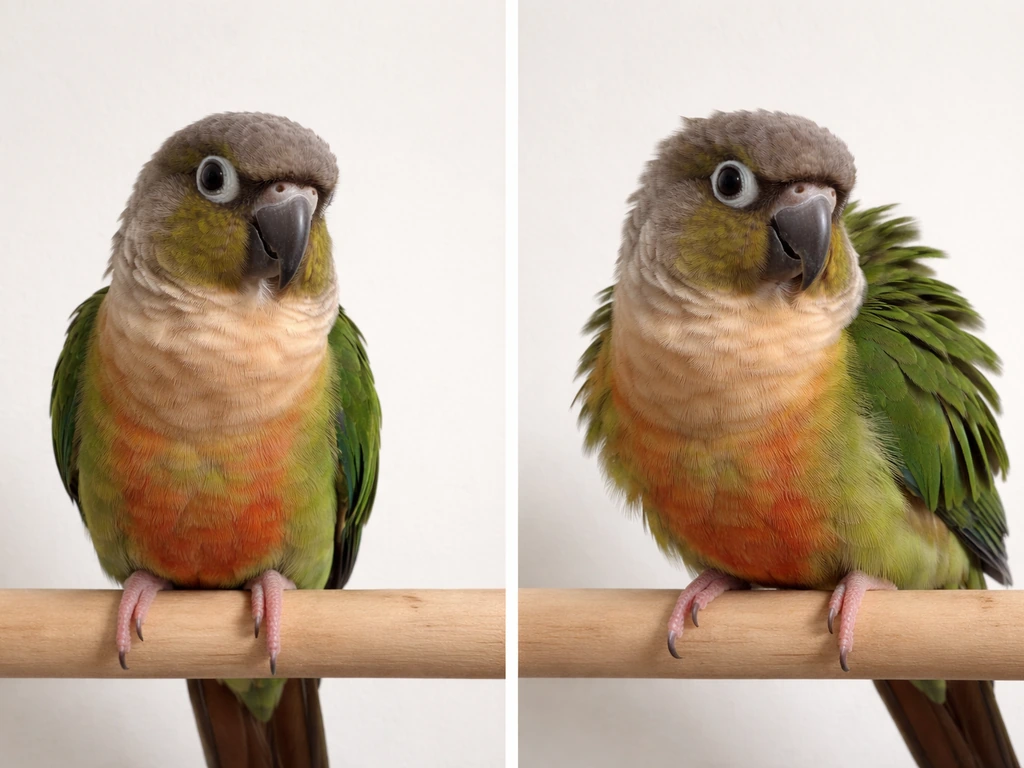
A relaxed conure will have its feathers lying smoothly, eyes soft, and body posture upright but not rigid. The moment things shift, pay attention. Fear signals include leaning away from you, feathers pulled tight against the body, a low crouch, wide open eyes scanning for an escape, and sometimes an open beak. Aggression looks different: feathers puffed around the head and shoulders, wings slightly out, tail fanned, and eye pinning (the pupil rapidly dilating and constricting). Eye pinning in a handling context is a reliable warning that a bite is coming, so treat it as a stop sign, not a green light to push through.
Feather fluffing can be a threat display, making the bird look bigger, but it can also just mean your conure is cold or sleepy, so context matters. If you're mid-session and the feathers puff, the eyes pin, and the body stiffens, stop the interaction, give the bird space, and end on a neutral note. Biting and lunging in most conures is a stress or fear response, not deliberate aggression, and forcing through it almost always makes the problem worse.
Temperament and safety basics
Sun conures and green cheek conures are probably the two species most people are working with, and they share a lot of traits: loud, curious, nippy when young or under-socialized, and incredibly affectionate once bonded. Sun conures in particular are naturally vocal. Their high-pitched calls function as flock-contact signals, meaning a conure that screams when you leave the room is doing something biologically normal, not just being difficult. Understanding that shifts how you respond.
For safety: always close windows and ceiling fans before bringing a conure out. Never train near a hot stove or other birds that could trigger fear. Trim nail tips if your bird's grip is drawing blood during step-up practice, but avoid over-clipping wings as this can damage confidence and balance, which actively hurts training. If you ever see feather-destructive behavior, significant feather loss, or self-mutilation, treat it as a medical concern first before assuming it's a training or behavioral problem, because birds hide illness signs and chronic stress can manifest physically.
How to build a humane training plan
Good training is designed before you ever walk up to the cage. You need a clear goal for each session, a predictable schedule your bird can start to anticipate, and the right supplies on hand so sessions run smoothly.
Set your goals and schedule
Pick one skill per week to focus on, especially at the beginning. Trying to teach step-up, recall, and perch tolerance all at once fragments your sessions and confuses the bird. For a brand new conure, the first goal is simply comfort with your presence and hand. Sessions should run 5 to 10 minutes maximum, once or twice a day. Conures have good attention spans for parrots, but they tire of repetition quickly. Stop while the bird is still engaged, not after it has started ignoring you.
Supplies you actually need
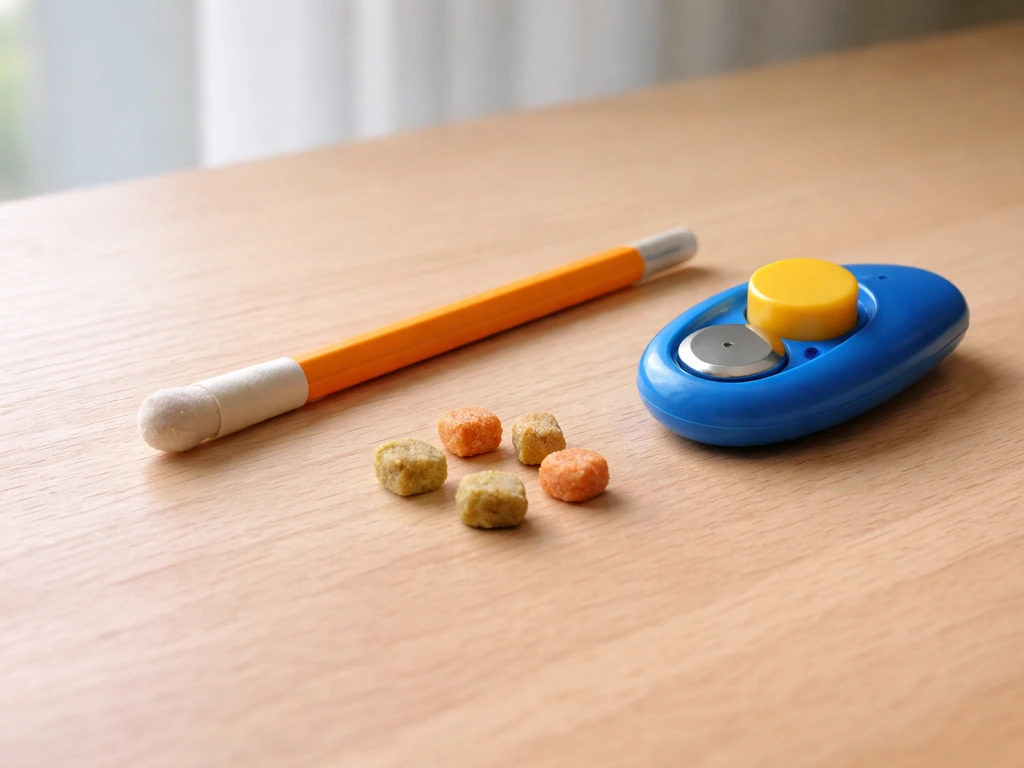
- A target stick: a chopstick or a pencil with a small ball of tape on the end works perfectly
- A clicker or a consistent verbal marker like a short 'yes' said the same way every time
- High-value training treats: small pieces of nutrient-rich food your conure loves but doesn't get free access to (pine nuts, a tiny piece of almond, a berry, or a bit of nutrient-dense pellet)
- A flat, calm training surface away from the cage, ideally a T-perch or tabletop perch
- A small notebook or phone note to track what you worked on, what the bird's response was, and where you stopped
On the clicker: a clicker is a better marker than your voice for new behaviors because it's consistent. Your voice changes pitch and tone depending on your mood, while the clicker sounds exactly the same every time, making it an unambiguous signal to the bird that the treat is coming. Once behaviors are well-established, you can phase into a verbal marker if you prefer, but start with the clicker.
Building real trust before you ask for anything
Rushing into commands with a bird that isn't comfortable with you is the single most common mistake new conure owners make. Spend the first few days or even weeks just being present. Sit near the cage, talk quietly, offer treats through the bars without expecting the bird to come to you, and let the conure dictate the pace. Trust is a prerequisite, not a luxury.
- Sit near the cage daily for 10 to 15 minutes without attempting to handle the bird. Let it observe you.
- Offer a high-value treat through the bar or from your open palm held near the door. Don't push your hand in. Wait.
- When the bird eats from your hand without retreating, hold the treat closer each session so it has to lean toward you slightly.
- Once the bird is relaxed eating from your palm, open the cage door and let it come to the threshold on its own.
- Only move to handling after the bird is voluntarily approaching you and showing relaxed body language: smooth feathers, calm eyes, normal posture.
Some conures move through these steps in three days. A bird that was poorly socialized or had a bad experience may take three weeks. Neither timeline is wrong. What you're building here is a bank of positive associations, and every good interaction makes the next one easier. If you also keep other small hookbills, it's worth knowing that the trust-building process for parakeets follows a very similar pattern, so the patience you practice here transfers across species.
The core skills every conure should learn
Step-up
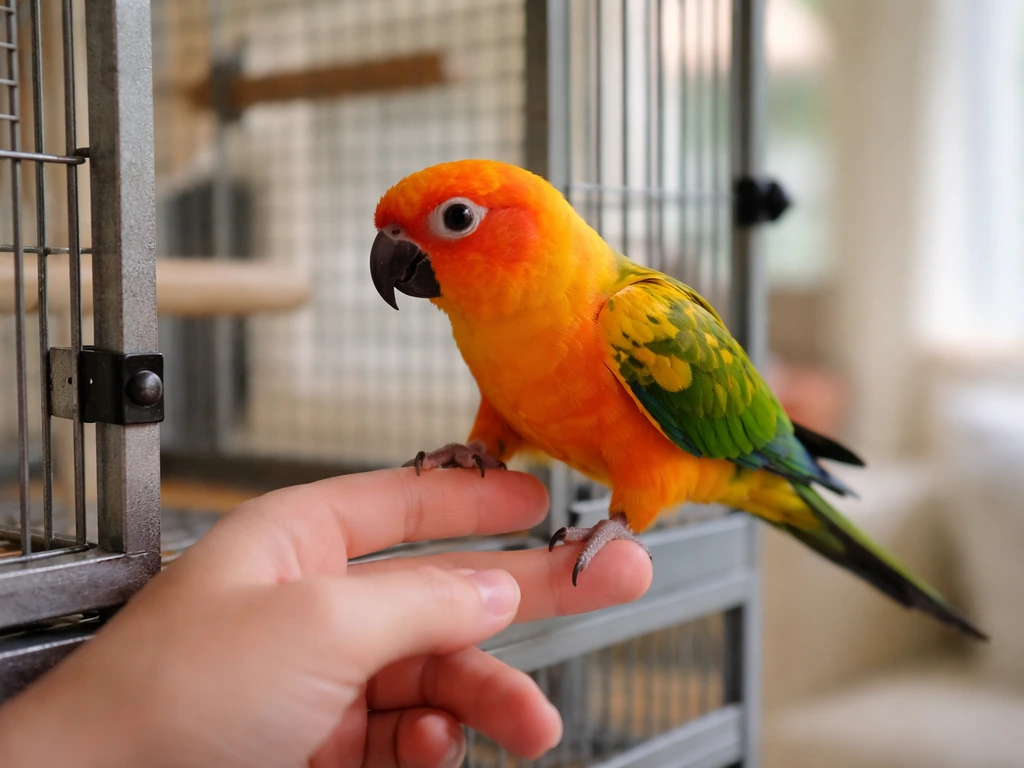
Step-up is the foundation of everything else. It's how you safely move your bird, how you build handling confidence, and how you establish a cooperative relationship. The mechanics are simple: hold your index finger or hand horizontally against the bird's lower chest, just above its feet, and say 'step up' in a calm, consistent tone. Do not shove your hand at the bird. Place it gently in front of and slightly below the feet so the bird's instinct is to step up rather than back away. Then wait. Mark the moment a foot lifts with your clicker and reward immediately. Forcing a bird to step up is one of the fastest ways to get bitten, and it damages trust significantly. If the bird steps back or leans away, remove your hand, pause, and try again in 30 seconds.
Comfort with step-up may come in one session or it may take several, and that's completely normal. Practice step-up from the perch to your hand, hand to perch, and eventually from the cage to your hand. Each direction is a slightly different behavior in the bird's mind, so reinforce them separately.
Target training
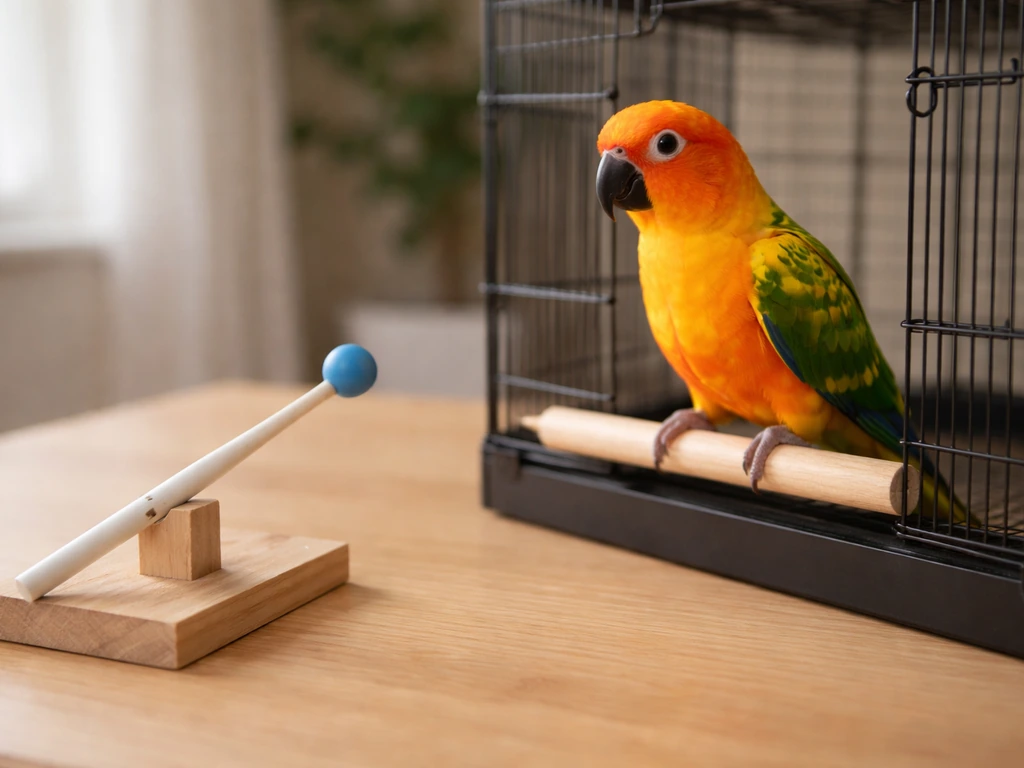
Target training teaches your conure to touch its beak to the end of a stick on cue. Target training typically starts by pairing the click or marker with a reward, then gradually teaches the bird to touch a target object or stick, and finally moves the target to shape follow behavior Target training teaches your conure to touch its beak to the end of a stick on cue.. It sounds simple, but it's one of the most powerful tools in parrot training because you can use it to guide the bird anywhere, teach it to move between perches, and build the foundation for recall. Present the target stick slightly in front of and below the bird's beak so it only has to make a small movement to touch it. The instant the beak makes contact, click and treat. Repeat until the bird is deliberately seeking the target. Then start moving it so the bird has to take a step to follow it. Keep each 'step' small and achievable, always marking contact and rewarding immediately.
Recall and return
Recall is teaching your conure to fly or walk to you on cue. Start at close range, just a few inches, using the target stick or your hand as the destination. Say a consistent recall word ('come,' 'here,' or whatever you'll remember to use every time), present the target or hand, and reward arrival every single time, no exceptions. Gradually increase distance as the bird becomes reliable. Recall is a safety skill, and you want it to be strongly reinforced, which means using the highest-value treat in your kit every time the bird returns on cue.
Perch tolerance and station training
Perch tolerance means your conure can sit calmly on a designated perch while you move around it, step away, and return without the bird panicking or flying off. This is also called station training. Place the bird on a T-perch or training perch, reward it for staying, and then take one small step back. Return and reward. Gradually increase the duration and distance before you return. A bird with a reliable station is calmer during vet visits, easier to manage during out-of-cage time, and less prone to screaming when you leave the room because it has learned that your return is predictable and worth waiting for.
Positive reinforcement methods that actually work for conures
Conures respond best to reward-based training, full stop. Punishment, including shouting, spraying with water, and covering the cage as a consequence, does not teach the bird what you want it to do. It teaches the bird to fear you and your hands, which is the opposite of what training requires. Stick to reinforcement.
Choosing and managing treats
The treat has to matter to the bird. If your conure will eat something out of the food bowl all day, it's not a high-value training treat. Reserve the best stuff exclusively for training: a small pine nut, a tiny piece of almond, a raspberry, or a fragment of a nutrient-dense pellet your bird particularly likes. Keep training pieces tiny, about the size of a pea or smaller, so the bird stays motivated without filling up. As behaviors become reliable, you can start varying the reward schedule, rewarding every other correct response, then every third, to build durability. This gradual shift away from constant treats is how you keep behaviors working long-term without a treat in your hand at all times.
Timing your marker
The clicker or verbal marker bridges the gap between the behavior and the treat. It has to land at the exact moment the desired behavior happens: the instant the foot lifts for step-up, the instant the beak touches the target. A marker that comes a second late tells the bird something different from what you intended. Practice your click timing away from the bird first if you need to, by clicking the moment a bouncing ball hits the floor or the moment a word appears on a video. Precision here speeds up learning dramatically.
Cue development
Introduce a verbal or hand signal cue only after the bird is reliably offering the behavior. Say or show the cue, wait for the behavior, then mark and reward. If you add the cue too early, before the behavior is consistent, you just end up with a meaningless word that the bird ignores. Once the cue is established, use it consistently and make sure everyone in the household uses the same word and gesture. Mixed signals from different people slow learning and confuse the bird.
Troubleshooting the problems that stall training
Most training problems in conures come down to one of four things: the bird is scared, it's in hormonal season, it's been accidentally reinforced for a bad behavior, or something in the environment is causing chronic stress. Identifying which one you're dealing with changes what you do next.
Biting and nipping
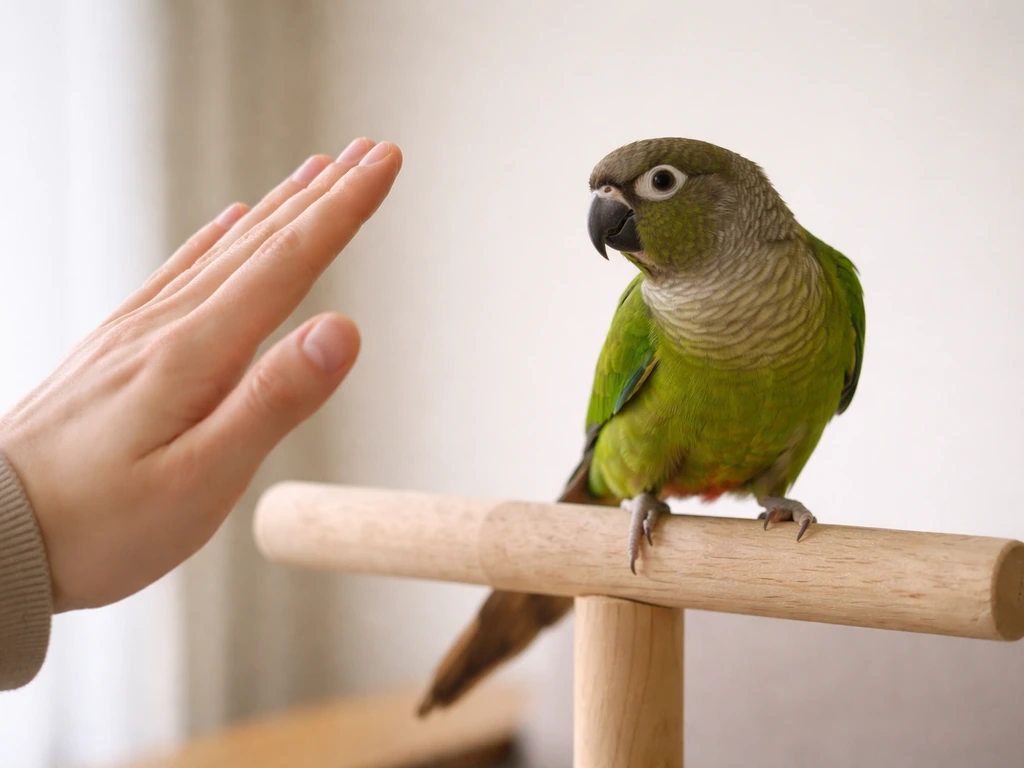
Conure bites during handling are almost always fear-based or a response to being pushed past a comfort threshold. Go back and check your body language checklist: was the bird showing stress signals before the bite? If yes, the solution is to reduce pressure, shorten sessions, and rebuild comfort at a lower level of difficulty. If the bird bites specifically when you try to return it to the cage, it may have learned that biting keeps the out-of-cage time going, which is an accidental reinforcement problem. The fix is to make returns predictable and rewarding: offer a treat the moment the bird steps back onto the cage perch.
Fear and refusal to engage
A bird that freezes, retreats to a corner, or refuses to eat treats in your presence is telling you the trust level isn't there yet. Don't interpret this as stubbornness. Go back to passive presence sessions: sit near the cage, don't attempt interaction, and let the bird acclimate to you at its own pace. You can also try counter-conditioning by placing a treat on a flat surface near you and letting the bird choose to approach. This approach is very similar to what works well when building trust with budgies, where slow, voluntary approach almost always outperforms forced handling.
Screaming
Conures scream. That's not a problem to eliminate entirely, it's biology. What you can address is excessive screaming that's driven by stress, boredom, or learned attention-seeking. First, rule out a welfare issue: is the bird getting enough out-of-cage time, social interaction, and mental enrichment? If not, fix the environment before trying to train around the symptom. For attention-seeking screaming, the rule is simple and hard to follow consistently: do not return to the room, do not look at or talk to the bird while it's screaming, and do reward quiet behavior with calm attention. Reinforce any pause in the screaming, even a two-second one, and build from there. If screaming is accompanied by other stress signs, it may also be worth checking whether hormonal changes are a factor, since conures going through breeding season can show intensified screaming and aggression that's hormonally driven rather than a training problem.
Aggression and over-stimulation
Over-stimulated conures can flip from playful to biting in seconds. Watch for the warning signs: rapid eye pinning, tail fanning, wings held slightly out from the body, feathers puffing at the head. When you see those, end the interaction before the bite happens. Put the bird back on its perch calmly and without making it a big event. Over time, you can work on extending the bird's tolerance for handling by keeping sessions below the stimulation threshold. The goal is never to push the bird to its limit but to stop just before it and build from there incrementally.
When to check with a vet
If your conure suddenly shows new behavior problems (biting when it didn't before, screaming much more than usual, feather picking, lethargy, or appetite changes) and training adjustments aren't helping, get a vet check before doing anything else. Birds are experts at masking illness, and what looks like a behavior problem can actually be pain or disease. An avian vet exam is the right first step when something feels off. This is also true for training plateaus that come out of nowhere after a period of good progress.
How to compare conures to other small parrots for training
If you've trained other small birds before and want to calibrate your expectations, this table gives you a quick comparison of how conures stack up against a few common species across key training dimensions.
| Species | Typical trainability | Bite risk during training | Vocal during sessions | Treat motivation | Trust timeline |
|---|---|---|---|---|---|
| Conure | High, motivated and social | Moderate, reads body language carefully | High, contact calls and screaming common | Very high for novel/reserved treats | Days to weeks depending on history |
| Budgie | High, quick learners | Low, bites are usually light | Moderate, chatty but not piercing | Moderate, millet is reliable | Days to weeks |
| Canary | Lower, more independent | Very low | High singing, less contact-call focused | Lower treat drive generally | Weeks to months |
| Finch | Lower, not naturally handleable | Very low | Moderate, softer vocalizations | Seed-motivated but less interactive | Months, if at all |
The trainability difference between conures and finches is significant. If you want to go deeper on any of these species, it helps to understand their specific motivations and limits. Training finches is a fundamentally different project from working with a conure, focused more on habituation than active skill teaching. Canaries sit somewhere in between: the approach covered in a canary training guide leans heavily on environmental conditioning rather than hands-on command work.
Your practical training plan: what to do daily and weekly
Here's how to structure the first four weeks so you're making real, measurable progress without overwhelming your bird.
| Week | Daily focus | Goal by end of week | Watch for |
|---|---|---|---|
| Week 1 | Passive presence + treat through bars | Bird takes treat from open palm without retreating | Fear signals, refusing treats, hiding |
| Week 2 | Hand presence near open cage + target introduction | Bird touches target reliably 3-5 times per session | Over-stimulation, biting at target stick |
| Week 3 | Step-up practice + target movement | Bird steps up on cue 3 out of 4 attempts | Biting during step-up attempts, reluctance |
| Week 4 | Station perch tolerance + short recall | Bird stays on station 15-30 seconds and returns on cue | Screaming when left on station, flight off perch |
Tracking progress simply
You don't need a complex spreadsheet. After each session, note three things: what you worked on, what the bird's response was (willing, hesitant, or avoidant), and where you stopped. If the bird is hesitant two sessions in a row, that's your signal to dial back difficulty. If it's succeeding easily for three sessions in a row, that's your signal to raise the challenge slightly. Progress in parrot training is not linear, and a bad day after a great week is normal, not a failure.
When to bring in professional help
If after six to eight weeks of consistent, welfare-first training you're still dealing with biting that draws blood regularly, severe fear responses that aren't improving, feather-destructive behavior, or a bird that won't engage with you at all, it's time to get help from a certified parrot behavior consultant or an avian behaviorist. These professionals can observe your bird in real time, identify triggers you might be missing, and give you a customized plan. A referral from your avian vet is usually the best way to find someone qualified. Don't wait until problems are deeply ingrained: the earlier you bring in support, the faster things turn around.
Training a conure takes consistency more than it takes skill. Show up daily, keep sessions short and positive, read the body language, and let the bird's comfort drive the pace. The birds that end up nippy, fearful, or screaming constantly almost always got there because someone pushed too hard too fast. The ones that become confident, bonded companions are usually the result of an owner who was patient enough to let trust develop on the bird's terms. Start there, and everything else in this guide will fall into place.
FAQ
My conure is biting right away when I reach in. Should I begin with step-up anyway?
If your conure is new to you, start with “presence sessions” (sit near the cage, talk softly, offer treats through the bars) for a few days before asking for step-up. In the first week, keep hands mostly still and low to the perch, so your bird learns that your body movements are predictable and nonthreatening.
What should I do if my training session goes badly halfway through?
Yes, but don’t force a calendar. If your bird shows stress signs, end early and return later that day or the next morning with the same lower-level goal. Two short, calm sessions that end before overstimulation often work better than one long session that triggers avoidance.
My bird freezes or leans away during step-up. How do I get started without making it worse?
For step-up, a brief, gentle pause is better than pushing through. Place your finger or hand at the correct height, wait for even a partial forward shift, then mark and reward. If the bird leans away or stiffens, remove your hand, give space, and try again after about 30 seconds.
When do I introduce the verbal “step up” or “target” cue?
Yes, but only once the behavior is consistent. If you add a verbal cue before the bird reliably touches the target or steps up on your hand, the word becomes noise and can slow learning. Start by marking every correct response, then gradually pair the cue right before you expect the behavior.
How do I know if my treat is actually working for training?
Use a high-value treat even if your bird eats casually all day. The key is that training pieces should be small and offered only during learning. If your conure loses interest, swap to a different preferred item (for example, a tiny favorite pellet fragment) rather than increasing portion size.
My conure bites specifically when I try to put it back in the cage. Why and how do I prevent it?
If the bird bites while trying to return to the cage, fix the routine, not the bird. Return attempts should be predictable and paired with an immediate reward after step-in. You can also practice “station training” first, so out-of-cage time ends in a calm, rehearsed sequence rather than a rushed grab-and-return.
My clicker feels late or early. How can I improve timing quickly?
Clicker timing matters, but you can troubleshoot it. If you struggle, click practice away from the bird until you can reliably mark the exact moment of contact (for example, the instant your fingertip taps a surface). Then resume training with the same criterion, mark once, and reward.
How should I practice recall if I’m afraid my bird won’t come back?
For recall, don’t train it like a one-time obedience drill. Always start at very short distance, reward on every correct return, and keep the bird’s route low-pressure (no chasing, no verbal scolding). Once it’s reliable, you can increase distance and only later add distractions.
What are the most important signs that I should end training to prevent a bite?
Body-language problems are often the cue that you are asking for too much too soon. Rapid eye pinning, tail fanning, and a stiff body mean the session should end immediately, then rebuild at a lower difficulty level. The goal is to stop just before the bite, not to “wait and see.”
Do conures become harder to train during hormonal season, and should I change my plan?
Yes, but treat hormonal changes as a training condition, not a failure. During breeding season, shorten sessions further, reduce handling pressure, and focus on station and target work that the bird can do calmly. If aggression escalates suddenly, pause skill training and get an avian vet check if anything feels off physically.
My conure screams when I leave. How do I reduce the screaming without making it worse?
Don’t cover the cage or punish yelling, that usually teaches fear or attention-seeking. Instead, keep the environment meeting their needs, then reinforce quiet moments with calm attention, and gradually shape shorter, less intense screaming intervals. Consistency matters, so use the same response every time.
When should feather picking or behavior changes be treated as a medical issue instead of a training issue?
If feather destructive behavior or sudden appetite or energy changes appear, it may be medical or stress-related. Remove the assumption that it is purely behavioral, schedule an avian vet visit, and only then adjust training. Birds often hide illness, so “it’s just behavior” is a risky default.
How do I know it’s time to bring in a parrot behavior consultant?
Get help earlier if progress stalls even while you’re staying consistent and welfare-first. Signs that warrant outside guidance include repeated blood-drawing bites, severe fear that does not soften over weeks, or refusal to engage at all. A qualified parrot behavior consultant can observe triggers you might not notice and revise the plan.
Next Articles
How to Train Finches: Step-by-Step Taming and Behaviors
Welfare-first step-by-step finch training: taming, step-up and target cues, reduce fear, stress, and setbacks with safe
How to Train Canary Bird: Step-by-Step Trust and Cues
Step-by-step, welfare-first canary training: trust, step-up, simple targets, positive rewards, and fixes for biting or f
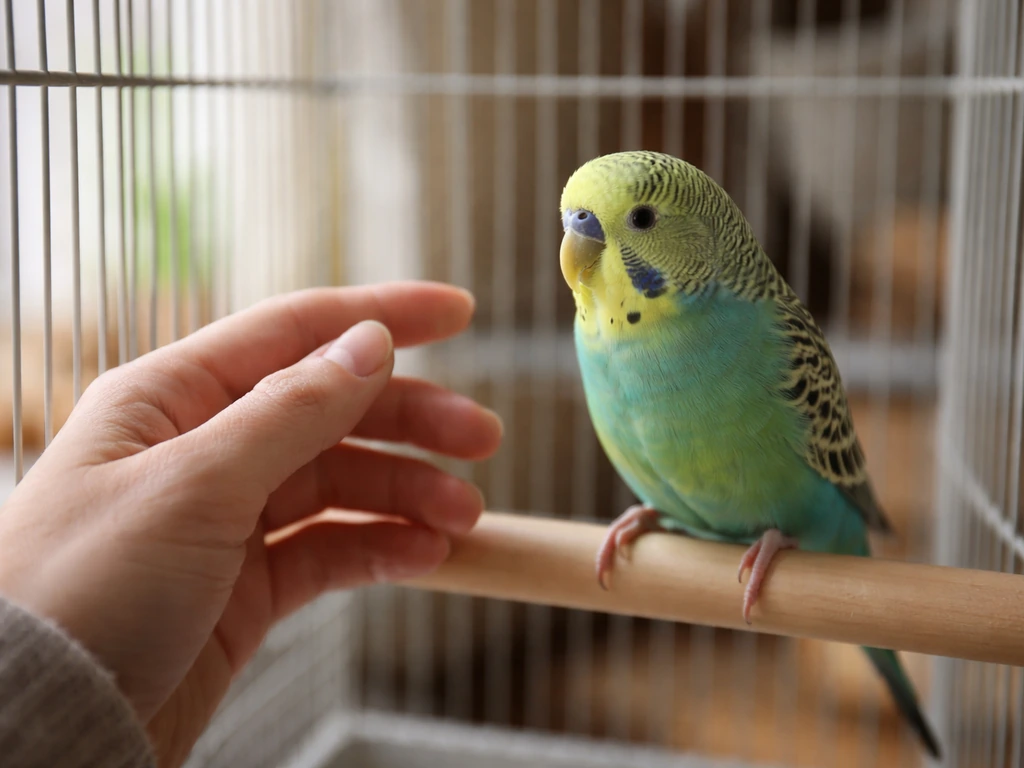
How to Train a Budgie Bird: Step-by-Step Beginner Guide
Step-by-step, welfare-first budgie training for bonding, calm handling, step up, and target cues with safe tips and trou