You can train a budgie to step up, come when called, and sit calmly on your hand, and you can start today. The process is not complicated, but it does require patience, consistency, and a genuine respect for what your bird is communicating. Budgies are smart, social, and highly trainable when you work with their instincts instead of against them. This guide walks you through everything: environment setup, hand-taming, teaching core behaviors, running proper positive reinforcement sessions, and handling the problems that most people run into along the way.
How to Train a Budgie Bird: Step-by-Step Beginner Guide

Maya Harris
2 Apr 2026
What budgie training actually means
Training a budgie is not about tricks for their own sake. At its core, it is about building a relationship where your bird is comfortable with you, can communicate clearly, and can participate in their own care without chronic stress. For most people, that means three things: earning trust so your bird chooses to be near you, teaching practical behaviors like stepping onto your hand, and creating a shared language using cues your bird can understand and respond to predictably.
Budgies are prey animals, which means their default response to something unfamiliar is avoidance or alarm. This is not personality failure. It is survival wiring. What you are doing through training is showing your bird, repeatedly and reliably, that you are not a threat and that interacting with you predicts good things. Once that foundation exists, you can build on it almost indefinitely. Some budgies learn dozens of cues. Others are happiest with just a calm step-up and daily handling. Both outcomes are completely valid.
Get your setup right before you start
A lot of training failures happen before a single session runs because the environment is not working in your favor. Before you introduce any deliberate training, spend a few days optimizing the space your budgie lives in.
Cage placement and perch positioning
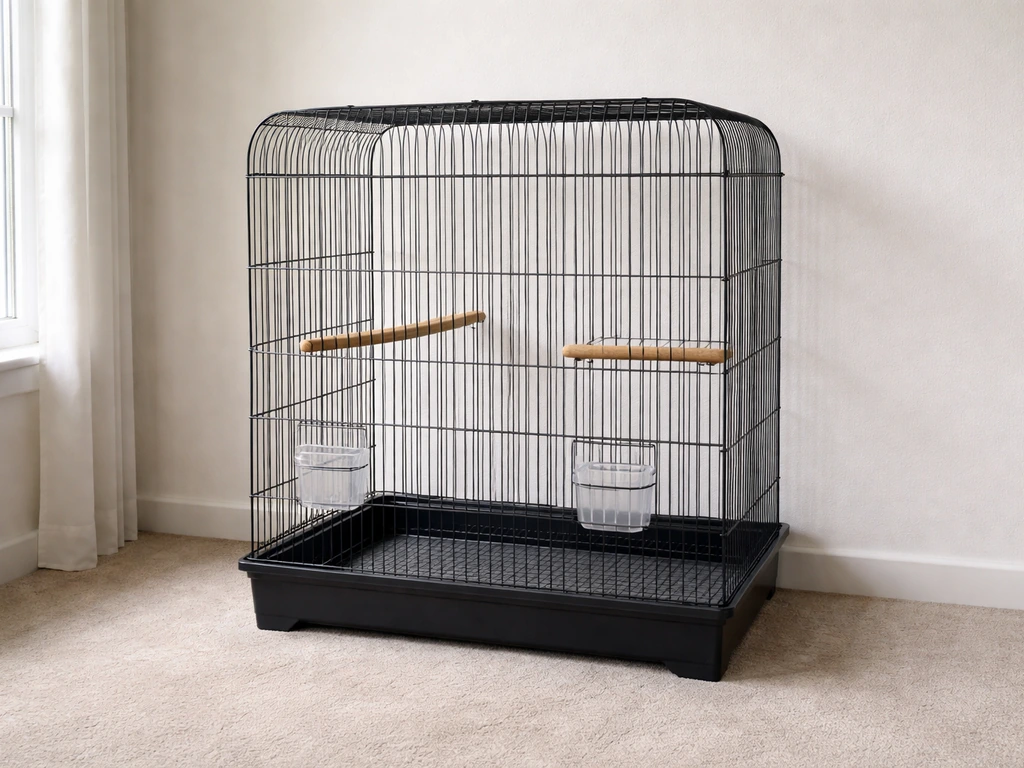
Place the cage at roughly eye level in a room where your bird can observe household activity without being in the middle of it. Avoid drafty spots, direct heavy sun exposure, and locations near the kitchen (cooking fumes, including from non-stick cookware, are toxic to birds). Perches should be positioned so your bird can move between levels easily. Vary perch diameters (natural wood perches work well) to keep feet healthy. Leave open space in the cage for movement rather than stuffing every corner.
Routine, rest, and noise
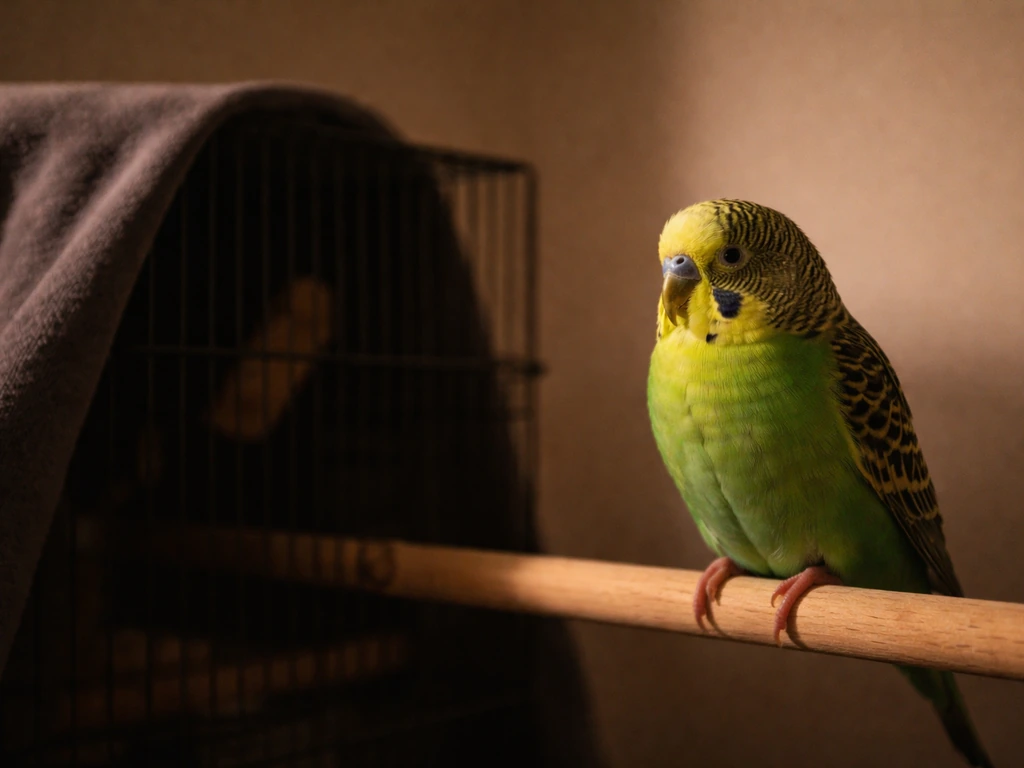
Budgies gain real security from a predictable daily routine. Consistent feeding times, a regular sleep schedule of around 10 to 12 hours in a dark, quiet space, and a familiar environment help reduce baseline stress, which directly improves your bird's readiness to engage with training. Noisy or chaotic environments keep budgies on edge and make learning harder. Controlled lighting and keeping loud sounds away from the training area also supports calmer handling, which aligns with humane handling principles that use species-specific sensory considerations to reduce stress.
Treat selection
Treats need to be small, immediate, and genuinely motivating to your bird. For most budgies, a small piece of millet spray is highly effective. You can also use tiny pieces of their favorite seed or a fragment of a leafy green they enjoy. Keep portions very small so your bird stays hungry enough to stay motivated across a session.
On the food safety front: avoid avocado, chocolate, onion, garlic, alcohol, mushrooms, rhubarb, caffeine, and high-calorie processed foods entirely. Lafeber’s “Unsafe Foods For Birds” also warns to avoid chocolate and avocado, along with other high-risk items like garlic and onion [avoid avocado, chocolate, onion, garlic, alcohol, mushrooms, rhubarb, caffeine, and high-calorie processed foods entirely. ](https://lafeber. com/vet/wp-content/uploads/Unsafe-Foods.
pdf). These can cause serious illness or death in birds. Stick to known-safe, bird-appropriate foods.
Safety basics
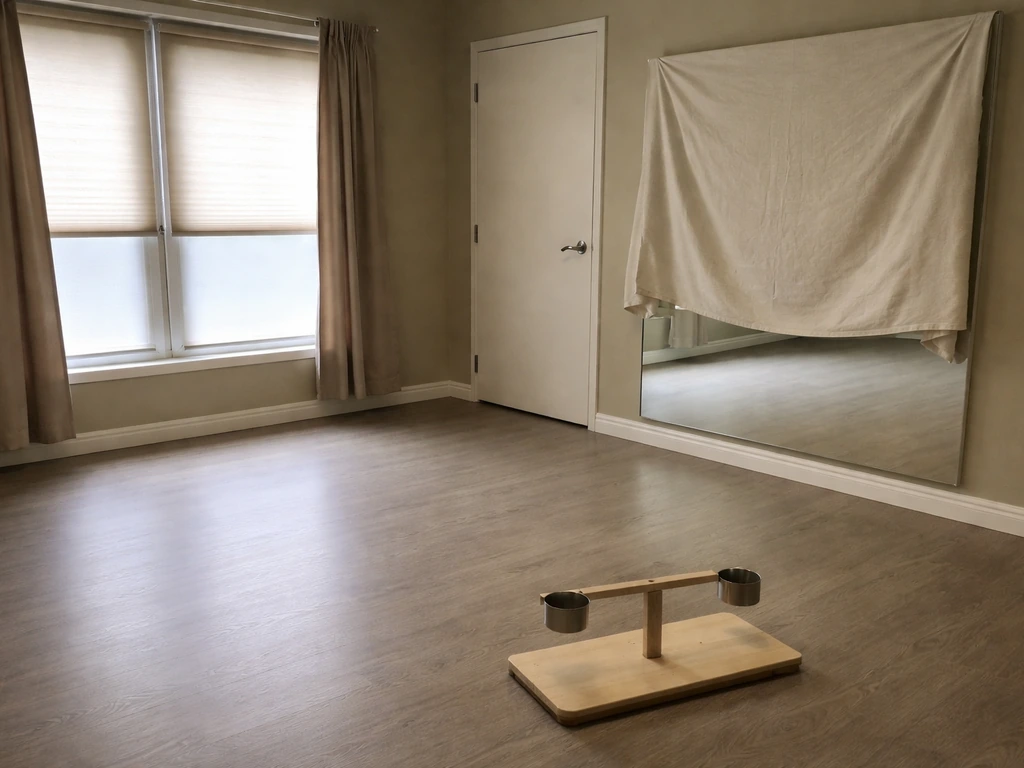
Before any out-of-cage training session, close windows and doors, cover mirrors, and remove other pets from the room. Clip wings only if you have discussed it with an avian vet and understand the implications. An unclipped bird can fly off during early training, but wing clipping has welfare trade-offs and is not required for successful training. If you are unsure, leave wings intact and keep sessions to a small, contained room.
Hand-taming and bonding: from nervous to comfortable
Hand-taming is the foundation of everything else. Do not skip or rush this phase. A budgie that tolerates your hand but is visibly tense is not ready for the next step. You are aiming for a bird that is calm, curious, and approaches you voluntarily.
- Spend time near the cage without interacting. Sit beside it, talk softly, read aloud, or watch TV nearby. Let your bird get used to your presence as a non-threatening constant.
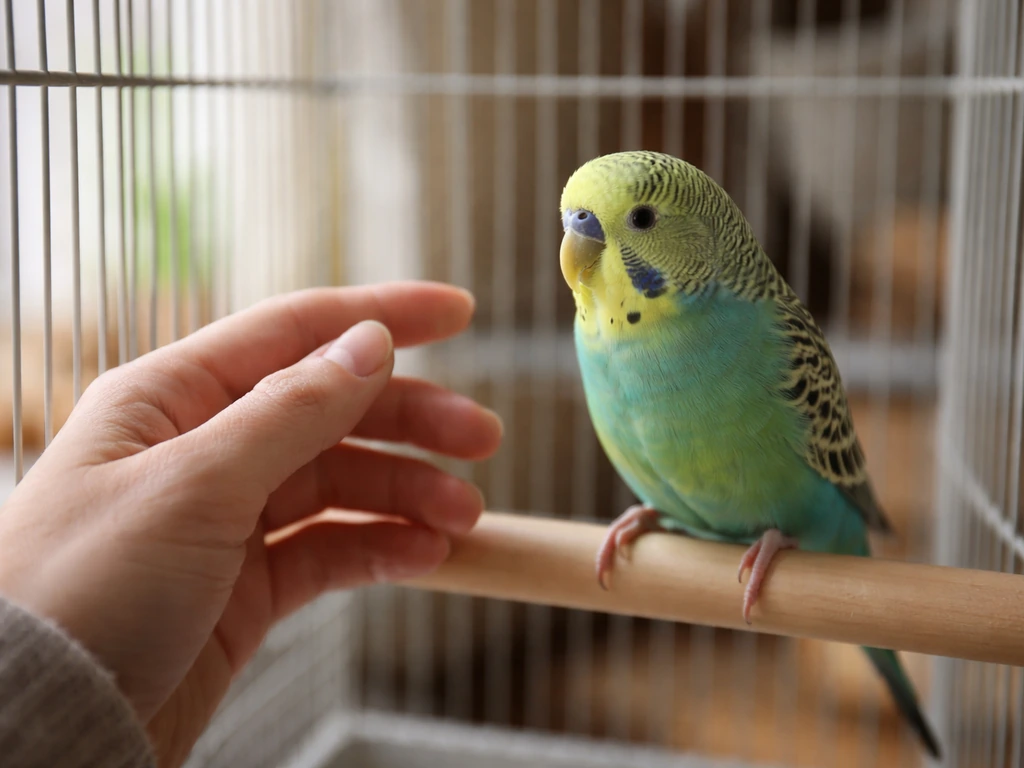
- Introduce your hand at cage level. Rest it near the cage bars without reaching in. Let your bird approach the hand on their terms. Do not jerk away if they come close.
- Begin offering treats through the bars. Hold a piece of millet between your fingers and wait. The moment your bird takes it, that is a win. Repeat this multiple times before moving on.
- Move treat delivery inside the cage. Open the door and hold the treat just inside, low and still. Keep your movements slow and predictable. Avoid looming over the cage from above.
- Progress toward placing the treat on your palm. This encourages your bird to land on your hand to eat. Do not force or grab. Just wait.
- Once your bird steps onto your hand for a treat reliably, begin practicing short, calm handling: a minute of sitting on your hand, then back to the perch. Build duration gradually.
- Reinforce every calm interaction. Your bird sitting on your shoulder, investigating your sleeve, or eating from your palm all count as progress.
Watch your bird's body language throughout. Fluffed feathers, rapid breathing, open beak without vocalizing, and trembling are all distress signals. If you see them, end the session immediately, give your bird space, and back up a step in your progression. Never push through obvious fear responses. Doing so does not build resilience; it builds distrust.
Teaching step up, target training, and recall
Step up
Step up is the single most practical behavior you can teach a budgie and the one that makes daily care much easier. Once your bird is comfortable sitting on your hand for treats, you can introduce the cue. Hold your finger or hand just below your bird's chest, lightly pressing against the lower belly or legs (this triggers a natural stepping reflex). Say "step up" in a calm, consistent tone at the moment you present your hand. The second your bird steps on, mark the behavior (more on marker training below) and deliver a treat. Never force a parrot onto your hand or lunge at them; that shortcut creates the exact fear you are trying to avoid.
Practice step-up in short bursts of three to five repetitions, then end on a good one. Progress to asking for step-up from different perches, from the cage door, and eventually from a distance. Consistency in the verbal cue matters: use the same phrase every time and make sure everyone in the household does too.
Target training
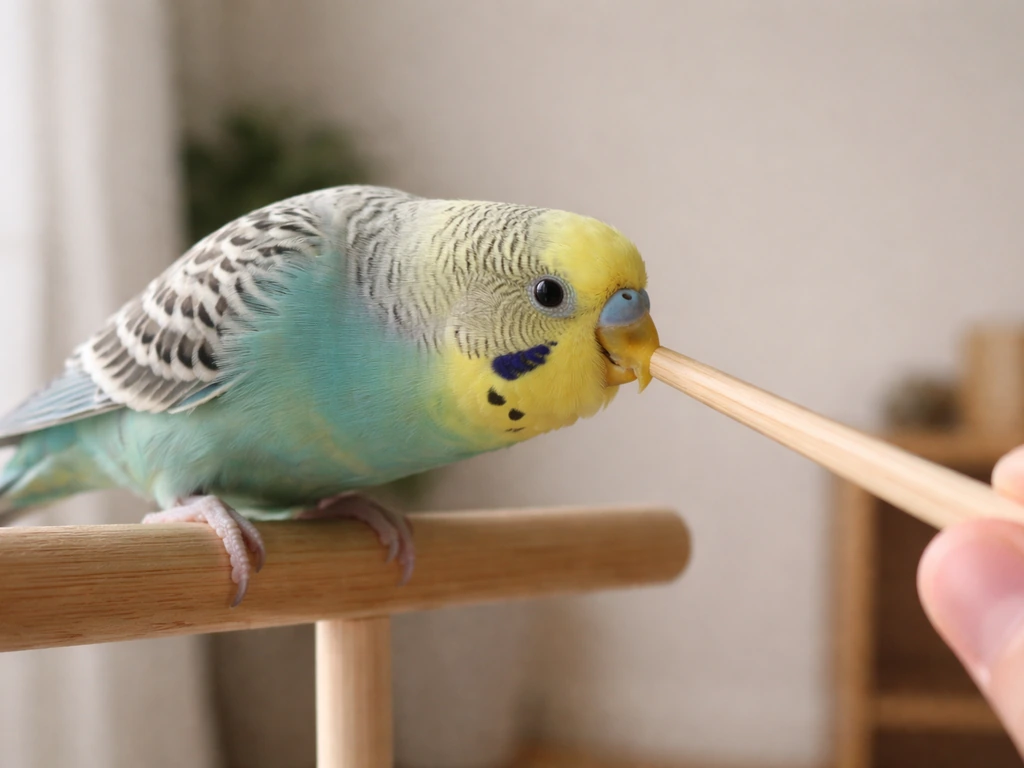
Target training is teaching your bird to touch a specific object (usually a chopstick or the eraser end of a pencil) with their beak. It sounds simple but it is a powerful tool. It lets you guide your bird's movement without physical contact, which is helpful for birds that are still nervous about hands. Hold the target near your bird, and the moment they touch it with their beak (even sniffing it counts at first), mark and reward. Gradually ask your bird to move toward the target, then follow it short distances, then fly to it from a perch. Once your bird understands targeting, you can use it to teach almost any other behavior.
Recall (come when called)
Recall means your bird flies to you on cue. This is useful for safety and for daily interaction. Start with very short distances: your bird on a perch, you a foot or two away, your hand or target extended, and your recall cue (a specific word or whistle) delivered clearly. The moment they fly to you, mark and reward generously. Over many sessions, increase the distance. Only introduce recall in a fully secured room and do not rush it. A bird that has a solid step-up and basic target skill will learn recall much faster.
Running positive reinforcement sessions the right way
blank" rel="noopener noreferrer">Positive reinforcement means your bird gets something they value immediately after they perform the behavior you want. The value of the reward is what drives the learning. Punishment (including yelling, forceful restraint, or flicking) is not recommended and should not be used. Beyond being unkind, it can damage the bond you are building and increase fear, stress, and the risk of injury. There is no upside.
Using a marker
A marker is a sound (a click from a small clicker, or a consistent word like "yes") that tells your bird the exact moment they did the right thing. The marker acts as a bridge between the behavior and the treat delivery, which is important because it can take a second or two to get the treat to your bird.
The marker must be paired with the reward consistently until your bird understands that the sound means a reward is coming. Then, when you click or say "yes" at precisely the right moment, your bird gets clear information about what earned the reward. Timing is everything here. A well-timed click is a precise teaching tool.
A late or random one is confusing noise.
Session length and pacing
Keep sessions short. Two to five minutes per session is enough for most budgies, especially early in training. End the session just as your bird's interest starts to wane, not after they have already checked out. A bird that ends a session still slightly interested will come back eager next time. A bird that ends a session bored or frustrated will be harder to re-engage. Aim for two or three short sessions per day rather than one long one. Always end on a successful repetition and return your bird to their cage with a positive reinforcement routine, never by chasing or grabbing.
Common reinforcement mistakes
- Rewarding after a long delay: the treat must follow the marker within a couple of seconds or the connection is lost
- Using treats that are not actually motivating to your specific bird: test a few options and watch which one gets the biggest response
- Running sessions when your bird is tired, unwell, or just finished eating a large meal
- Progressing too fast: if success rate drops below about 80%, go back one step
- Inconsistent cues: using different words for the same behavior confuses the learning
- Forgetting to end on a win: always close on a behavior your bird can succeed at easily
When things go wrong: biting, fear, and setbacks
Every trainer hits rough patches. The important thing is diagnosing what is actually happening before deciding how to respond.
Biting
Biting in budgies is almost always communicative, not malicious. It is most commonly triggered by fear, stress, territorial behavior, routine changes, poor sleep, frustration, or reproductive hormones. The bird is not being "mean. " They are telling you something.
When you get bitten, resist the urge to react dramatically (pulling away fast, yelling) because strong reactions can actually reinforce the biting by making it an effective way to end an uncomfortable interaction. Stay calm, move slowly, and back up in your training progression to find the point where your bird is comfortable again.
If biting is sudden and out of character, consider a vet visit to rule out pain or illness, both of which can cause a bird to bite who never did before.
Persistent fear and pacing
If your bird is consistently showing fear responses (retreating, pacing, fluffing, panting, or rapid breathing), do not push forward with training. Behavior problems frequently arise when handlers use coercion or fail to respect avian body language. Slow everything down, go back to basics, and consider whether something in the environment is causing chronic stress: too much noise, an inconsistent schedule, not enough sleep, or too many unfamiliar people. Desensitization and counter-conditioning (slowly pairing the scary thing with positive outcomes in tiny increments) are the right tools here, not more repetition of a behavior that already has fear attached to it.
Aggression
Territorial aggression is common around the cage, especially if your bird has claimed it as their territory. For some birds, step-up is easier to ask for away from the cage than at the cage door. Practice in neutral space first, then gradually work back toward the cage over time. Seasonal hormone changes can also cause temporary increases in aggression. Ride these periods out with patience, reduce handling pressure, and resume normal training when the hormonal phase passes.
Backsliding
Regression is normal and does not mean you have failed. Illness, a stressful event, a change in routine, or even a new piece of furniture in the room can send a bird back several steps. Treat backsliding exactly like you treated the original training: go back to the last point where your bird was confident, rebuild from there, and do not try to shortcut back to where you were. Skipping steps makes the problem worse.
When to call a vet
If your bird is showing labored breathing, open-mouth breathing with tail bobbing, persistent panting or trembling that does not resolve, or a sudden dramatic change in behavior, stop training and contact an avian vet. These are not training problems. They are medical problems that need professional attention. Training should only happen with a healthy, comfortable bird.
Pet budgie vs wild or rehomed bird: different goals, different approach
Pet budgies
If you have a hand-raised or captive-bred budgie, you are working with a bird that has at least some baseline exposure to humans. Even a shy or nippy pet budgie can be brought around with consistent positive reinforcement and patience. The full training pathway above applies. Your realistic timeline for a nervous pet budgie to become comfortable with handling is anywhere from a few weeks to a few months, depending on the bird's history and your consistency.
If you have a budgie that came from a previous home and may have had negative handling experiences, treat them like a wild-caught bird initially. Do not assume they will transfer their previous training or comfort level. Start from scratch with trust-building and let the bird show you when they are ready to progress. If you enjoy training multiple small birds, the same patient approach applies whether you are working on how to train a parakeet or tackling budgie-specific quirks, since the principles are nearly identical across closely related species.
Wild or found budgies
Wild-type budgerigars found outside (escaped pets or feral birds in regions where they exist) present a different situation. If the bird appears injured or is clearly a domestic escapee that cannot survive independently, contact a licensed avian wildlife rehabilitator rather than attempting to handle and train the bird yourself. Attempting improvised handling of wild birds without training can injure the bird and may expose you to legal issues depending on your location.
In the United States, many wild bird species are protected under the Migratory Bird Treaty Act, and handling them without proper permits is a federal offense. A wildlife rehabilitation permit does not automatically cover all activities, and federal authorization may be required for migratory species. If you are unsure whether a bird you have found is protected, contact your local wildlife authority or an avian rehabilitation center for guidance before doing anything else.
Imprinting risk in rehabilitation contexts
If you are involved in wildlife rehabilitation and working with young budgies or other species susceptible to imprinting, minimizing the number of people who handle the bird is important. Imprinting on humans reduces a bird's chance of successful release. Rehabilitators manage this deliberately by limiting contact and using methods that do not teach the bird to associate humans with food or safety. This is a specialized field, and if you are working in it, coordinating with an established avian rehabilitation center is strongly recommended rather than relying on general pet-training guidance.
How budgie training compares to other small birds
Budgies are among the most trainable small birds you can keep. They sit in a middle ground between highly social parrots that thrive on complex interaction and more independent species like finches. If you are also working with other species, the core positive reinforcement approach transfers well, though the specifics differ. Training finches requires a lighter touch and relies much more on environmental design than direct handling, since finches are not typically hand-tamed in the same way. On the other end of the scale, training a conure involves managing stronger personalities and louder vocal behavior, but the marker-and-reward mechanics are identical.
| Feature | Budgie | Canary | Conure |
|---|---|---|---|
| Trainability for handling | High | Low to moderate | High |
| Typical hand-taming timeline | Weeks to months | Months (often not achieved) | Weeks to months |
| Vocalization during training | Moderate, chatty | Song-focused, low interaction | Loud, expressive |
| Best for beginners | Yes | Yes (song, not handling) | Intermediate |
| Marker training response | Excellent | Limited | Excellent |
If you are curious about the differences, training a canary bird is a good read alongside this guide, particularly if you have both species and want to understand why the same approach that works brilliantly with a budgie may not translate directly.
Your practical starting point
Here is where to focus in your first week. Day one: do nothing except sit near the cage, talk softly, and let your bird observe you. Days two through four: offer treats through the bars and note which ones your bird responds to most. Days five through seven: begin marker conditioning by delivering a treat immediately every time you click or say your marker word, so your bird starts associating the sound with a reward. After that foundation, introduce your hand inside the cage and begin the hand-taming progression above. Most people try to rush to step-up in the first session. Resist that. The trust you build in this first week is what makes everything else work.
Budgie training is a process that rewards patience more than technique. You do not need expensive equipment, a large space, or prior experience. You need consistency, short focused sessions, accurate reward timing, and a genuine willingness to listen to what your bird is telling you. Get those things right and the behaviors will follow.
FAQ
My budgie won’t step up after a week, what should I change first?
If your budgie avoids your hand, you likely moved too fast or offered the cue in a stressful moment. Go back to treat delivery through the bars, then work up to your hand staying still at the same height for 2 to 3 minutes while the bird chooses to approach. Only raise the difficulty after your budgie shows relaxed body language (steady breathing, soft posture) while near your hand.
Should I use different words or whistles during training, or keep the same cue?
Start with one cue per behavior, not multiple words. For step-up, pick a single phrase and use it only at the moment you present your finger or hand. For recall, use one whistle or one word consistently. If you change cues mid-training, your bird may appear “confused,” even when the timing and rewards are correct.
Can I use praise instead of a clicker as the marker?
Choose a marker and stick to it. If you use a clicker, use the click every time, don’t mix it with random “good bird” praise at the exact same moment. If you use a word like “yes,” keep it clear, calm, and consistent in volume. Later you can add praise as a bonus, but the marker itself should stay precise and predictable.
How do I know when to stop a training session?
If the session ends with reluctance, end anyway once you notice attention fading, even if you planned “one more rep.” A good rule is to stop while the bird is still willing to take treats or look at you. Ending after the bird rejects contact increases stress and can slow progress for several days.
When is it safe to start practicing recall, and where should I do it?
For safety and clarity, use a training area without escape routes. If your bird is comfortable stepping up but not reliable flying to you, keep recall practice to short distances with a barrier or secured room and never call in an open, uncontrolled space. Also avoid recall during times your budgie is highly motivated to chase or escape.
Do I have to reward every step up forever, or can I reduce treats later?
Many budgies learn faster on an “access to treats” plan, where you offer small rewards after a calm response, then gradually space out treats as the behavior becomes consistent. Do not withhold treats entirely at first, and never switch from tiny, immediate rewards to large, delayed ones, because the learning link weakens.
What should I do if my budgie starts biting during training instead of stepping up?
If a bird targets you with head-bobbing, biting, or lunging during sessions, treat it as communication, not defiance. Pause the training, remove your hand from the bird’s space, and resume at the last step your budgie found easy (often targeting or taking treats). If the behavior is sudden or accompanied by breathing changes, contact an avian vet to rule out pain.
My budgie was making progress, then suddenly regressed. What usually causes that?
If your budgie is calm and taking treats but suddenly will not approach your hand, investigate recent changes: new furniture, new people, louder room sounds, a shifted cage location, or changes in your daily schedule or sleep timing. Return to the previous trust-building phase (treats through the bars, calmer cue sessions) before continuing progression.
Can I use millet spray for every training session, or should I rotate treats?
Millet spray is commonly motivating, but you should still vary within safe foods to avoid an unbalanced diet. Use millet as a training staple for behavior shaping, then rotate in tiny pieces of seed or leafy greens your bird tolerates. Keep amounts small, and ensure the budgie still eats a proper daily diet outside training.
Should I clip my budgie’s wings to make training easier?
Do not start wing clipping as a substitute for training. If a vet recommends it, ask how it affects recall and flight-based safety plans, and update your training goals accordingly (for example, recall may need more controlled practice). If you are unsure, leave wings intact and train in a contained room as the article suggests.
My budgie won’t touch the target (chopstick or pencil eraser). How can I fix that?
Targeting often fails when the object is too far away, moving too quickly, or not presented in the bird’s line of interest. Hold the target close enough that a beak touch is possible, reward even “sniffing,” and keep your hand steady. If the bird seems unsure, return to conditioning your marker with treats before reintroducing the target.
How do I handle training when more than one person in the household wants to participate?
If your household includes multiple people, assign a single person to lead training sessions at first, then teach everyone the exact same cue, same marker, and same reward timing. Inconsistency among handlers is one of the most common reasons a bird seems “untrainable,” even though the bird understands the behavior.
Next Article
How to Teach a Bird to Fetch Step by Step Guide
Humane, step-by-step training to teach your bird to fetch safely, with targets, rewards, troubleshooting, and gradual re