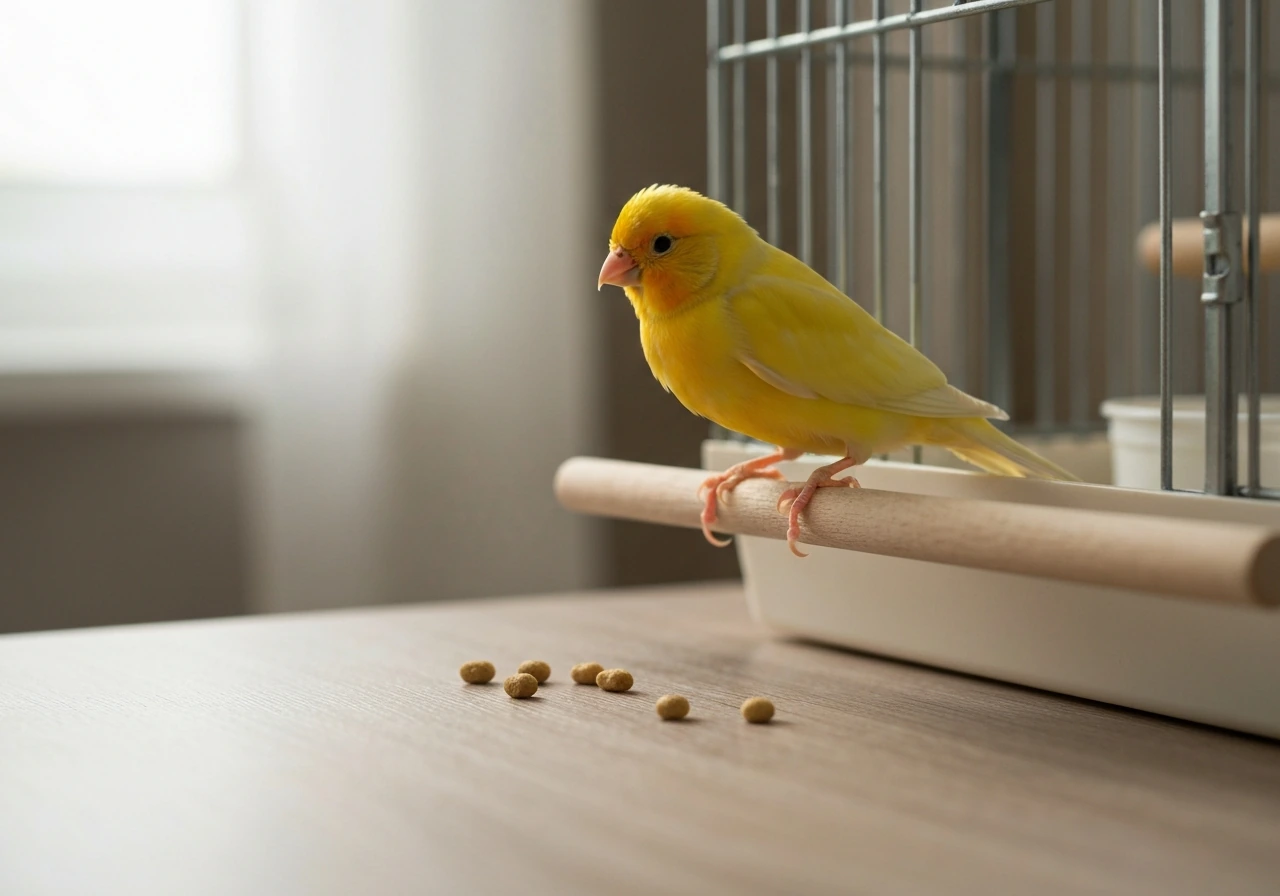
Yes, you can train a finch, but the process looks very different from training a parrot. Finches are small, quick, and wired to be prey animals, so most of the work is about building trust and reducing fear rather than teaching tricks on command. That said, zebra finches and society finches can absolutely learn to tolerate and even enjoy your presence, approach you voluntarily, and respond to basic target-style cues. Research has confirmed that zebra finches are capable of operant conditioning, where a bird learns to peck a target stimulus to receive food reinforcement. In the study by social reinforcement and auditory learning research in adult zebra finches, researchers describe operant behavior training frameworks that motivate engagement through reinforcement operant conditioning. What that means practically is that your finch is smarter and more trainable than people give it credit for. You just have to work at finch speed, not parrot speed.
How to Train Finches: Step-by-Step Taming and Behaviors

What's actually realistic when training finches
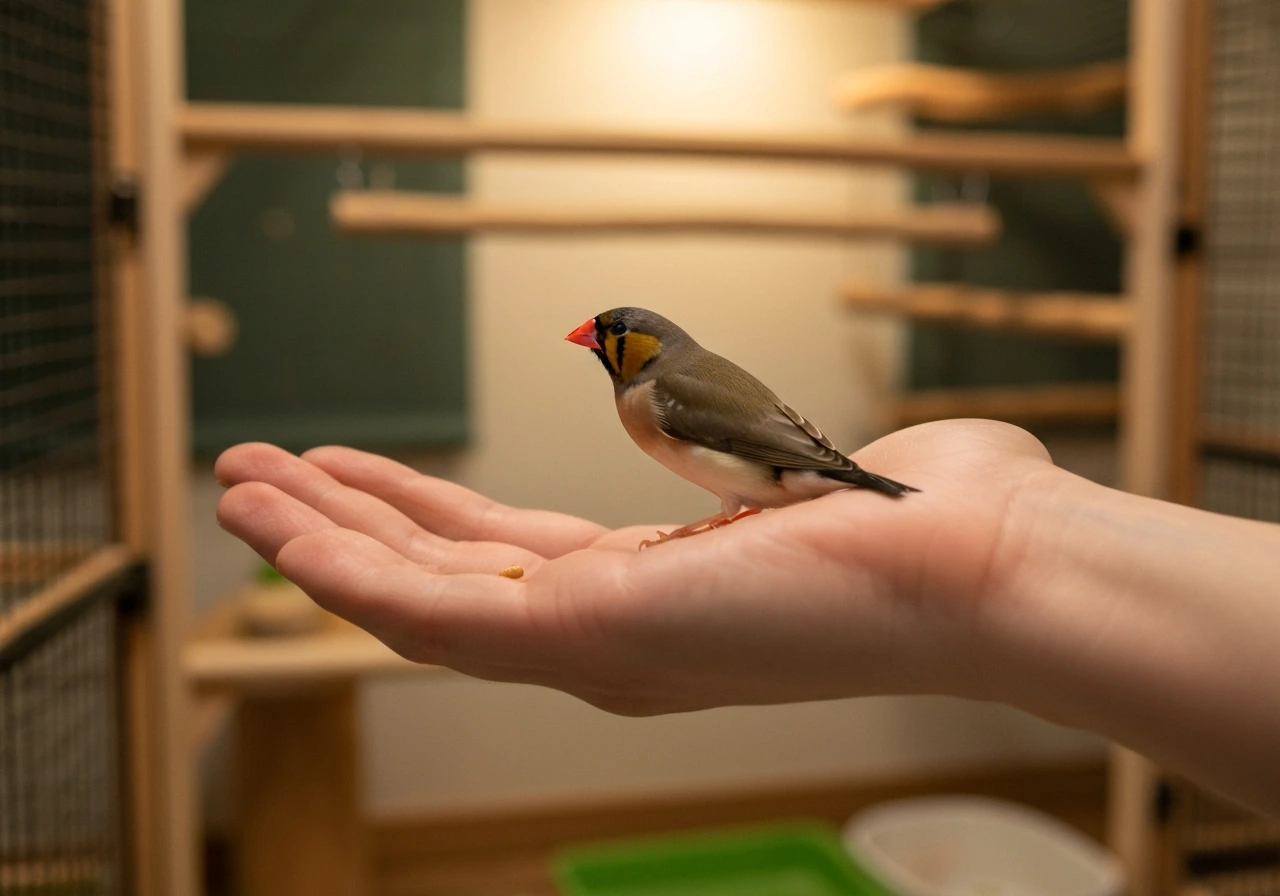
The first thing to get right is your expectations. Finches are not parrots. They did not evolve to form one-on-one bonds with a human handler, and most species naturally stay flocked rather than pair-bonded with people. That doesn't mean training is pointless. It means you're aiming for a different kind of outcome. A well-trained finch will be calm when you're nearby, will eat from a dish near your hand, may step onto a finger or perch voluntarily, and won't show visible signs of stress during routine cage maintenance. That is genuinely achievable for most pet finches.
Zebra finches and society finches (also called Bengalese finches) are the two species most commonly kept as pets, and they respond best to training because they were bred in captivity over many generations. Gouldian finches and other wild-type species tend to be more nervous and are better suited to experienced keepers. If you have a hand-raised finch, your starting point is much easier. If your bird was aviary-bred with minimal human contact, expect the bonding stage to take several weeks before you even attempt handling.
One more honest note: finches are flock birds, and a lone finch is often a stressed finch. If you want to train your bird without the complication of a companion bird influencing behavior, one finch can work, but you will need to be its primary source of social interaction. Many keepers keep a pair and train both, which is perfectly fine. The birds may be slightly less dependent on your interaction, but training still works.
Setting up the environment for success
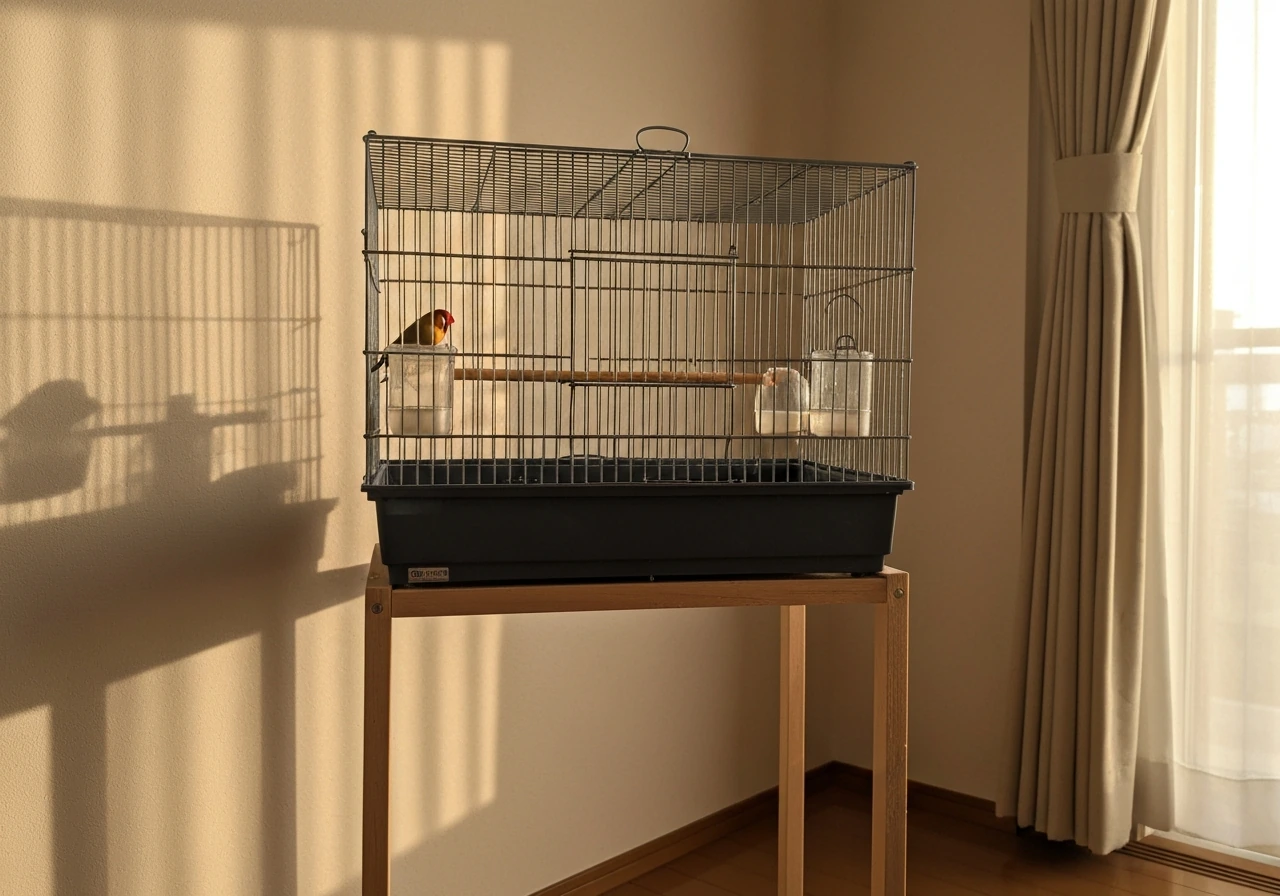
Where you put the cage and how you manage the daily routine matters more for finch training than it does for most other pet birds. Finches are sensitive to their surroundings, and a bird that feels unsafe in its home will never relax enough to engage in training. Get the habitat right first, and everything else becomes easier.
Cage placement and the daily routine
Place the cage off the floor, at roughly chest height or slightly below eye level, in a warm and bright area away from drafts and direct sunlight. A wall-adjacent position is calming because the bird has a solid backing and feels less exposed. Avoid high-traffic hallways, rooms with cooking fumes or aerosols, and spaces where loud unexpected noises happen regularly. A living room or dedicated bird room where the bird can observe household activity without being overwhelmed is ideal. Consistency matters: put the cage in one spot and leave it there. Constant relocation is stressful.
Routine hygiene is part of training setup because a clean, predictable environment is a calm environment. Spot-clean the cage daily by removing discarded food and droppings, and do a thorough clean weekly. Fresh food and water should be provided at the same times each day. Finches also need daily access to a shallow dish of lukewarm water for bathing, which supports feather health and reduces stress. These daily care interactions are also your first low-pressure opportunities to be near your bird without making demands.
Enrichment inside the cage
Provide perches of varying diameters and textures at different heights so the bird can choose where to sit. Natural wood perches are better than uniform dowels for foot health. Include foraging toys that require the bird to work for some of its food, as mental stimulation reduces restlessness and builds the confidence you'll need during training. Foraging also mirrors natural behavior and keeps birds engaged between sessions. A cuttlefish bone provides calcium and a safe surface to beak on. For diet, a good base is a quality finch seed mix built around millets and canary seed, supplemented with pellets and occasional fresh greens. Avoid relying entirely on seeds, especially during training when you want treats to feel rewarding and food motivation to be high.
Building trust before you train anything
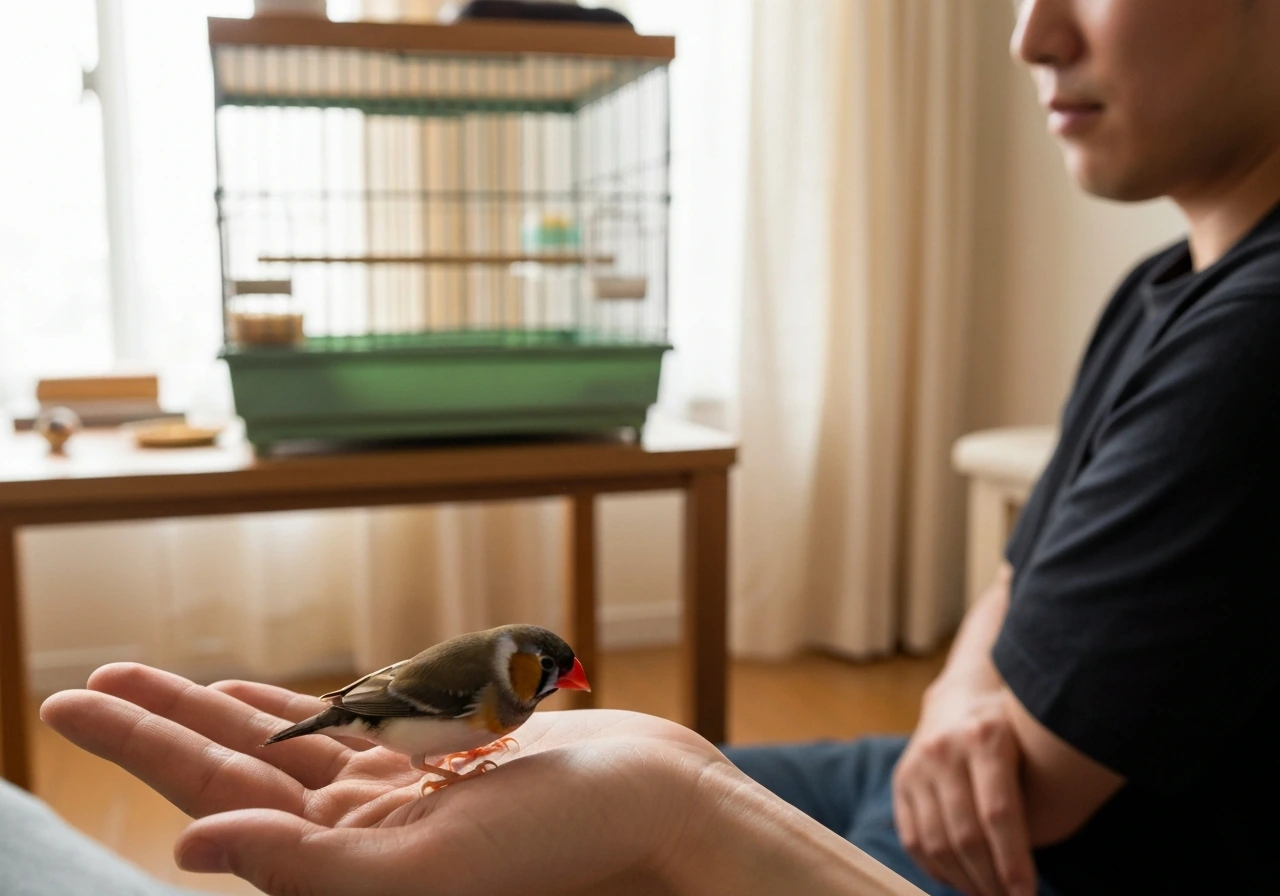
This is the stage most beginners rush, and it's the reason most finch training fails. If your bird panics when you walk into the room, you are not ready to train. You need to become a neutral, then a positive, presence in the bird's world first.
- Week 1: Presence at a distance. Sit near the cage for 10 to 15 minutes daily. Read, use your phone, talk softly. Don't stare directly at the bird. Let the bird observe you without feeling threatened. Watch for calm body language: relaxed feathers, normal posture, chirping, eating while you're present.
- Week 2: Closer presence and slow movements. Move the chair a little closer each day. Begin approaching the cage slowly and calmly, pausing before you reach it. Avoid looming over the bird or making sudden movements. Start talking to the bird in a quiet, consistent voice so it associates your sound with safety.
- Week 3: Hand near the cage exterior. Rest your hand against the outside of the cage bars for a few minutes during your daily sitting session. Don't push it inside yet. The goal is for the bird to approach the area near your hand while you're stationary.
- Week 4 and beyond: Hand inside the cage. Once the bird is comfortable with your hand on the outside, begin placing your hand inside the cage without reaching toward the bird. Let your hand rest near a favorite perch. Offer a small treat (a sprig of millet works well) from your hand and wait. Do not chase or follow the bird. End the session whether the bird approached or not.
- Milestone check: You're ready to move to formal training when the bird will eat from a dish or millet spray you're holding without backing away, fluttering, or showing stress signals.
The published guidance from avian welfare research is clear on this: use time, distance, and low pressure, often called TLC in shelter and rehab contexts, rather than persistent handling or forcing contact. Pushing past a bird's comfort threshold doesn't speed up bonding. It sets you back by weeks.
Teaching the basics: step-up, voluntary approach, and target training
Once your finch is eating calmly from your hand inside the cage, you can introduce structured cues. Most finch owners work toward three practical behaviors: voluntary approach (the bird comes toward you), step-up (the bird steps onto your finger or a handheld perch), and target touching (the bird touches a specific object, which you can then use to guide movement). These three build on each other.
Voluntary approach
Voluntary approach is just what it sounds like: the bird chooses to come to your hand or perch. You've already started this during bonding. To formalize it, hold a small piece of millet or a treat at the end of your fingertip inside the cage and wait. When the bird takes a step toward you, say a consistent marker word like 'yes' in a calm, short tone, or use a clicker if you prefer an audible marker. Then let the bird eat the treat. Repeat this daily for short sessions of about 3 to 5 minutes. You're reinforcing the idea that moving toward you produces something good.
Step-up onto a finger or perch
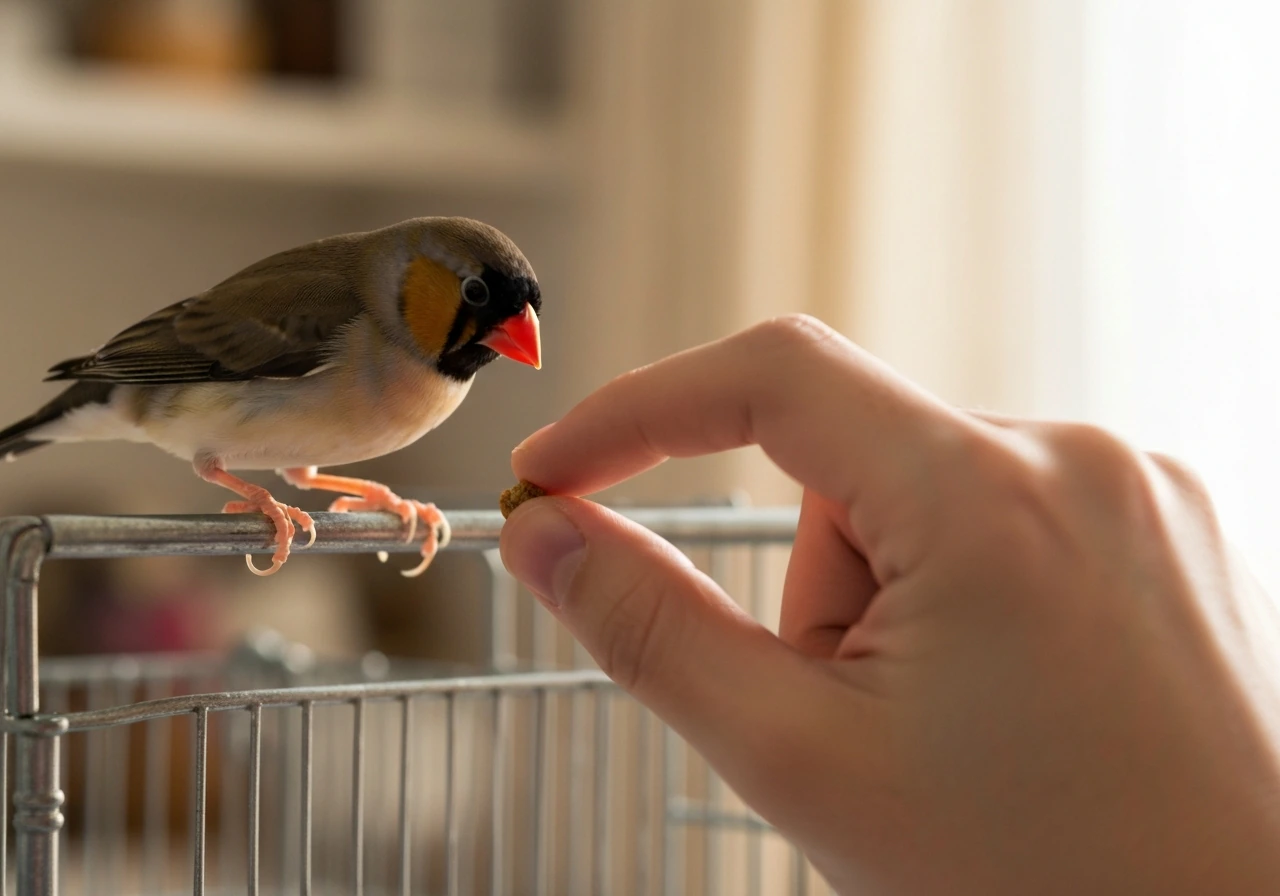
Once the bird regularly approaches your hand for treats, place a small perch or your extended finger just below the bird's chest level while it's on a cage perch. Hold a treat just above and beyond the perch so the bird has to step up to reach it. The moment a foot touches your finger or the handheld perch, mark and treat. Keep sessions short. Don't try to carry the bird across the room in the first session. The goal is just the weight transfer, marked and rewarded, and then done.
Target training
Target training is a powerful tool because once a bird learns to touch a target, you can use it to guide the bird to new perches, through a carrier door, or onto a scale for weight checks. A target can be the eraser end of a pencil, a yogurt lid, a cotton swab, or a commercially available target stick. The principle, as described in clicker and target training literature, is to present the target near the bird's beak, wait for it to touch or investigate, then immediately mark and reward. Most birds investigate novel objects within a few sessions. Once the bird reliably touches the target, you can begin moving the target to guide the bird's movement step by step.
How to reward your finch: treats, timing, and session length
Timing is everything in reinforcement-based training. The reward needs to come within one to two seconds of the behavior you want, or the bird won't make the connection. This is why a verbal marker word or clicker is so useful: you mark the exact moment the correct behavior happens, then deliver the treat within a second or two afterward. Clicker training works as an event-marker or bridge concept, clearly signaling when the desired behavior has happened so the reward is coming a verbal marker word or clicker is so useful.
For treats, small millet sprigs are the most universally effective option for finches. Egg food, small pieces of greens like spinach or romaine, and a bit of soft fruit can also work if your bird likes them. Keep treats tiny, especially for a small bird. You want the bird to eat the treat in one second and be ready to try again, not sit and gnaw for 30 seconds. Treats should be extras that fit within a balanced diet, not replacements for the bird's main food. A good quality pellet and seed diet is the baseline, and treats are small bonuses that fit within that framework.
Session length should stay between 3 and 7 minutes for finches. These are not parrots who can focus for 20-minute sessions. End each session on a success, even a small one, before the bird shows any restlessness or stress. One or two sessions per day, spaced apart, is plenty. Overtraining a finch will cause it to associate you with stress rather than rewards, undoing all your trust-building work.
Troubleshooting: when your finch won't cooperate
Almost every beginner hits at least one wall during finch training. Here's how to work through the most common ones.
Bird backs away or flies off during sessions
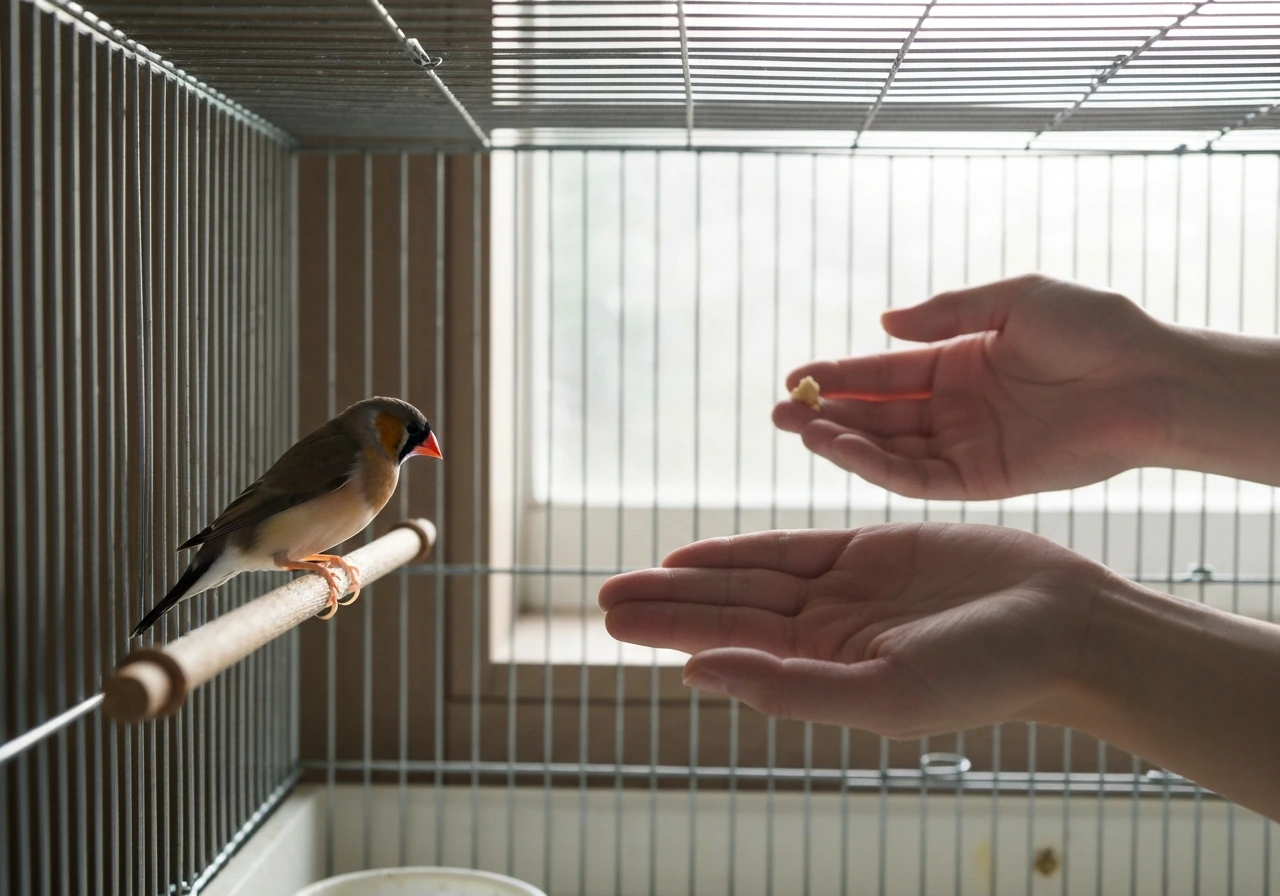
This almost always means you moved too fast through the trust-building stages. Go back one step. If the bird flies off when your hand enters the cage, stop putting your hand inside and return to sitting near the cage exterior for another week. Never reach toward a fleeing bird. That teaches the bird that your approach means pursuit, which creates lasting avoidance. Patience here isn't just kindness, it's the faster strategy.
Bird won't eat treats from your hand
Try a different treat. Some finches are indifferent to millet but will approach for spray millet, egg food, or a small piece of apple. Also check timing: if you're offering treats after a full meal, motivation will be low. Brief the bird before its morning feeding so it's mildly hungry, which increases treat motivation. Never withhold food as a training strategy, that crosses into harmful territory, but light timing of sessions before meals (not instead of them) is appropriate.
Biting or aggression
Finches can nip, and while a finch bite doesn't hurt much compared to a parrot bite, it's a clear communication signal that you're too close or moving too fast. Don't pull your hand away sharply (that's rewarding the bite with a reaction), but do end the session calmly and step back in your training progression. Biting during handling is a sign the bird is beyond its stress threshold.
Recognizing stress signs before they escalate
Knowing when to stop is as important as knowing what to do. Watch for these signs during any training session and end immediately if you see them: rapid breathing or panting, hissing, feathers held tight to the body combined with a crouched posture, tail fanning, wings held away from the body, or a fixed wide-eyed stare. A finch showing these signs is not in a state to learn anything, and continuing will set back your progress. Give the bird at least 20 to 30 minutes of undisturbed quiet before approaching again.
No progress after several weeks
If you've consistently followed the bonding and training steps for four to six weeks and the bird still panics at the sight of your hand, consider whether the bird might have an underlying health issue causing elevated stress, whether the cage placement is causing chronic stress (noise, drafts, other pets nearby), or whether the bird simply needs more time. Some aviary-bred finches take three months or more to become comfortable with handling. If you're working with a species that's naturally high-strung, like a Gouldian finch, the realistic outcome may be a bird that is calm in your presence but never voluntarily steps up, and that's still a meaningful welfare improvement. If you're genuinely concerned about behavioral or health issues, consult an avian veterinarian.
Finches compared to other trainable small birds
It helps to understand where finches sit in the spectrum of small pet birds when it comes to trainability. Budgies, parakeets, canaries, and conures all have different temperaments and starting points.
| Bird | Trainability | Handling tolerance | Typical bonding timeline | Best for |
|---|---|---|---|---|
| Finch (zebra/society) | Moderate (operant tasks, target, voluntary approach) | Low to moderate with patience | 4 to 12 weeks | Patient owners, low-handling setups |
| Budgie | High (speech, tricks, step-up) | High when hand-raised | 2 to 6 weeks | Beginners who want interactive bonds |
| Canary | Low to moderate (song response, voluntary approach) | Low | 6 to 16 weeks | Owners focused on song and observation |
| Parakeet (rosella/ringneck types) | High | Moderate to high | 3 to 8 weeks | Intermediate owners |
| Conure | Very high (tricks, speech, step-up) | Very high | 1 to 4 weeks | Owners wanting highly interactive birds |
If you've been wondering whether a budgie might suit your training goals better, training a budgie follows a similar positive-reinforcement approach but moves faster because budgies are naturally more comfortable with hands-on interaction. If you already keep a canary alongside your finches, the bonding and low-pressure approach described here applies directly, and you can find species-specific details on how to train a canary in a separate guide. For those interested in parakeets, the step-up and target methods translate well, and parakeet training techniques go deeper on the cue-building side. If you eventually want to move to a more interactive bird with a bigger personality, the trust-building groundwork you've laid with your finch will carry directly over when you start working with a conure.
Safety, welfare, and what's actually legal
This section matters whether you're a pet keeper or someone who has found a wild bird and is wondering what to do with it.
Pet finches and welfare standards
Finches fall under USDA APHIS animal welfare standards in regulated contexts, which reflects how seriously bird welfare is taken at a policy level. For pet keepers, the practical takeaway is that handling a bird is always a physiological event. Research on bird handling confirms it biases stress hormones and can affect health if done repeatedly or carelessly. This is why the training approach in this guide minimizes forced handling and prioritizes voluntary behavior. The bird's welfare is not separate from your training goals. It is your training goal.
Wild finches and the law
If you've found a wild finch that appears injured or orphaned, you are not legally permitted to keep or train it. In the United States, the Migratory Bird Treaty Act is a federal law that makes it illegal to possess, take, or transport most native wild birds without a permit. This applies even when your intentions are good. Several state laws independently reinforce this: Washington state law, for example, explicitly prohibits possessing wild animals without a valid permit, and Florida's Fish and Wildlife Conservation Commission states clearly that a wildlife rehabilitation permit is required to do anything beyond immediate transport of injured wildlife.
The right step with a wild finch is to contact a licensed wildlife rehabilitator. Most states have searchable directories: your state's fish and wildlife agency website is the best starting point, and some states provide map-based finders to locate the nearest permitted facility. Rehabilitators hold federal migratory bird rehabilitation permits and have the training, facilities, and legal standing to care for and, when possible, release wild birds. Attempting to tame or train a wild finch yourself is both illegal in most jurisdictions and harmful to the bird's chances of survival if release is the goal.
Disease and biosecurity basics
If you've handled a wild bird or are introducing a new pet finch, wash your hands thoroughly before and after. Wild birds can carry pathogens transferable to other birds in your home. Any new pet finch should be quarantined from existing birds for at least 30 days before introduction. If a bird shows labored breathing, fluffed feathers, weight loss, or discharge, contact an avian vet promptly.
Your plan for this week and how to track progress
Here's what to actually do starting today, depending on where you are with your bird.
- Day 1 to 3: Assess your bird's current comfort level. Sit near the cage for 10 minutes and note whether the bird eats, vocalizes, or watches you calmly, or whether it flutters away and shows stress signals. That tells you which trust-building week to start on.
- Day 4 to 7: Introduce your hand to the cage exterior for 5 minutes per session. Note whether the bird approaches the area near your hand or avoids it. This is your baseline.
- Week 2: Begin hand-inside-cage sessions with a millet treat. One session per day, 3 to 5 minutes. Track whether the bird moves closer, stays neutral, or retreats.
- Week 3 to 4: If the bird is eating from your hand, introduce a held perch or finger below the bird's chest and begin voluntary step-up attempts. Mark and reward every foot placement.
- Week 4 onward: Introduce a target object and begin target training using mark-and-reward. Add one new element only after the previous behavior is reliably repeated in 3 out of 4 attempts.
- Keep a simple log: date, session length, what you tried, and how the bird responded. One sentence per session is enough. Progress in finch training is slow and easy to miss without a record.
Stop and seek help if: the bird is losing weight, sitting fluffed at the bottom of the cage, showing labored breathing, or displaying persistent aggression that doesn't ease over weeks. Those are veterinary issues, not training problems. For behavioral stalls that don't respond to adjusting your approach after four to six weeks, a certified parrot behavior consultant or avian vet with behavior experience can give you a fresh set of eyes. Training a finch is a slow, rewarding process when you match your pace to the bird's, and that patience is exactly what makes the result meaningful when it comes.
FAQ
How can I tell if I’m doing too much during training, or overtraining my finch?
Use short, predictable sessions and stop the moment the bird shows the first stress cues, even if you planned to continue. A practical rule is 3 to 5 minutes early on, once daily at most, and only add a second session if the bird’s posture and breathing stay calm afterward.
Can I train my finch while other household activity is happening, like cooking or vacuuming?
Do not train when the bird is already stressed, for example right after cleaning, during loud household events, or if the cage location is in a draft or near cooking aerosols. Instead, schedule sessions when the room is quiet and the bird has a normal daily rhythm, then keep the cage position unchanged.
What training outcomes are realistic if my finch never steps up voluntarily?
Expect a lot more “neutral tolerance” than full step-up for many species, especially wild-type or high-strung finches. A successful outcome can mean calm body language, eating near your hand, and reliable target touching, even if voluntary approach is limited and the bird never chooses your finger.
What should I do if my finch refuses treats or ignores my hand?
If the bird won’t take treats, reduce the difficulty (offer the treat closer to the bird’s current perch without forcing approach), and try a different treat type like spray millet, egg food, or a tiny bit of fruit if your bird ignores millet. Also try timing sessions shortly before a planned feeding so motivation is higher.
How do I progress target training without causing fear or losing the behavior?
When the finch touches the target reliably, change only one variable at a time, such as moving the target a few centimeters further toward the desired perch. If the bird hesitates or starts flinching, move the target back to the last easy spot and rebuild the pattern at a slower pace.
My finch bites when I try to step it up, what’s the correct response?
Biting is a clear sign of too-close timing or too-fast movement, not a “discipline” issue. End the session calmly, step back to a farther distance, and return to earlier trust stages for several days before attempting again.
What is the best way to move a finch for cage cleaning or vet visits without ruining training progress?
Avoid handling as a way to “get the bird comfortable.” Instead, use voluntary steps you can control, start with inside-the-cage steps onto your finger, and only later guide using target cues. If you need to move the bird for care, use a carrier setup and gentle net-free transfer where possible.
Should I train in the same room as the cage, or is it better to use a separate training area?
Do it once the bird is calm and eating normally from your hand, then pair the approach with rewards. If the bird flares or panics at your presence, don’t relocate training to a different room immediately, keep sessions in the same area so the bird learns that your movement is predictable.
When do I stop training and assume the problem might be medical?
If stress signs appear, pause training and give the bird quiet time, then resume at the previous easier step the next day. If the bird keeps escalating for weeks despite matching your pace, consult an avian vet to rule out pain, respiratory issues, or other health drivers.
I found a wild finch, can I keep it and train it myself?
After a wild bird incident, do not attempt taming or long-term “training.” Contact a licensed wildlife rehabilitator right away for permitted guidance, and handle only the minimum necessary steps for immediate safety and transport until help arrives.
What hygiene and quarantine steps should I take when introducing a new pet finch?
Wash hands thoroughly before and after any bird contact, and quarantine new pet finches from existing birds for at least 30 days. Use separate tools (food dishes, nets, perches) for the quarantine period to reduce pathogen transfer risk.
How to Train Canary Bird: Step-by-Step Trust and Cues
Step-by-step, welfare-first canary training: trust, step-up, simple targets, positive rewards, and fixes for biting or f