You can train most pet birds to poop in a designated spot inside their cage, and the whole process comes down to three things: learning your bird's pre-poop cues, setting up the cage so the target spot is obvious and easy to hit, and reinforcing the right behavior every single time with something your bird actually wants. It takes consistency over days or weeks, not a single session, but it genuinely works for parakeets, cockatiels, conures, African greys, and most other common companion species.
How to Train Your Bird to Poop in the Cage

Maya Harris
12 May 2026
What 'poop in the cage' actually means in practice
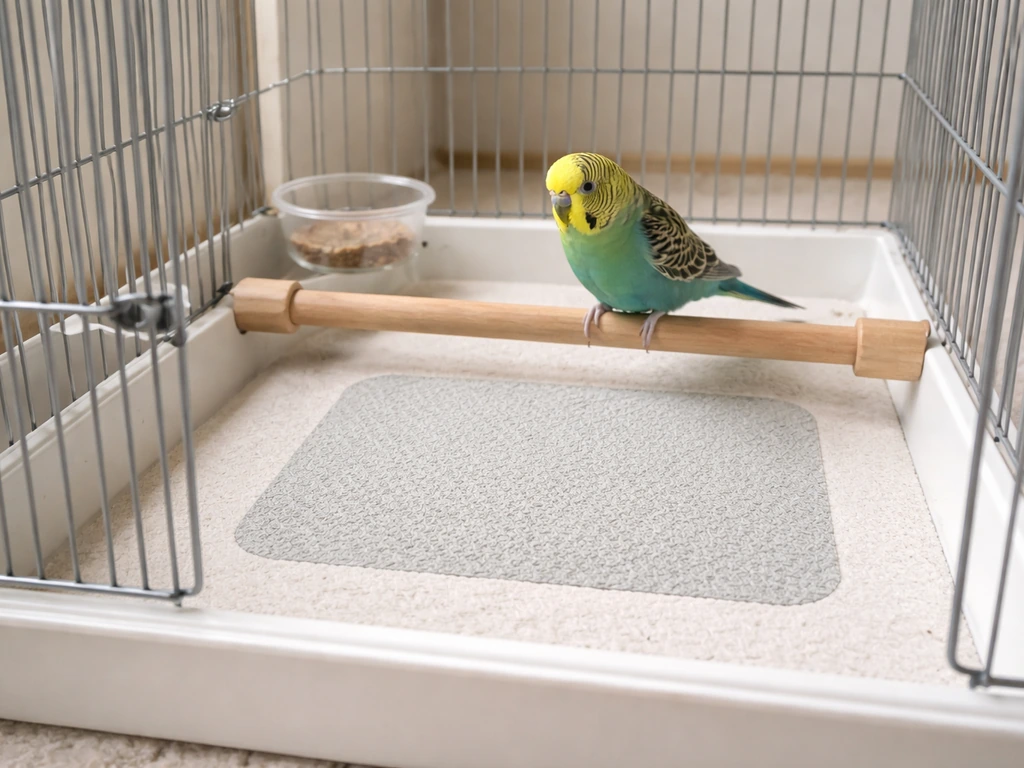
Before you start training, be clear about what you're actually teaching. The goal isn't for your bird to hold it indefinitely or eliminate only on a verbal command like a dog. Birds have fast digestive systems and genuinely cannot wait for long. What you're training is a preference: your bird learns that a specific spot inside the cage is where droppings belong, and returns there (or stays there) when the urge hits rather than going on your shoulder, furniture, or elsewhere in the room.
The 'poop target' is a defined zone inside the cage, typically the cage floor directly beneath the bird's favorite perch or a dedicated low perch positioned over the liner tray. That spot should be consistent, easy to clean, and accessible to your bird without confusion. Keep it simple: one spot, one association.
Learn your bird's elimination cues and timing first
Spend two to three days just watching before you do any active training. You cannot redirect a behavior you haven't learned to recognize. Most parrots and similar species give a reliable physical sequence right before they go: they back up a step or two, crouch slightly, and raise or fan their tail. Some birds also puff up briefly or shift their weight. This whole sequence lasts only a few seconds, so the more you watch, the faster you'll catch it.
Timing is just as important as the physical cues. Most birds eliminate within a few minutes of waking up, shortly after eating, and regularly during active out-of-cage play, sometimes every 10 to 20 minutes during high-activity periods. Keep a simple log for two or three days: note the time, what your bird was doing, and what the pre-poop posture looked like. After a couple of days you'll see a pattern, and that pattern is your training window.
- Back-up steps followed by a slight crouch: the most reliable early signal in parrots
- Tail raise or fan: usually the last signal before elimination, you have 1 to 3 seconds
- Brief puffing or weight shift: an earlier, softer signal worth noting
- Predictable timing windows: first thing in the morning, 5 to 15 minutes after meals, and frequently during play
Set up the cage so success is the easiest option
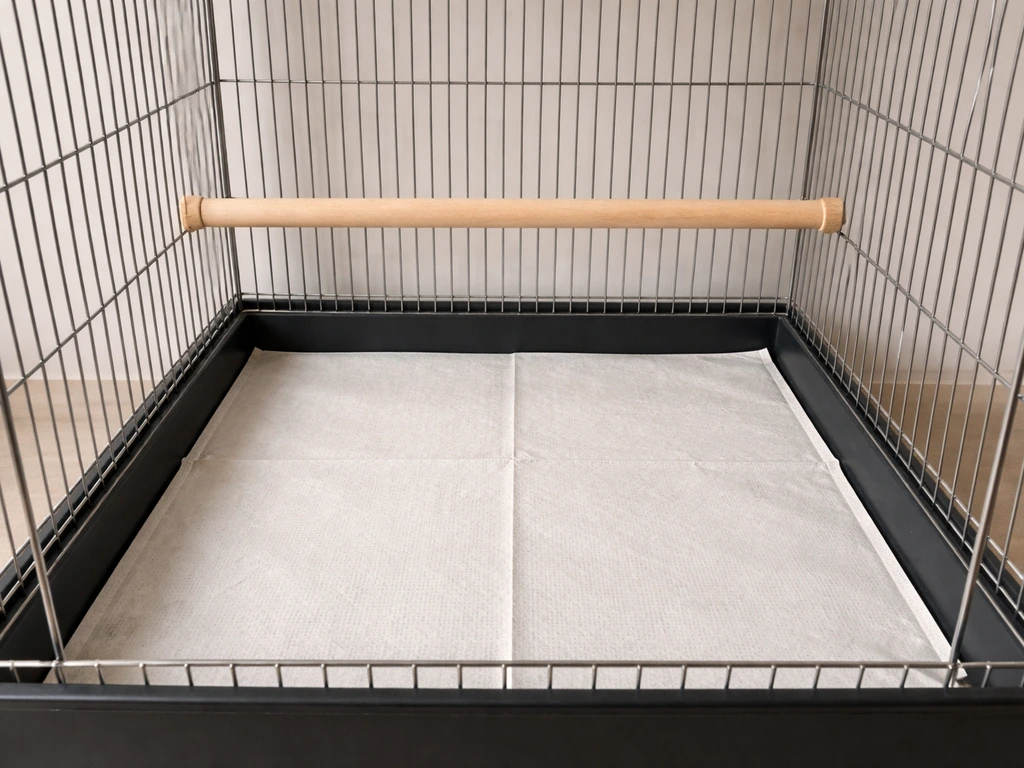
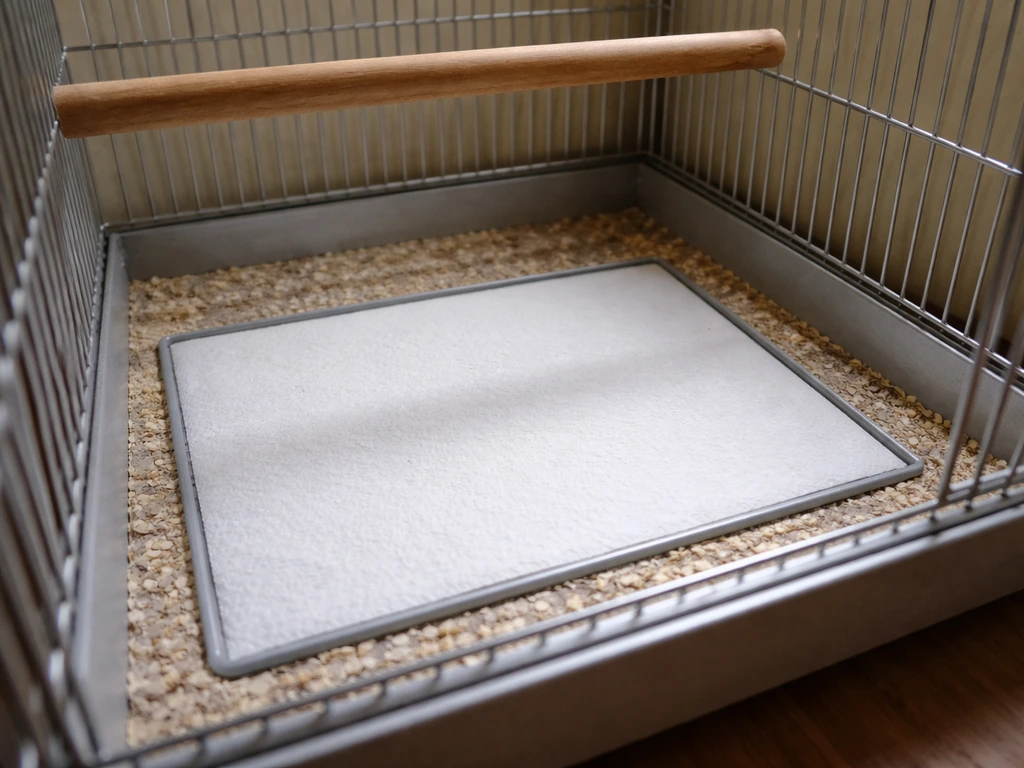
Cage setup does a lot of the training work for you. Line the cage floor with newspaper or plain paper towels, both of which are non-toxic, cheap, and easy to replace daily. A layered stack of liners means you can pull off the top sheet each morning without a full scrub. Place a tray or grate beneath the liner to contain droppings and make the cleanup area clearly defined. Avoid wood shavings, corn cob bedding, or anything absorbent that hides droppings, because you need to see what's landing where.
Position one perch directly above the liner tray. This becomes the 'poop perch.' Its job is to be close enough to the floor that your bird can reach it easily, and positioned so that normal droppings land on the liner rather than on food dishes, toys, or the side of the cage. Many birds naturally perch lower when they sense the urge to go, so you're working with biology rather than against it.
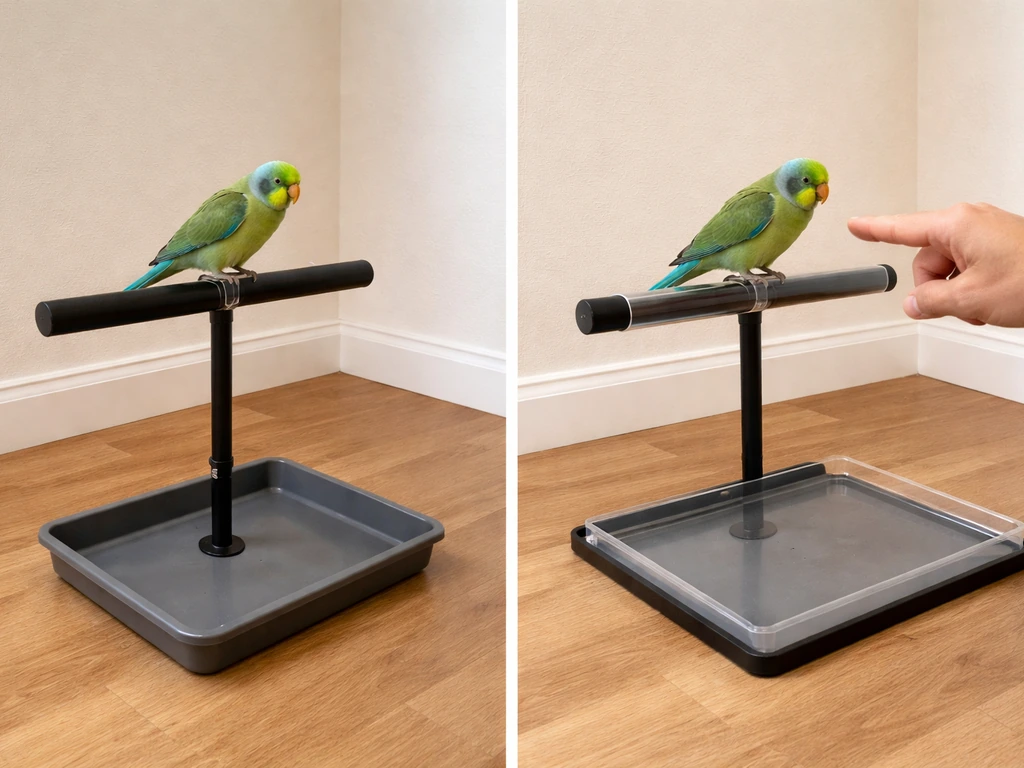
If your bird spends significant time outside the cage, a small portable playstand with its own liner can serve as the out-of-cage poop station. The training principles are identical. Avoid tube-style watering systems that drip onto the liner, since wet spots make it hard to track where droppings are actually landing and can confuse your cleanup routine.
The training sequence: cue, redirect, and reinforce
Once you know your bird's cues and your cage is set up, you're ready to train. The core loop is simple: catch the pre-poop signal, calmly move or guide your bird to the poop perch, mark the moment they eliminate there, and immediately deliver a reward.
- Watch for the pre-poop cue (back-up, crouch, tail raise). As soon as you see it, say your chosen cue word calmly, something like 'go potty' or 'poop time,' in a quiet, neutral tone.
- If your bird is out of the cage or on a different perch, gently and calmly move them to the poop perch. Do not rush, grab, or startle. Use a step-up if needed.
- The moment your bird eliminates on the poop perch or over the liner, immediately mark the behavior. A clicker works perfectly here because it bridges the gap between the behavior and the reward, telling your bird precisely which action earned the treat. If you don't use a clicker, a short, bright word like 'yes' works as your marker.
- Deliver the reward within a second or two of the marker. A small piece of a favorite food, a brief scratch, or enthusiastic verbal praise, whatever motivates your individual bird most.
- Repeat every single time you catch the cue. Consistency is the whole game.
The marker (click or word) is critical because bird training happens fast. You have maybe one or two seconds between when the behavior happens and when your bird's brain is ready to connect it to a consequence. The marker freezes the moment, so even if the treat takes a few seconds to get to your bird, they already know exactly what they did right.
Over time, your bird will start associating the cue word with the behavior and the location. Some birds generalize this within a week of consistent practice. Others take three to four weeks. Don't rush it by reducing the reinforcement too early. Keep rewarding every successful on-target poop for at least two to three weeks before you start fading the treats.
Using a target stick to teach the poop perch location
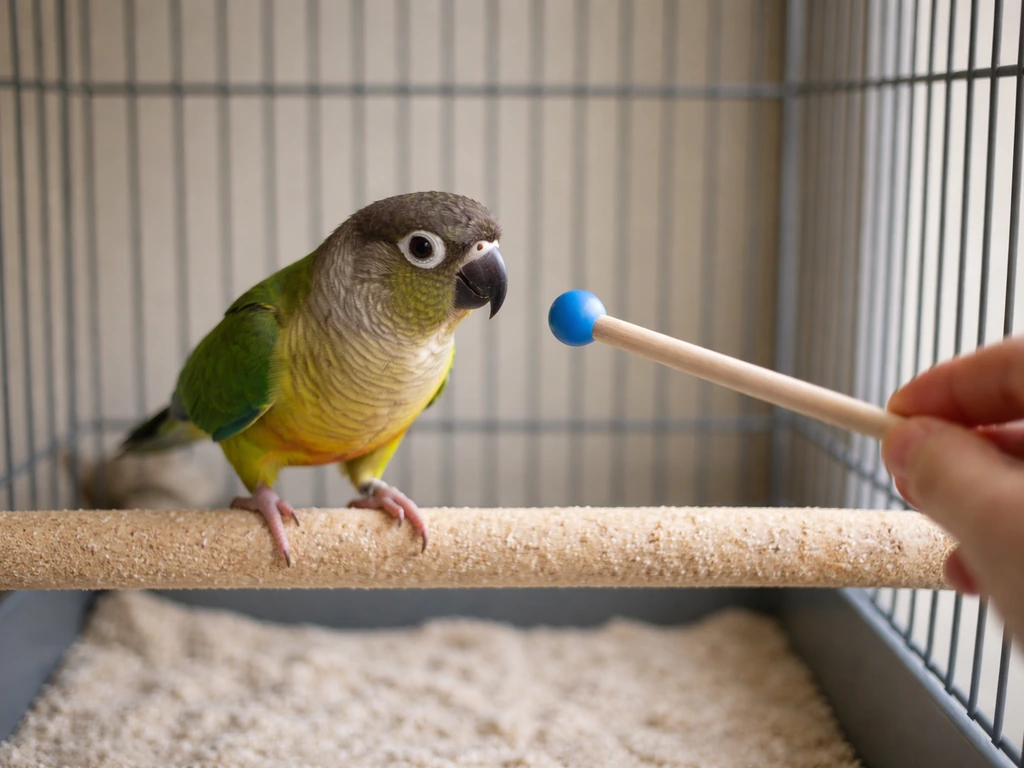
If your bird already knows how to follow a target stick, you can use it to guide them to the poop perch on cue. Once your bird accepts the idea of following a target stick, you can also brush up on cue timing and guide them toward the poop perch more confidently. Touch the target to the perch, wait for your bird to step onto it, then wait for elimination and mark it. This station-training approach works especially well for larger parrots like African greys, Amazons, and cockatoos, and for any bird that tends to resist being physically moved.
Welfare-first handling: keep stress out of the equation
Stress actively disrupts toileting training. A stressed bird eliminates unpredictably, may refuse to go on the target perch at all, or may develop feather-related or behavioral problems that derail your progress entirely. The goal is always to make training feel like a pleasant, low-stakes interaction, not a correction or a demand.
- Never restrain your bird to force them onto the poop perch. Heavy-handed restraint is inappropriate for companion birds and damages trust.
- If your bird doesn't go when you guide them to the poop perch, wait quietly for up to 30 seconds, then let them move freely. Do not repeat the cue multiple times in a row.
- Never punish accidents. A calm 'oops' while you clean it up is the entire response to a miss.
- Keep training sessions short. You're not drilling; you're catching natural behavior and reinforcing it. Most birds respond to 5 to 10 reinforced successes per day.
- If your bird seems anxious or flighty during redirects, slow down and spend more time on observation before trying to move them.
Cleaning accidents safely is also part of welfare-first practice. Birds have extremely sensitive respiratory systems and can be blank" rel="noopener noreferrer">harmed by fumes from bleach, ammonia, and aerosol cleaners, even in small amounts. blank" rel="noopener noreferrer">Mixing bleach and ammonia produces chloramine gas, which is acutely toxic to birds. For daily liner swaps, no cleaning product is needed at all. For the cage tray and bars, use a bird-safe enzyme cleaner or plain hot water, rinse thoroughly, and make sure the bird is in a separate room with good ventilation before any disinfectant touches the cage. Never use aerosol sprays near your bird.
Troubleshooting when things aren't working
Inconsistency is the most common problem, and it almost always traces back to one of three things: missing the cue window, reinforcing too late, or the training environment being too stressful. Before you change your approach, check those three things first.
| Problem | Likely cause | Fix |
|---|---|---|
| Bird misses the poop perch and goes on nearby bars or toys | Poop perch is positioned wrong or too far from where the bird naturally hangs out | Move the poop perch directly under the bird's favorite resting spot |
| Bird eliminates right after being removed from the poop perch | Redirect happened too late (past the cue window) or bird was anxious on the perch | Work on catching cues earlier; make the perch more comfortable and familiar |
| Bird eliminates normally in the cage but goes everywhere when out | Out-of-cage time has no poop station and no reinforcement history | Add a portable playstand with a liner and apply the same training steps out of cage |
| Bird shows no pre-poop cues you can read | Observation time has been too short or the bird is new to your home | Spend another 3 to 5 days purely watching; video your bird during active periods and review in slow motion |
| Bird was improving but has regressed | Routine changed, stressor added, or reinforcement faded too quickly | Go back to rewarding every success, check for environmental changes, rule out health issues with a vet |
One thing worth knowing: if your bird suddenly changes their elimination frequency, consistency, or the appearance of droppings, check with an avian vet before assuming it's a training problem. Changes in droppings can signal dietary issues, infection, or other health concerns that training cannot fix.
Adjusting the plan by species, age, and personality
Small birds like budgerigars and finches eliminate very frequently (sometimes every few minutes) and are harder to catch mid-cue. For these species, the realistic goal is usually a well-positioned liner that catches most droppings by default, with the poop perch doing the heavy lifting. Full on-cue training is achievable but takes longer and requires a very sharp eye.
Medium species like cockatiels and conures are often the easiest to train because their cue signals are clear and their timing is predictable. Most owners see reliable results within two to three weeks of consistent practice. Larger parrots like African greys and cockatoos can learn this behavior very reliably, but they're also more sensitive to changes in routine, so consistency matters even more. Introduce any change (new perch, new liner, new cue word) gradually.
Young birds and newly adopted birds need more time. A fledgling or a recently rehomed adult bird is still figuring out their new environment, and adding toileting training too early can create stress. Give a new bird at least two to four weeks to settle in before you start active training. Observation during this period is fine and useful, but keep the expectation low.
Personality matters just as much as species. A bold, food-motivated bird will pick this up fast. A shy, easily startled bird needs a gentler pace, smaller steps, and extra patience with the redirect. If your bird has a strong aversion to being moved, invest more time in target-stick training first so the redirect feels like a game rather than an interruption.
Where to go from here
Once your bird reliably poops on the target perch inside the cage, you can build on that foundation. If you want to go beyond toileting, you can apply the same basics of cueing and reinforcement to learn how to train a bird to deliver mail. Some owners expand the training to out-of-cage perches and even teach a reliable on-cue elimination behavior, where the bird goes on command rather than just in the right location.
Some r/Parrotlet owners also describe differences between keeping droppings in/near the cage versus using out-of-cage spots, based on what works for their parrotlet. If you are wondering whether birds can be trained for trickier goals, like stealing money, it's important to keep in mind that training should be focused on safe, consent-based behaviors rather than theft can you train a bird to steal money.
That's a more advanced skill, but it uses exactly the same marker-and-reward loop you've already built. The cage training you've done here is the foundation for house training your bird more broadly, and it connects directly to managing out-of-cage time cleanly and confidently. It's also worth knowing that while true litter-box training in the cat sense isn't really how bird biology works, consistent poop-spot training gets you close to the same practical result.
Be patient with yourself as much as with your bird. Missing cues, cleaning up accidents, and restarting after a rough week are all part of the process. The birds that reliably use their poop spot didn't get there because their owners were perfect; they got there because their owners kept showing up, kept reinforcing, and kept the whole thing positive.
FAQ
Can I train my bird to poop on a schedule, like right after I wake up?
Yes, but start only if the droppings are already normal for your bird and the bird is not fearful. If you shorten sessions because you are rushed, you often miss the cue window, and the bird learns to eliminate wherever it feels safe. For first-time training, aim for calm, consistent observation and do not add any firm handling until the bird reliably follows your approach to the poop perch after the cue.
What should I do if I miss the pre-poop cues and my bird poops on the cage floor?
Use a “before you move” rule: if you notice the pre-poop posture, guide the bird to the poop perch immediately, then stop any extra interaction. If the bird is already mid-elimination or the moment passes, simply clean up and continue observing, do not try to correct the bird in that instant. Your marker should only come after the droppings land on the target liner area.
Is it okay to change liners, or move the poop perch while training?
It helps to reduce variables one at a time. If you change the liner type, perch position, or cue word all at once, you lose the ability to tell what caused progress or setbacks. When you need to make a change, keep the target spot in the same location and keep the same cue word for at least two to three weeks.
Should I interrupt or physically move my bird during the cue to force it onto the perch?
Don’t. Birds often generalize the “poop spot” cue to whatever was happening last, and if you move the perch too late or touch the bird during elimination, you can accidentally create an aversion to the target area. If cleanup is the issue, swap the top liner layer and let the bird keep access to the same target spot.
How do I know when poop-spot problems are actually health problems?
A sudden increase or decrease in elimination, watery droppings, very strong odor, blood, straining, or repeated pooping in small amounts can indicate illness or dietary problems. If any of those appear, contact an avian vet before adjusting training, because changing routines to “fix” toileting can delay proper treatment.
My bird seems confused about the cue word. What’s the right fix?
Stop using the cue word until things are stable. If you say the word when the bird is not about to eliminate, you may create a habit where the bird expects a reward for unrelated behavior like stepping onto the perch. Once you see consistent pre-poop cues again, resume cueing only right before elimination and marker right after droppings land on target.
What if my bird only poops on their favorite perch, not the poop perch?
If your bird poops only when you are out of the room, treat that as a data point about stress or timing. Lower expectations, increase observation time during high-probability windows (soon after wake-up, after eating, and after play), and keep training sessions quiet. Consider that some birds eliminate on their preferred perch height, so slightly adjust the poop perch position while keeping it above the same liner zone.
Can I train toileting outside the cage, on a playstand?
Yes, but keep it low-stakes. You can guide toward the poop perch during normal periods of out-of-cage play, but do not make the playstation so “command-like” that the bird resists going. Make the playstand liners easy to replace, reward only on-target droppings, and keep the same marker and cue word across cage and playstand so the association stays consistent.
What if my bird gets very close, but the droppings miss the liner target area?
If droppings land near the target but not exactly in the liner zone, start by rewarding the closest success and gradually raise your standard. For example, first reward any landing on the defined tray area beneath the perch, then tighten to the exact center as the bird improves. This avoids frustrating the bird when the cue is right but the landing spot is slightly off.
What’s the safest way to clean up accidents during training?
Use an enzyme cleaner or hot water for cage liner and bars, rinse thoroughly, and ensure the bird is in a separate, well-ventilated room until everything is fully dry and odor-free. Never rely on aerosol products for “fast cleanup,” because odors and fumes can trigger respiratory irritation and stress, which directly disrupts toileting training.
How do I adjust training for budgies or finches that poop constantly?
For very frequently eliminating species, the best approach is accuracy by setup rather than perfect timing. Place the liner and poop perch where droppings naturally fall, reward any on-target landing you can confirm, and accept that full “cue-to-poop” reliability may take longer and require more careful observation. If you cannot consistently see the pre-poop posture, focus rewards on outcomes you can verify.
My bird suddenly refuses the poop perch. Should I keep trying the same method?
If your bird starts refusing the target perch or shows sudden fear, pause active guidance for a few days and return to observation and gentle, non-demand positioning (for example, letting the perch be part of the cage routine). Fear often comes from forcing, slipping feet on a liner-covered surface, or making cleaning smells noticeable. Once the bird is relaxed again, restart with smaller steps and immediate rewards for voluntary approach.