Yes, you can train your dog to reliably leave a bird alone, and you can do it without punishment. The short version: manage the environment first so the dog can't practice the wrong behavior, teach 'leave it' and 'look at that' in low-distraction settings, then use a gradual desensitization ladder to build calm behavior around real birds. The long version is what this guide covers, step by step.
How to Train a Dog to Leave a Bird Alone
Maya Harris
17 Apr 2026
Why dogs go after birds (and what 'good leaving' actually looks like)
Dogs chase birds because of prey drive, which is a deeply hardwired sequence of behaviors: blank" rel="noopener noreferrer">orient, stalk, chase, grab, and dissect. Every part of that sequence can be triggered independently. A bird flying up from the grass hits the 'orient and chase' buttons in most dogs almost automatically. The bird's movement, unpredictability, and smell combine into what trainers call a 'high-value trigger,' which is a stimulus that produces arousal fast and shuts down the thinking brain just as quickly.
Some dogs have stronger prey drive than others. Terriers, sighthounds, working herding breeds, and many sporting dogs were selectively bred over generations to track, flush, or retrieve birds. If you have a dog from one of those lines, you are not working against bad manners; you are working against centuries of selective breeding. That does not mean training is impossible, but it does mean you need realistic expectations and a structured plan rather than a quick fix.
What does 'good leaving' actually look like? It is not a dog who never notices a bird. It is a dog who notices the bird, maybe glances at it, and then voluntarily turns attention back to you without lunging, barking, or fixating. The dog's body stays loose, breathing stays normal, and they can still respond to a cue. That is the behavioral goal: not zero awareness, but manageable, redirectable attention.
Warning signs that your dog is past the threshold for productive training include a hard stare with a stiff body, hackles up, low growl or whine, trembling with excitement, or pulling so hard on the leash that they are nearly lifting off the ground. At that point the dog is not in a learning state. Your job is to create distance before you hit that wall, not after.
Safety and management before you start any training
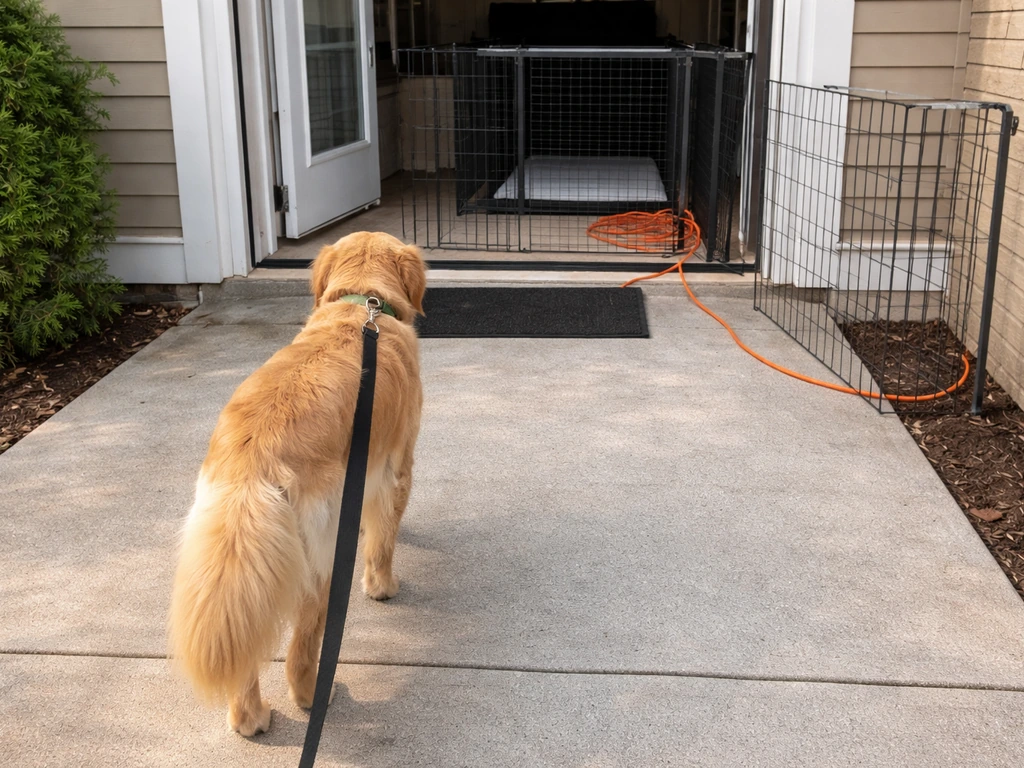
Management is not training, but it is the foundation without which training cannot succeed. Every time your dog gets to rehearse the full chase sequence, whether it is a pigeon in the park or a parakeet in its cage, that behavior gets stronger. Your first priority is to stop the rehearsals.
- Use a standard 4-6 foot leash on walks, not a retractable. Retractable leashes give dogs momentum before you can respond.
- Indoors, use baby gates, closed doors, or exercise pens to create a physical barrier between your dog and any pet birds.
- Establish a consistent daily routine so the dog knows when 'bird room time' happens and never gets unsupervised access to that space.
- In yards, keep the dog on a long line (15-30 feet) rather than off-leash until training is solid. This prevents successful chases while still giving freedom.
- If you have pet birds, keep cages elevated and positioned so a dog jumping or pawing at a cage cannot tip or reach it. Even the stress of a dog pressing against a cage can injure a bird.
Distance is your most powerful management tool. The farther your dog is from the bird when they first notice it, the more cognitive capacity they have for learning. During training sessions, always start at a distance where the dog can see or smell the bird but stays under threshold. If you are not sure what that distance is, start at 30 feet and adjust from there based on your dog's body language.
Teach the foundation cues first: marker timing, 'leave it,' and 'look at that'
Before you ever train near a bird, your dog needs two reliable cues: 'leave it' and 'look at that' (often called LAT). Both are taught first in boring, low-distraction environments using high-value food rewards, a clicker or a consistent verbal marker like 'yes,' and your full attention.
Marker timing
Your marker, whether a clicker or a word, needs to land within half a second of the behavior you want to reinforce. If your dog looks away from a tempting object and you mark two seconds later, you are reinforcing whatever they were doing at the moment of the mark, not the look-away. Practice your marker timing on simple behaviors like a sit or a hand touch before you try it around birds.
Teaching 'leave it'
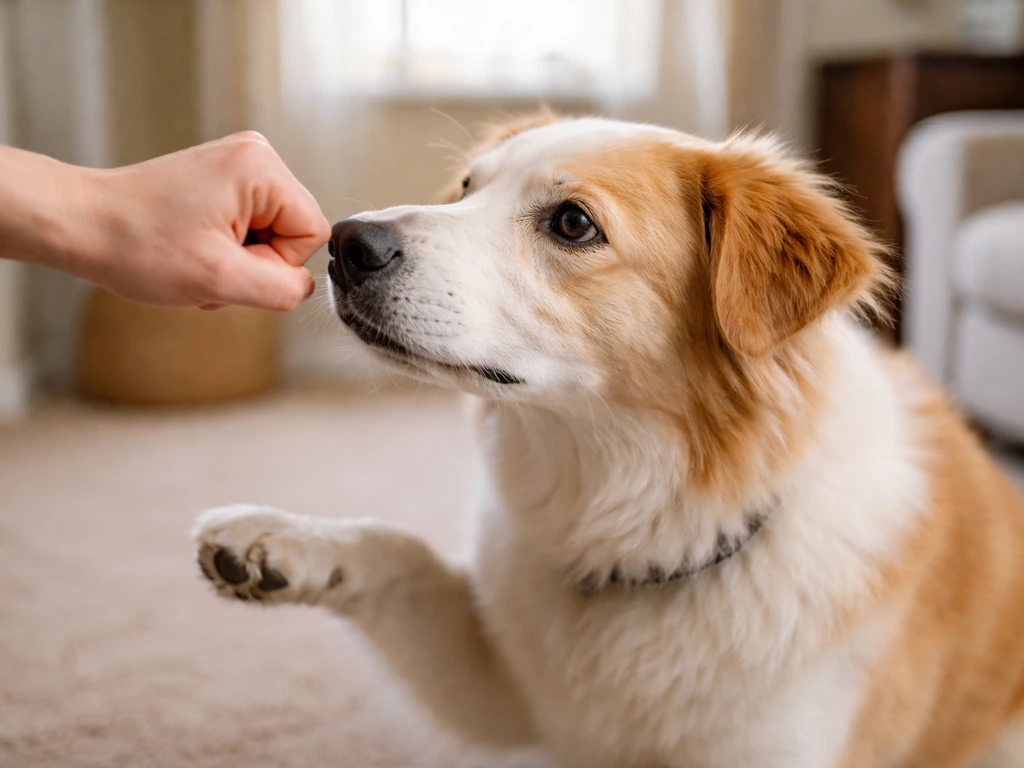
The American Veterinary Society of Animal Behavior recommends building 'leave it' by setting up conditions where the dog cannot access the forbidden item in the first place, then marking and rewarding the dog for disengaging. The dog is never punished for trying to approach; the reward simply only appears when they choose to look away. The AVSAB Humane Dog Training position statement (2021) emphasizes that reward-based methods teach desired behavior without relying on pain or force high-value food rewards (reward-based methods). This is important: the dog is not rewarded for sniffing or pawing at the item; reinforcement only follows disengagement.
- Hold a low-value treat in your closed fist. Let the dog sniff and paw at your hand. The moment they pull their nose back or glance up at you, mark and reward with a different treat from your other hand.
- Once the dog reliably backs off from your fist, open your hand flat. Cover the treat with your palm if the dog dives for it. Mark and reward the moment they pull back.
- Place a treat on the floor. Cover it with your foot. Say 'leave it' once. Mark and reward the instant the dog disengages, and give them a better treat from your hand, not the one on the floor.
- Practice with progressively more tempting items: food scraps, toys, tissues, until 'leave it' is solid with any object in the house.
- Then and only then, begin practicing around bird-related items: a feather, a bird toy, a recording of bird sounds playing from a speaker.
Teaching 'look at that' (LAT)
LAT is a counterconditioning tool that teaches the dog that noticing the trigger predicts a reward. You start at a distance where the dog can perceive the trigger and still function. The moment the dog looks at the trigger, you mark, and then feed the reward in a way that naturally pulls their gaze back to you. Over many repetitions, the dog begins to look at the trigger and then immediately look back at you in anticipation of the treat. The LAT protocol works especially well for dogs who fixate or stare, because it gives that orienting behavior a job and a productive consequence rather than just suppressing it.
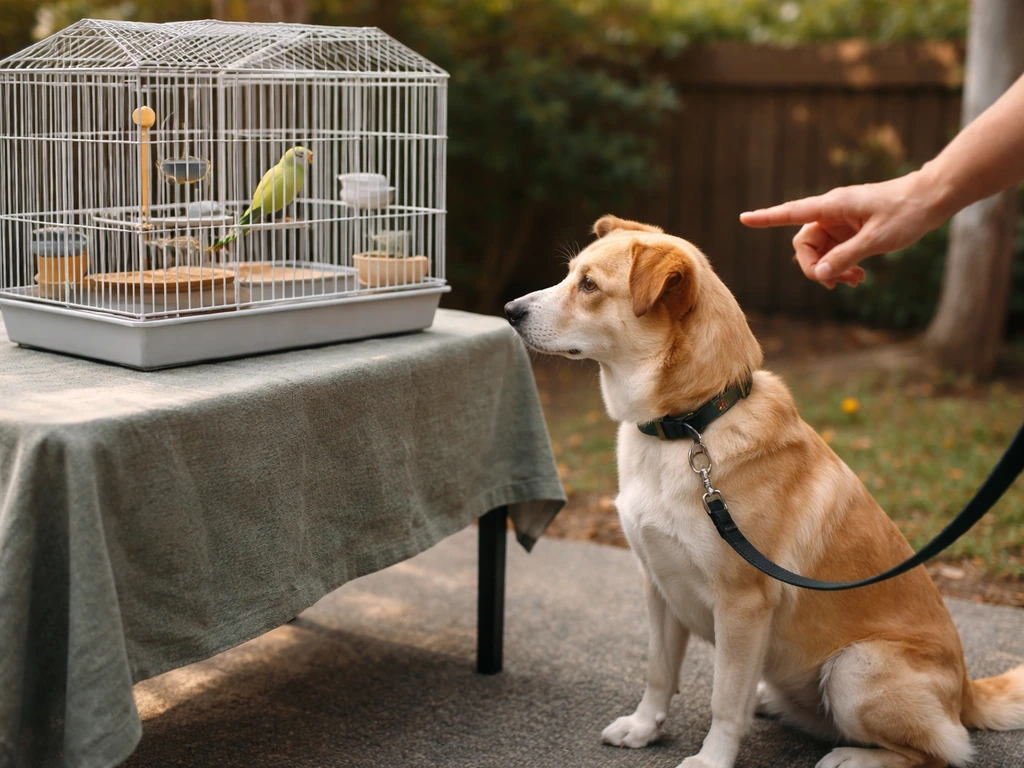
A good starting setup: sit across the room from a bird in its cage with your dog on leash. Wait. The moment the dog glances at the cage, click or say 'yes,' and feed a treat near your face so the dog has to swing their head back to you. Repeat 10-15 times per session. When the dog starts automatically looking back at you after glancing at the cage without you needing to prompt it, you are making real progress.
The desensitization and counterconditioning ladder around birds
Desensitization means presenting the bird stimulus at a level below your dog's reaction threshold, then gradually increasing intensity. Counterconditioning means pairing that stimulus with something good, usually food, so the dog's emotional response shifts from arousal or anxiety to calm anticipation. The two techniques work together and should always be used together when you are dealing with prey drive.
The key rule: never move up the ladder until the dog is calm and offering eye contact or looking back at you spontaneously at the current level. If the dog is still fixating, still whining, or still pulling at a given distance, you have not finished that step. Moving forward too fast is the most common reason this process fails.
| Step | Setup | Criteria to move forward |
|---|---|---|
| 1 | Dog can hear bird sounds from another room, no visual contact | Dog remains relaxed, not orienting toward the sound |
| 2 | Bird in closed carrier or covered cage in the same room, dog 20+ feet away on leash | Dog glances at carrier and looks back to you voluntarily |
| 3 | Bird visible in cage, dog 15 feet away, short 2-3 minute sessions | Dog can hold a sit or walk parallel without fixating |
| 4 | Dog on leash, 10 feet from occupied cage, practicing LAT | Dog reliably auto-checks in with you after each glance |
| 5 | Dog on leash, 6 feet from cage, practicing 'leave it' with bird in view | Dog disengages from cage on cue within 2 seconds |
| 6 | Dog walks past cage multiple times on leash at 4-6 feet | Dog passes without slowing, staring, or pulling |
| 7 | Dog off-leash but in a gated space with the cage visible | Dog moves freely without approaching or fixating on cage |
| 8 | Real-world encounters: birds in yard, birds on walks (on leash) | Dog notices bird and checks back with you without cueing |
Session length matters. Keep early sessions to 3-5 minutes, especially if your dog has high prey drive. End on success, meaning end while the dog is still calm, not after they have already gone over threshold. Multiple short sessions per day beat one long frustrating session every time. As the dog builds fluency at each step, you can extend session duration gradually, but only if the dog stays under threshold throughout.
Pet birds vs. wild bird encounters: same goals, different setups
The training principles are identical whether you are working around a pet cockatiel or wild shorebirds on a beach walk. The setups, safety precautions, and stakes are different.
Training around pet birds at home
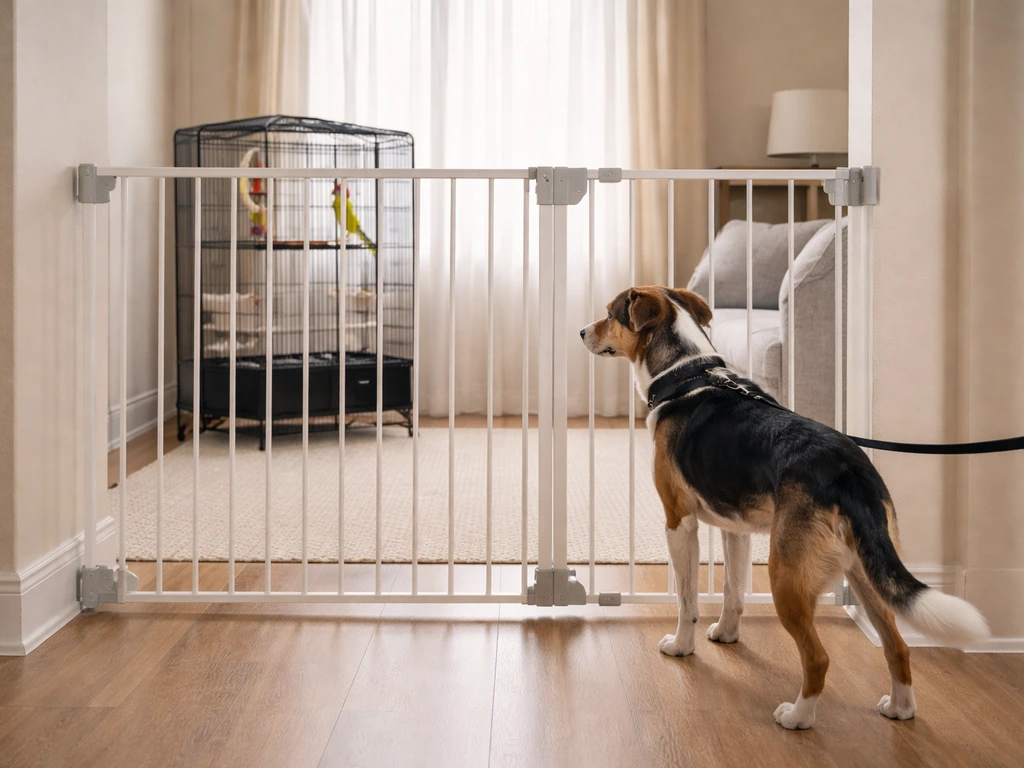
Pet birds are stress-sensitive animals. Even a dog pressing against the outside of a cage can cause a bird to injure itself, feather-pluck, or go into a stress response with health consequences. Before you begin any training, make sure the bird has a visual barrier it can retreat behind inside its cage. Cover three sides of the cage with a lightweight cloth if the bird shows fear responses like bating, fluffing, or screaming when the dog is in the room. Your bird's welfare and your dog's training are both served by keeping early sessions calm and short.
Never allow the dog to be in the same open space as a free-flighted bird until the dog has demonstrated reliable 'leave it' behavior with the bird in the cage for weeks of consistent training. Even then, a free-flight introduction should be supervised, brief, and have an exit plan ready for the bird. This is not a milestone to rush.
Training around wild birds on walks
Wild bird encounters on walks are harder to control because you cannot set the distance or predict when a bird will appear. This is why solid leash skills and reliable 'leave it' at home are non-negotiable before you try to generalize to the outdoors. On walks, use a non-retractable leash, watch for birds before your dog does, and use that head start to increase distance or cue 'look at that' while the dog is still under threshold.
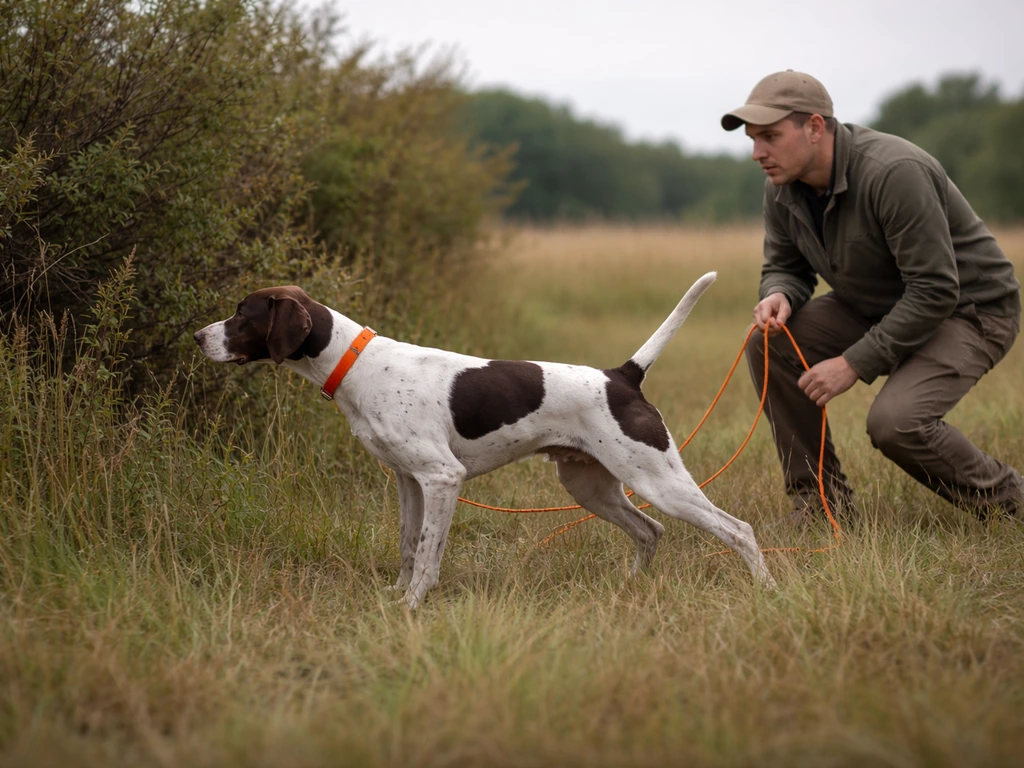
Wildlife conservation guidance is clear that dogs, even on leash, can alter normal bird behaviors and cause measurable distress to nesting and feeding shorebirds. This is not just a training issue; it is a welfare issue. Some coastal and protected areas have specific leash rules and buffer zones around bird colonies. Check local regulations before you walk your dog in wildlife-sensitive areas. If you are interested in the broader sport context of dogs working around birds in controlled field settings, it helps to understand how how to train a bird dog differs from training a pet dog to disengage, since the goals are structurally opposite.
Quick fixes for the most common problems
Lunging
If your dog lunges, you are too close or the stimulus appeared too suddenly. Do not yell, yank hard, or force the dog to 'face' the bird. Instead, calmly turn and walk the other direction to create distance. Once the dog settles, try a shorter approach angle next time. A front-clip harness or a head halter can help you redirect a lunge physically without pain, but they are management tools, not training tools. Pair them with consistent counterconditioning.
Fixation (hard staring)
A dog locked into a hard stare is at or past threshold. Move further away immediately. When you are back at a working distance, use LAT to give that visual orienting a structured outlet. Mark the instant the dog glances at the bird (not the sustained stare), and feed the reward right at your face. You are teaching the dog that a brief look earns a reward, while a sustained stare earns nothing.
Barking
Barking at birds is usually frustration or arousal, not aggression. The fix is the same: more distance, shorter sessions, and higher-value rewards. If the dog barks the moment they see the bird from any distance, start with sound-only exposure (a bird audio recording) before adding visual access. Some dogs also need an incompatible behavior cue like 'sit' or 'touch' to give their arousal somewhere productive to go.
Window and yard triggers

Window barking and fence-running after yard birds are high-repetition rehearsal loops that undo your training. Use frosted window film on lower window panes to block sightlines from the couch or dog bed. In the yard, supervise and interrupt fence-running immediately by calling the dog inside rather than letting the behavior continue. You can also use a long line in the yard during training to prevent successful chasing of birds that land nearby. Interrupt the visual access to break the rehearsal cycle first, then work on the training.
Building real-world reliability: off-leash recall and proofing on walks
Here is the honest truth about off-leash situations: recall around birds is an advanced skill that takes months of consistent proofing, and for some dogs with very high prey drive, 100% reliable off-leash recall around birds may not be achievable. That is not a failure of training; it is a realistic assessment of drive level and risk.
To build toward off-leash reliability, proof your 'leave it' and recall cues at every level of the desensitization ladder before removing the leash. Practice in fenced spaces first. Use a long line (30 feet) as an intermediate step so you have a safety net without the dog feeling fully tethered. Add distractions in layers: first a stationary bird stimulus, then a moving one, then a real bird encounter at distance, and only then consider off-leash work in a safe fenced area.
A useful concept from clicker training: if the dog is breaking the behavior constantly, you are progressing too quickly. Drop back a step and build duration and distance more slowly. The goal is to make success easy so the dog can be reinforced at a very high rate early on, then gradually shift toward intermittent reinforcement once the behavior is solid. This is the same principle that makes 'stay' reliable: many, many short successes before you stretch the criteria.
On walks, generalization is built by practicing your cues in as many different locations as possible. A 'leave it' learned in your kitchen does not automatically transfer to a city park with pigeons. Practice in multiple environments, at different times of day, and with different bird species.
If you are curious how working breeds approach this kind of environmental exposure in a hunting context, reading about bird dog training tips can actually inform your approach, because many of the proofing principles overlap even when the end goal is opposite.
When you reach the stage of proofing around birds in actual field environments, understanding the differences between your dog's pet-dog context and how trainers approach how to train dog to bird hunt helps clarify why your dog's instincts are so persistent and what you are actually working against neurologically.
Legal considerations you should know before you train outdoors
Wildlife protection laws are not just about hunting. Several states and federal frameworks specifically address dogs chasing or harassing wildlife, and the rules vary significantly by location, species, and season. In some jurisdictions, allowing your dog to chase birds (including shorebirds, waterfowl, or game birds) on public land can result in fines or other legal consequences, even if the chase was accidental. Some seasonal windows, for example spring turkey nesting periods, carry specific restrictions in certain states. At the federal level, migratory birds are protected under the Migratory Bird Treaty Act, and harassment can potentially trigger federal liability.
The practical takeaway: always leash your dog in areas with known bird colonies, nesting sites, or protected habitat. Research your local leash laws and any wildlife protection rules for parks and wildlife refuges you visit. If you are in a protected coastal or wetland area, assume a leash is required and keep your dog on the established path. This protects the birds, protects your dog from legal risk, and honestly makes your training easier because you maintain control.
When to stop doing this yourself
Most dogs with moderate prey drive toward birds can make meaningful progress with the approach described in this guide. But there are situations where DIY training is not enough, and recognizing them early saves you time, frustration, and potential harm to birds or people.
- Your dog has already injured or killed a bird, even once. This is a serious escalation and warrants assessment by a certified applied animal behaviorist (CAAB) or veterinary behaviorist.
- The dog's prey drive is so high that they cannot disengage from bird stimuli even at 50+ feet with high-value food rewards.
- Training has plateaued for 4-6 weeks despite consistent daily practice and no management failures.
- Your dog shows redirected aggression, meaning they bite or snap at you when prevented from chasing.
- You have pet birds and a dog with a history of predatory behavior, and the risk of an accident is high without professional supervision.
- Your dog is showing signs of stress-related health issues: not eating, pacing, hypervigilance, or sleep disruption related to bird exposure.
A veterinary behaviorist can also evaluate whether there is an anxiety or impulse control component that might respond to behavioral medication alongside training. Medication does not replace training, but it can lower the arousal baseline enough for training to work. Do not hesitate to ask for that assessment if you are hitting a wall.
If you are working with a professional trainer, look for someone who uses force-free or least-invasive minimally aversive (LIMA) methods. Punishment-based tools like prong collars, shock collars, or alpha rolls are not appropriate for prey-drive work with birds. They suppress behavior without changing the underlying emotional state, which means the behavior tends to return under higher-stress conditions, exactly when you need reliability most. A trainer who understands both bird behavior and canine prey drive is ideal. If pointing breeds are part of your context, it is worth understanding how trainers teach dogs the controlled pause before action, for example how to train a bird dog to point, because the impulse-control foundation overlaps with what you are building for disengagement.
Your practical starting checklist
Use this to organize your first two weeks. Do not skip ahead.
- Set up physical management: leash on walks, gates or barriers at home, long line in yard.
- Identify your dog's threshold distance with the target bird stimulus.
- Practice your marker (clicker or verbal) until your timing is sharp on simple behaviors.
- Teach 'leave it' through all indoor steps using food items before introducing bird-related objects.
- Teach LAT in a low-distraction room, then gradually near a caged pet bird or a bird audio recording.
- Run 3-5 minute sessions twice daily at the current step on your desensitization ladder.
- Record which step you are on and your dog's response level after each session.
- Move to the next step only when the dog is calm and auto-checking in with you consistently.
- Practice 'leave it' and recall in multiple locations to build generalization.
- Review local leash laws and wildlife protection rules for any outdoor locations you use.
This process takes weeks to months depending on your dog's drive level, history, and how consistent your management is. The dogs who make the most progress are the ones whose owners prevent rehearsal of the chase behavior while systematically building a new response. Small, consistent sessions beat occasional marathon efforts every time. Start today with whatever step is honest for where your dog actually is, not where you wish they were.
FAQ
What should I do if my dog reacts strongly even at the beginning of a session?
Use the leash to keep the dog under threshold, then change the trigger timing rather than trying to stop the bird. If the dog reacts, you are either too close or the bird appeared too suddenly, so step back (or slow the bird’s movement with a calmer setup) and resume at the last distance where the dog can briefly glance and then look back to you.
My dog freezes or ignores me when it sees the bird, how do I keep training effective?
If your dog cannot respond to cues like “leave it” or LAT, assume you have exceeded threshold. End the session, create distance, and restart later at a lower-intensity step (greater distance, slower bird movement, or less visual access). Only increase criteria when calm behavior and spontaneous look-backs are happening reliably.
Can I train for birds in the same way at home and outdoors, or is there a difference?
Yes, but proofing means you must train in phases: first with the dog on leash and the bird in a secure setup, then with lower-access distractions, then with brief, supervised real-world encounters at distance. Even if “leave it” works perfectly indoors, start outdoors conservatively because birds appear unpredictably and the environment adds competing stimuli.
Should I keep repeating “leave it” during a bird encounter to get compliance?
Do not use the command as a “stop sign” when the dog is already aroused. Instead, practice “leave it” and LAT proactively at distances where the dog can learn, then use the cue to reinforce disengagement. If you notice you are having to repeat the cue constantly, the dog is too close or the ladder is too fast, so scale back.
What if my dog keeps starting the chase, then stopping right before lunging?
If your dog starts to rehearse the chase sequence, the immediate fix is management: block sightlines, reduce access, and increase distance so the rehearsal cannot complete. Training can resume once the dog can perform the brief-glance pattern and disengage, otherwise the dog is strengthening the exact chain you are trying to weaken.
How close should I feed treats during LAT, and does treat location matter?
Start with rewards delivered near your body only when your dog looks back from the bird, not when they sniff or paw. If rewards are too far away, the dog may learn to stay fixated long enough to reach the treat location. Keep reinforcement consistent and fast, with the treat path encouraging head-turning back to you.
My dog is calm at first, then suddenly stops caring about the bird or the treats. Is that a problem?
If your dog loses interest quickly, you may be starting at too far a distance or using rewards that are not motivational enough for that specific trigger. Re-check your distance, and use genuinely high-value treats, smaller and frequent, to match the speed of disengagement you want.
How do I measure whether my dog is truly learning to leave birds alone?
It’s normal that “good leaving” is not zero awareness. If your dog can glance briefly, then return attention to you with a loose body and normal breathing, you are meeting the goal. Track progress by reducing stare duration, reducing pulling, and increasing spontaneous look-backs, not by expecting instant indifference.
What if my pet bird shows stress during training, even when I keep the dog calm?
Do not train around a pet bird that is already showing stress signs (fluffing, bating, screaming). Improve the setup first by adding a visual barrier inside the cage and keeping sessions very short. If the bird escalates, end the session and try again later at a lower intensity step.
My dog barks or stares at birds, does the training approach need to change?
Yes, and it changes your plan. For “hard stare” dogs, you may need to train at a much longer distance initially and reward for the first glance only, with no attempts to ask for extended eye contact. For “barker” dogs, start with sound-only or a very controlled visual step and consider adding an incompatible cue like sit to give arousal a job.
Can I rely on equipment like a head halter to control lunging instead of training?
If you ever plan to use a harness or head halter to redirect a lunge, treat it as a safety and management aid, not a correction. Pair it with immediate distance creation and the same counterconditioning steps, and avoid yanking or forcing the dog into position while it is aroused.
How do I know when to stop DIY training and get professional help?
DIY training is often not enough if your dog reaches threshold quickly across most distances, cannot generalize “leave it” even with management, or shows escalating frustration behaviors like sustained barking, fence-running, or unsafe lunging. A veterinary behaviorist can help if anxiety, compulsive behavior, or impulse control issues are part of the picture.
Next Article
How to Train a Bird Dog to Point Step by Step
Step-by-step pointer training to teach steady pointing, from scent setup to field progress and troubleshooting common is