Getting a bird to trust you comes down to one thing: making yourself predictable and safe, consistently, over time. Once you’ve made yourself predictable and safe, you can focus on the specific routine for how to get a bird used to you. Whether you're working with a nervous rescue parrot, a brand-new budgie, or a wild bird at your garden feeder, the core principle is the same. You don't earn a bird's trust by forcing contact. Once you understand why fear happens, you can follow a clear plan for how to make your bird not scared of you, step by step. You earn it by removing reasons for fear and giving the bird reasons to associate you with good things. Here's exactly how to do that, starting today.
How to Get a Bird to Trust You: Step-by-Step Guide
Maya Harris
22 Mar 2026
Wild vs. pet birds: the trust-building difference matters
Before you start, it helps to know what you're actually working toward, because wild birds and pet birds need very different approaches.
With a wild bird, trust is about habituation and food association. You're not trying to get a wild robin or sparrow to step onto your hand on day one. You're working on shrinking the bird's flight initiation distance (how close it lets you get before flying away) over days or weeks by being a calm, consistent, non-threatening presence that also happens to bring food. Most wild bird trust-building plateaus at comfortable coexistence, not physical contact, and that's perfectly fine. If you're hoping for a wild bird to eventually eat from your hand, that can happen with patient, daily repetition, but it takes weeks to months and works better with species like chickadees, nuthatches, and certain sparrows that are naturally less skittish around people.
With a pet bird, the goal is deeper and more interactive: you want the bird to voluntarily approach you, accept handling, and ideally enjoy your company. Pet birds have been exposed to humans from the start (or at least more regularly), but that doesn't automatically mean they trust you. A bird with a rough history or a new bird just arriving in your home may be just as fearful as a wild one. The tools you'll use, positive reinforcement, reading body language, controlled exposure, are more structured with pet birds because you're building toward a lasting relationship.
Start today: set up for success and avoid trust-breakers
The environment you create matters more than most people realize. Before you even think about interaction, get the setup right.
For pet birds
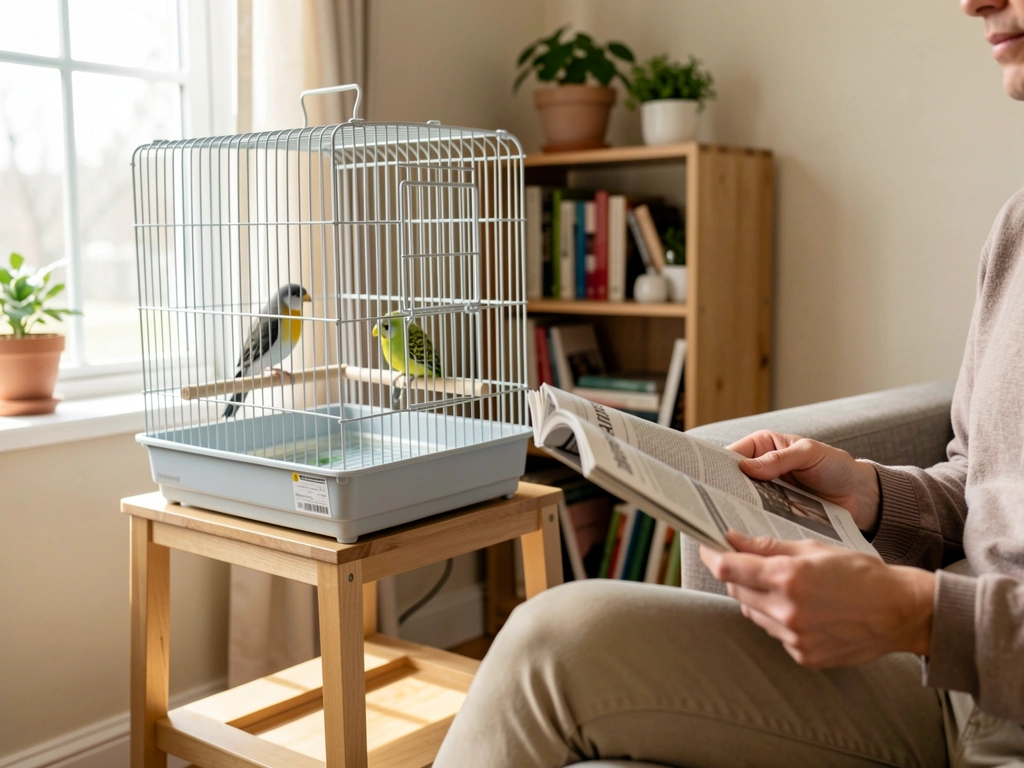
Place the cage in a room where the bird can observe household activity without being overwhelmed by it. A living room corner works better than a busy kitchen (fumes from non-stick cookware are genuinely dangerous to birds) or a quiet back bedroom where the bird feels isolated. Height matters too: eye level or slightly above tends to make birds feel more secure than a cage sitting on the floor where they feel exposed and vulnerable.
Keep the cage door routine consistent. Open and close it the same way, at the same times if possible. Predictability is the foundation of trust. Erratic handling, loud sudden movements near the cage, or grabbing at the bird unpredictably are the fastest ways to set back progress. The Merck Veterinary Manual is clear that any restraint of a bird should minimize stress and avoid undue fear, and that applies to everyday interactions, not just vet visits.
If you've just brought a new bird home, give it at least a few days of low-key adjustment time before you push for interaction. Sit near the cage, talk softly, go about your normal routine. Let the bird learn that you're not a threat before you ask anything of it. And if you have other birds in the home, keep the new bird in a completely separate room for 30 to 45 days. This quarantine period isn't just about disease (though that matters too, and your avian vet will thank you), it also lets the new bird decompress without the added stress of existing flock dynamics.
For wild birds
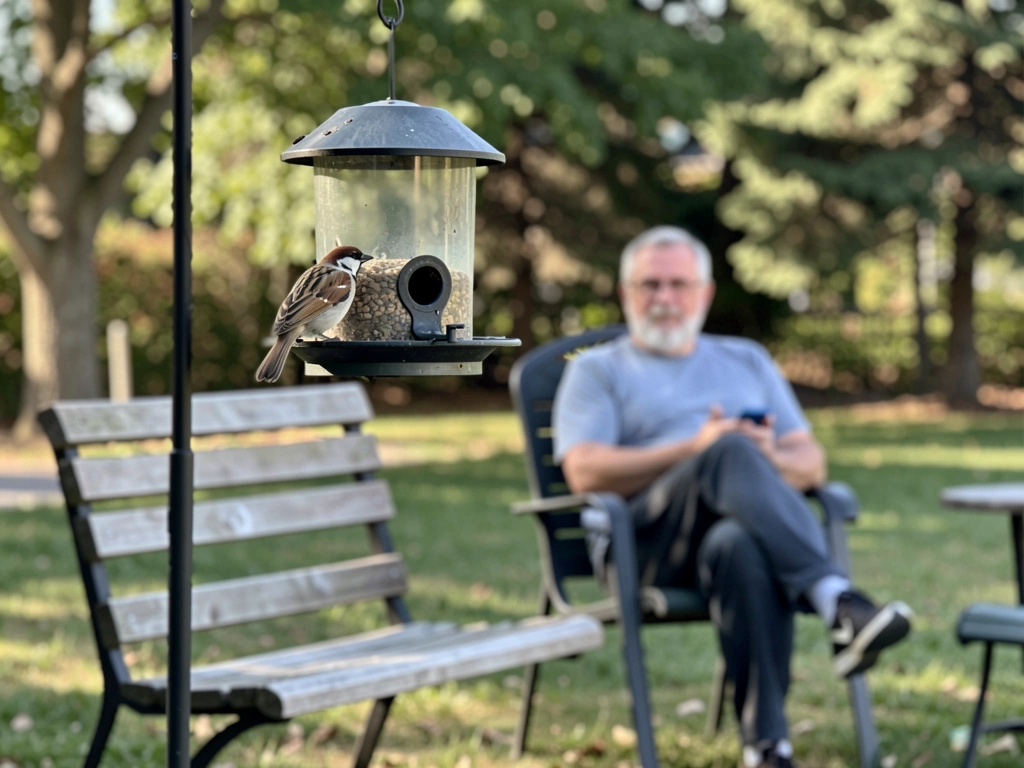
Place feeders and water sources where you can sit nearby without looming over them. A patio chair or bench a few meters away is a good starting point. Move incrementally closer over days as the birds become comfortable with your presence. Consistency of timing matters: if you come out at the same time each day, birds start to anticipate and relax around you faster.
Universal trust-breakers to avoid right now
- Rushing toward the bird or making sudden fast movements
- Staring directly and intensely at the bird (predator behavior in bird language)
- Reaching into the cage or toward the bird from above (overhead approach mimics a hawk)
- Forcing the bird to step up or be held before it's ready
- Loud voices, sudden noises, or slamming doors near the bird
- Using gloves or towels as your first point of contact (this almost always triggers panic)
- Letting strangers crowd around the bird before it trusts even you
Reading your bird's body language
You can't build trust if you're missing the signals the bird is sending you. Birds are incredibly expressive once you know what to look for. Learning to read these cues means you'll never push past a bird's comfort zone accidentally, which is the most common reason trust-building stalls. If you get stuck, revisit trust-building basics like positive reinforcement and how it helps with step-by-step progress.
Fear and stress signals
A scared bird will often go very still and quiet with feathers slicked tightly against the body. Watch for darting eyes scanning for escape routes, a crouched posture as if ready to launch, and leaning or moving away from you. These are all clear signals to back off and give more space. Continuing to approach a bird showing these signs is the single biggest mistake beginners make.
Aggression and overstimulation signals
Puffed feathers around the head and shoulders, wings held slightly out from the body, a fanned tail, an open beak, and eye pinning (the pupil rapidly dilating and contracting) all indicate a bird that is aroused, overstimulated, or about to bite. This isn't the same as fear but it's equally important to respect. Stop, step back, and give the bird a chance to settle before continuing.
Relaxation and positive engagement signals
A relaxed bird will show slow, soft blinking, slightly fluffed feathers in a comfortable (not tight or extreme) way, and may grind its beak or even start to groom itself near you, which is a strong sign of comfort. Vocalizing in a relaxed tone, leaning toward you rather than away, or offering to step onto your hand voluntarily are all green lights. Slow blinking back at a relaxed bird is a genuinely useful tool: it's widely considered a non-threatening, friendly signal in bird body language.
| Signal | What it means | What to do |
|---|---|---|
| Slicked feathers, crouching, darting eyes | Fear / stress | Stop, move back, reduce pressure |
| Leaning away, moving to far side of cage | Uncomfortable with your proximity | Give more space, slow down |
| Puffed head feathers, open beak, eye pinning | Aggression / overstimulation | Stop interaction, wait for calm |
| Slow blinking, soft feather fluff, beak grinding | Relaxed and comfortable | Good time to gently progress |
| Leaning toward you, vocalizing softly | Curiosity / positive engagement | Reward, continue at current pace |
| Voluntary step toward or onto your hand | Active trust signal | Reward immediately and warmly |
Training basics: positive reinforcement, treats, and step-up progression
Positive reinforcement is the backbone of <a data-article-id="35470A58-2E24-4AA0-B885-4F9F2E0BED68">trust-building with birds</a>. The concept is simple: you mark a desired behavior the instant it happens and immediately follow it with something the bird values. Over time, the bird learns that choosing to engage with you leads to good things. This is far more effective than any form of pressure or correction, and it keeps the whole process stress-free.
Choosing a marker and finding the right treat
A clicker (a small plastic device that makes a distinct clicking sound) works brilliantly as a behavior marker because the sound is precise and consistent. The marker bridges the exact moment of the desired behavior and the delivery of the reward, which is crucial for the bird understanding what it's being rewarded for. If you don't have a clicker, a short verbal marker like a bright 'yes' works too. The key is consistency: always use the same sound, always follow it immediately with a treat.
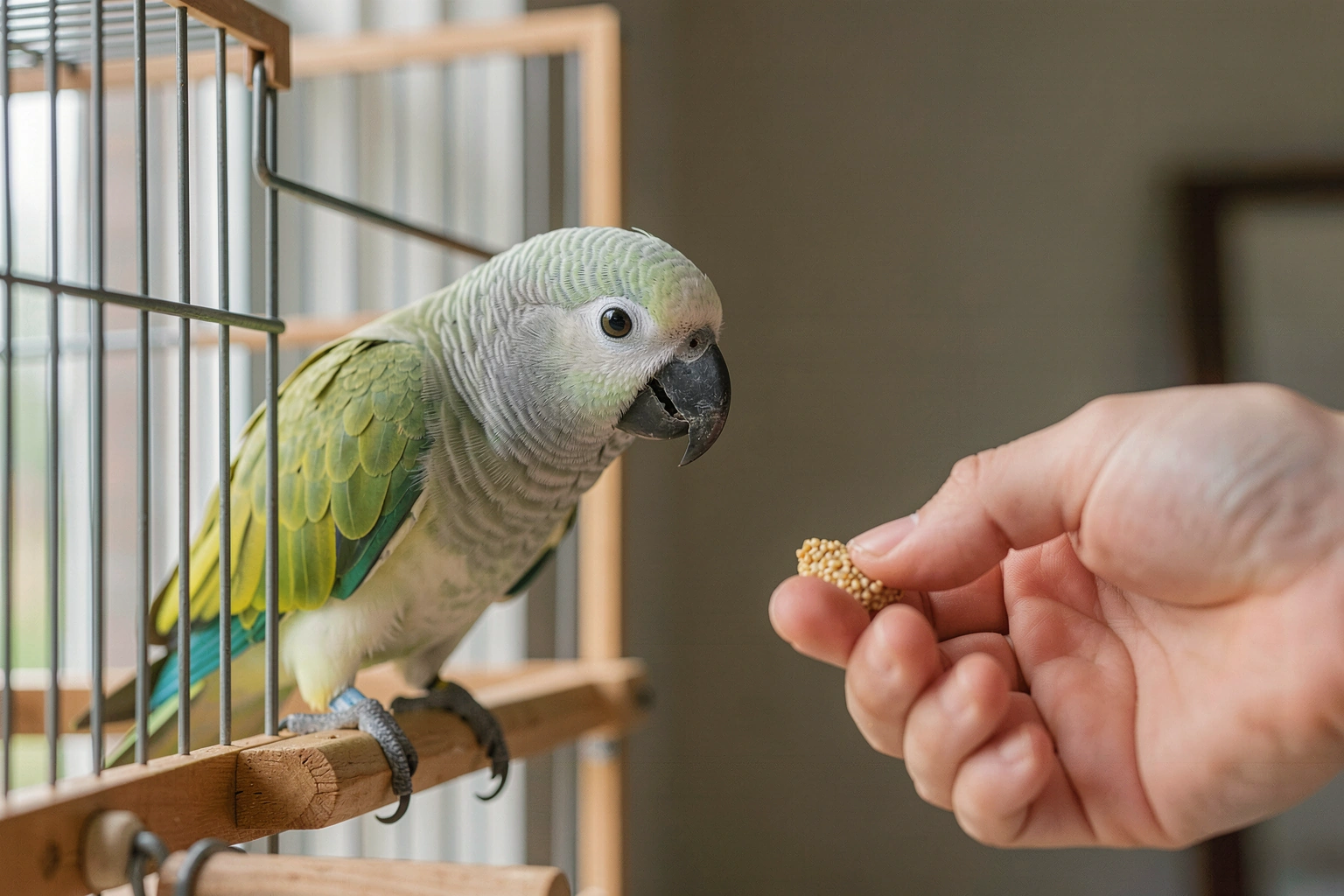
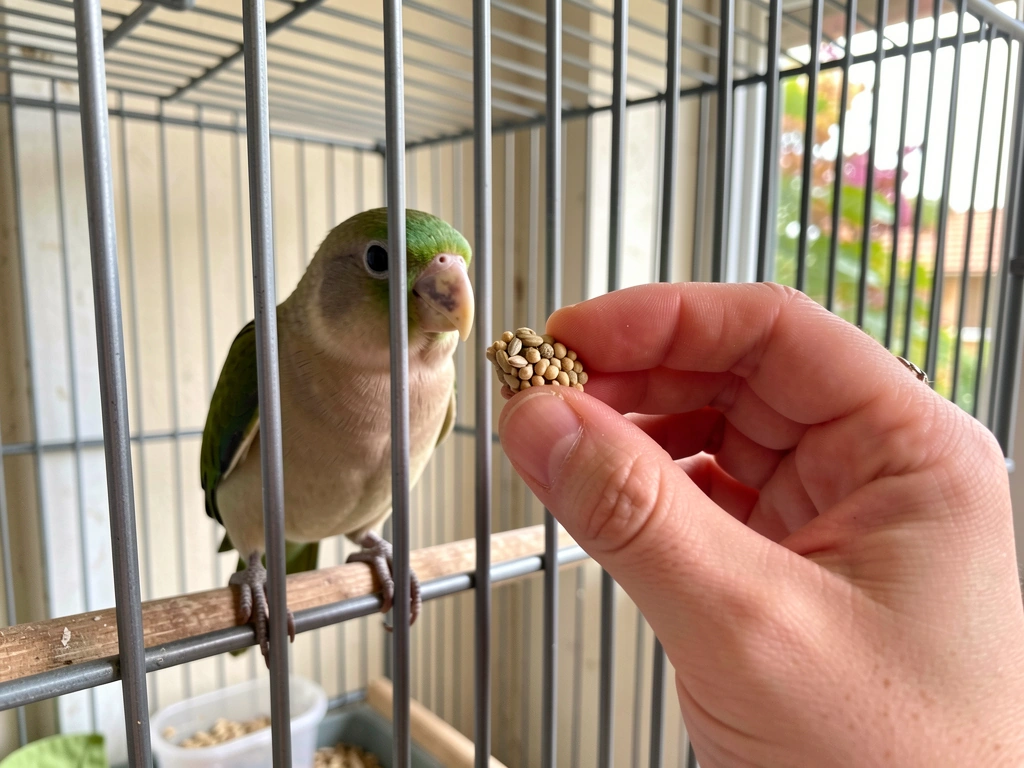
Find what your bird goes absolutely nuts for. Common high-value treats include millet spray for small birds like budgies and finches, pine nuts or almonds for parrots, and sunflower seeds for many medium-sized birds. Use these treats only during training sessions so they stay special. Keep sessions short: 5 to 10 minutes maximum, two to three times a day. Birds learn quickly but also fatigue quickly, and a frustrated or overstimulated bird won't make progress.
The step-by-step progression toward hand trust
- Start by simply sitting near the cage and talking softly. Reward any calm, relaxed behavior with a treat tossed gently into the cage (no reaching in yet).
- Move closer to the cage door over several sessions. The bird should stay calm and relaxed as you approach before you move to the next step.
- Offer treats through the cage bars or just inside the door opening, letting the bird come to you. Don't push your hand toward it; hold still and let the bird make the choice.
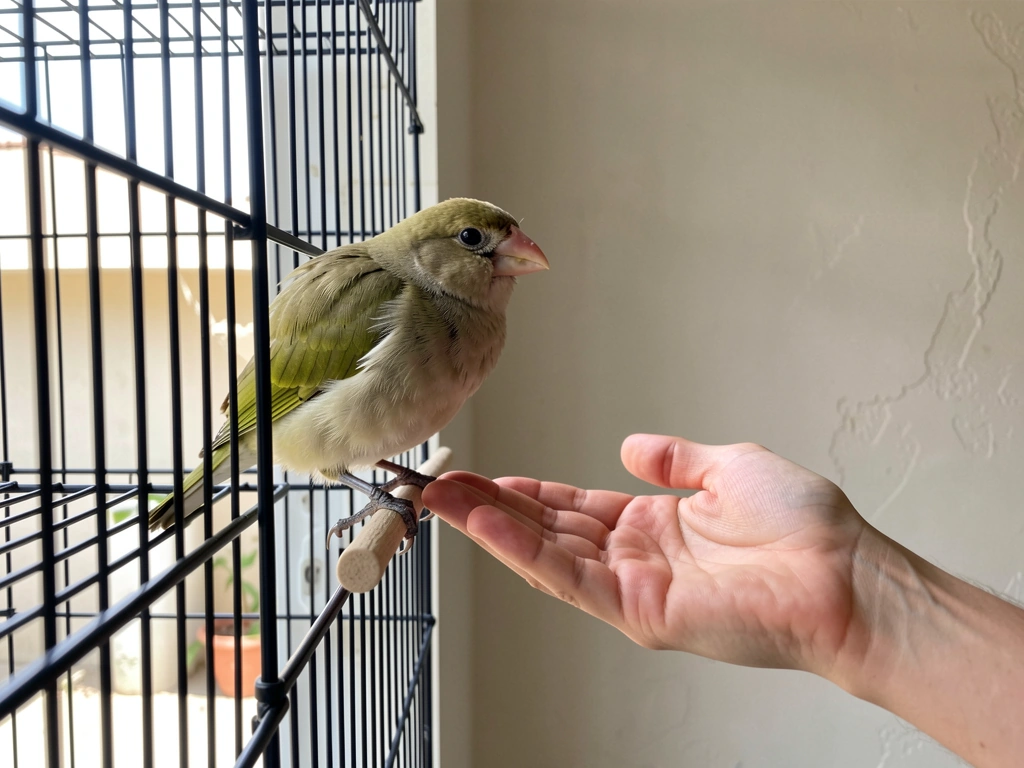
- Once the bird reliably approaches your hand for treats inside the cage, introduce your open flat hand as a perch option near the cage exit. Let the bird investigate without pressure.
- Teach the step-up cue: gently press a treat-holding hand or finger against the bird's lower chest (just above the feet) while saying 'step up.' The bird's natural balance response is to step forward. Reward immediately when it does.
- Practice step-up in short sessions until it's reliable, then gradually extend the duration of perching on your hand before rewarding.
- Once step-up is solid inside the cage or doorway, begin practicing in new locations around the room, always keeping sessions positive and ending on a success.
Never rush any of these steps. Best Friends Animal Society puts it plainly: rushing damages the trust you're building. If the bird regresses, go back to the previous step without frustration and rebuild from there.
Gaining trust with a scared or traumatized bird
A bird that's been poorly handled, neglected, or rehomed multiple times needs a different starting pace. These birds often have a well-established fear response to humans, and you can't train your way through that with treats alone. You need to change the emotional association first, then layer in training.
This is where systematic desensitization combined with counterconditioning comes in. Systematic desensitization means gradually exposing the bird to the thing it fears (you, your hand, your presence) at a distance and intensity low enough that it doesn't trigger fear. Counterconditioning means pairing that exposure with something the bird loves, like its favorite treat. Together, these tools slowly shift the bird's emotional response from 'danger' to 'neutral' to 'actually pretty good.'
Practically, this looks like: you sit across the room reading a book, and every time the bird looks at you calmly (rather than freezing or alarm calling), something good happens nearby. You're not demanding the bird look at you or come to you. You're just being a calm, good-things-nearby presence. Gradually, over days or weeks, you move closer in tiny increments, only when the bird is consistently relaxed at the previous distance.
Avoid towel-grabbing or any forced restraint as an early contact strategy. LafeberVet is clear that first contact should almost never be a rapid towel covering and physical restraint. That kind of experience can set fear conditioning back significantly. If you ever do need to use a towel (for example, for a vet visit), there are gentler shaping methods where the bird is trained to voluntarily step onto or into the towel, using it as a target rather than a capture tool.
Keep petting limited in early stages, and when you do pet, focus on the head and neck. Many birds become overstimulated by body petting, which can lead to frustration or hormonal issues over time. Other people in your household should follow the same rules: no grabbing, no forcing, no overwhelming the bird with attention before it's ready.
Helping a new bird settle and bond fast
The first week with a new bird is critical for setting the tone of your whole relationship. The temptation to interact constantly is understandable, but restraint in the early days pays off in a much faster bond overall.
For the first two to three days, give the bird space to decompress. Keep the environment quiet, maintain a consistent routine around the cage (feeding, cleaning, passing by), and let the bird observe you without feeling pressured. Talk to it while you do things nearby: birds pick up on vocal tone quickly, and a calm, cheerful voice becomes associated with safety.
By the end of the first week, most new birds will have started showing relaxed body language around routine activities. That's your green light to begin the step-by-step treat progression described above. Move through the steps based on the bird's readiness, not a fixed schedule. Some birds (young hand-reared birds, for example) may be ready for step-up practice within a week. A previously neglected adult bird might need three to four weeks of just getting comfortable before treat training makes sense.
Establish a daily routine the bird can predict: same wake-up time, same feeding schedule, same quiet evening wind-down. Predictability genuinely reduces stress in birds. Cover the cage at night at the same time, uncover it at the same time each morning. These small consistencies stack up into a sense of safety that makes trust-building dramatically faster.
If you have other birds, remember the 30 to 45 day quarantine before any introduction. This protects your existing birds' health and also lets your new bird fully settle without additional social pressure. Rushing this step is one of the most common mistakes new bird owners make.
Your progress plan, realistic timelines, and what to do when it's not working
Realistic timelines by starting point
| Bird type / situation | Typical time to basic hand trust | Notes |
|---|---|---|
| Young, hand-reared pet bird | Days to 1–2 weeks | Already socialized; needs consistency and routine |
| New adult pet bird (well-socialized) | 2–4 weeks | Adjustment period first, then fast progression |
| New adult bird (shy or under-socialized) | 1–3 months | Slow desensitization needed before treat training |
| Rescue or traumatized bird | 3–6+ months | Counterconditioning required; no shortcuts |
| Wild bird (hand feeding goal) | 4–12+ weeks | Species-dependent; some never reach hand contact |
Your week-by-week framework
- Week 1: Decompress and observe. Sit near the cage daily, talk softly, maintain routine. No hands in the cage yet.
- Week 2: Begin treat introduction. Offer high-value treats through bars or near the door. Note when the bird approaches vs. retreats.
- Week 3: Open-hand treat delivery near or just inside the cage door. Let the bird make the approach. Mark and reward every step forward.
- Week 4 onward: Begin step-up training if the bird is reliably coming to your hand for treats. Progress at the bird's pace, not yours.
Troubleshooting common stalls
If your bird has stopped progressing or seems to be getting more fearful, run through this checklist before changing your approach.
- Are you going too fast? Go back one step and consolidate before moving forward again.
- Is your treat actually high-value enough? Try a different food. A bird that isn't highly motivated by the treat won't work through mild discomfort for it.
- Are you training when the bird is hungry? Birds learn best when slightly food-motivated but not starving. Mid-morning or just before a regular meal works well.
- Are your sessions too long? Cap at 5 to 10 minutes. Fatigue kills progress.
- Is someone else in the household undermining the training with forced handling or rough interactions? Everyone needs to follow the same approach.
- Is the bird actually unwell? Birds mask illness well. If a bird suddenly becomes much more withdrawn or stops eating, see an avian vet before continuing training.
- Have you been consistent? Missing several days of sessions resets progress faster than most people expect.
One of the most important things to internalize is that trust with a bird is not linear. You'll have good days and bad days. A bird that stepped up happily yesterday might refuse today because it's molting, or the weather changed, or there was a loud noise outside. Don't take it personally and don't respond by pushing harder. Acknowledge the off day, end on a small easy win (something the bird can do comfortably for a treat), and try again tomorrow.
If you're working with a bird that's genuinely fearful or has a trauma history, consider reaching out to a certified avian behavior consultant for personalized guidance. What you're building here is a lifelong relationship. The time you invest now in doing this slowly and correctly will make every year after much easier and more rewarding for both of you.
FAQ
How do I know when it is safe to progress from sitting near the cage to using my hand?
Start with very small “permission-based” cues. Offer a treat through the bars first, then reward calm eye contact, then reward turning toward you, and only after that try a hand that stays still and open. If the bird freezes, leans away, or does repeated head jerks, stop the progression and go back a step, because those are signs you are exceeding its current flight comfort zone.
What is the biggest mistake people make when switching from talking near the cage to offering treats?
Use a predictable cue that happens every time you present the reward, like a specific word plus the same hand position, then keep your body movement minimal. Birds can learn timing, so if you start rushing, sweeping your arm in, or reaching from above, the bird may associate your hand with sudden changes rather than rewards. Keep sessions short and end while the bird is still showing relaxed, interested behavior.
My bird’s trust seemed to progress, then suddenly stopped. What should I check first?
Molting, weather swings, hormonal cycles, and even poor sleep can temporarily raise fear or irritability, so “stalled trust” is not always training failure. Instead of adding more handling, adjust for the trigger by lowering intensity (more distance, calmer pace) and look for an easy win, like taking a treat without approaching your hand. Reassess after the bird has had a few calmer days.
Should I take my bird out of the cage to build trust faster?
Do not remove the bird from the cage for early trust training. Keep the bird in its familiar area, with the cage door closed during most steps. If you are working toward step-up, practice with the bird already calm near the cage and use a target-style approach, then stop immediately if the bird shows “ready to launch” posture or frantic scanning.
How can I teach step-up without creating fear or using force?
If you want a bird to step onto you, set up “options” so the bird can choose. Use a perch or your hand as a stable target, hold it at a height the bird can reach comfortably, and reward any forward movement toward it. If the bird backs away or pins its eyes with a tense body, pause and reward relaxed behavior instead of forcing the step-up.
I’m trying with wild birds at my feeder, how do I avoid scaring them off while still making progress?
For wild birds, expect coexistence before hand-feeding. The practical target is shrinking the flight initiation distance, not immediate contact. Also, location matters, place food where the bird can eat while still watching you from cover, and keep your presence consistent at the same distance and times. If the birds stop coming, you likely reduced safety signals by moving too quickly or changing the spot.
How often should I use high-value treats, so I build trust instead of just training for food?
Treat frequency should not turn into constant bargaining. Use high-value treats only for brief sessions (a few minutes) and reward the specific calm behavior you are targeting, then return to normal feeding routine. If you over-reward proximity without any calming cues, the bird may become food-focused and less comfortable with you.
What if I adopted an older or previously neglected bird and treats don’t seem to help?
Some birds take longer because their threat history changes their baseline, so your timeline should match the bird, not your expectations. Look for readiness signs like relaxed blinking and steady posture during your presence. For tougher cases, emphasize counterconditioning at distance for weeks before any step-up goals, and keep intensity low enough that the bird can repeatedly stay calm while pairing you with good outcomes.
How do I tell whether my bird’s fear is behavioral versus a possible medical issue?
If you suspect a health problem, pause training intensity and consult an avian vet, because pain, breathing issues, and digestive discomfort can make birds fearful or defensive. Molting can also cause sensitivity. Avoid interpreting everything as “behavior,” if the bird shows sudden changes like lethargy, fluffed feathers all day, open-mouth breathing, or decreased appetite.
My bird tolerates being near me but hates petting. Is that still trust?
If a bird dislikes body contact, focus on building trust through proximity, calm handling of the environment, and optional step-up rather than forced petting. When petting is allowed, keep it brief and confined to the head and neck, and stop at the first signs of overstimulation like wing tension, tail fanning, or head bobbing. Not every bird will enjoy handling, and that is still progress.
How should I manage introductions to other birds while I’m trying to gain my new bird’s trust?
If you share space with another bird, do not introduce during the initial settle-in period. Use the separate-room quarantine window to decompress, then only progress to controlled interaction when the new bird is stable and cleared by your avian vet. Rushing introductions can overwhelm the new bird and also increase stress behaviors that slow trust building.
Next Article
How to Teach a Bird to Fetch Step by Step Guide
Humane, step-by-step training to teach your bird to fetch safely, with targets, rewards, troubleshooting, and gradual re