Getting a bird used to you comes down to one core principle: <a data-article-id="7712A773-2BCE-4DBF-AAE1-EB0FE5C706D2">letting the bird choose to engage rather than forcing it to</a>. That might sound slow, but it's actually the fastest path. Birds that are pushed, grabbed, or overwhelmed tend to become more fearful over time, not less. The approach that works, whether you have a new budgie, a rescue cockatoo, or a parrot that's decided it hates you, is the same: reduce stress, build predictability, and give the bird small wins every single day. If you want a more specific, step-by-step guide on building that calm comfort, see how to make a wild bird like you as a related approach.
How to Get a Bird Used to You: Step-by-Step Trust Guide
Maya Harris
22 Mar 2026
Understanding why your bird isn't comfortable yet
Birds are prey animals. Their default response to anything unfamiliar, including you, is caution or outright fear. That's not a personality flaw or a sign that your bird doesn't like you. It's survival programming. Understanding that changes everything about how you approach the process.
The first thing to get good at is reading your bird's body language. Fear and excitement can look surprisingly similar from a distance, but they mean very different things. A fearful bird typically holds its feathers slicked tight against its body, stands tall with its head pulled back, keeps its mouth slightly open, and scans the room with darting eyes looking for an exit. You might also see it crouching low or leaning away from whatever is scaring it. An excited bird, on the other hand, may fan its tail, pin its pupils (the iris rapidly contracts and dilates, called eye pinning), and vocalize loudly. The problem is that high excitement can tip quickly into aggression, so pinned eyes paired with puffed feathers or a leaning-forward posture are a warning: back off before a bite happens.
A relaxed bird looks completely different. Soft eyes, slightly fluffed feathers (but not slicked flat), one foot tucked up, willingness to eat near you, and quiet contact calls are all green lights. If your bird is preening in your presence, that's a great sign. Preening is something birds only do when they feel safe enough to let their guard down.
There are several common reasons a bird isn't comfortable yet. A bird may have had limited human contact early in life, been handled roughly or frightened in a previous home, experienced something stressful during transport or a vet visit, or simply not had enough time to adjust to a new environment. Some species are naturally more cautious than others. Cockatiels and budgies generally warm up faster than African greys or Amazons, which tend to be more sensitive and take longer to trust new people. Wherever your bird is starting from, the process is the same; only the timeline changes.
One more thing worth checking early: if your bird suddenly seems fearful or starts biting a lot after previously being friendly, that can signal a medical issue. Pain and discomfort show up as behavior changes in birds, and birds are exceptionally good at hiding illness. A sudden shift in temperament warrants a visit to an avian vet before you do any intensive trust-building work.
Set up a low-stress environment and routine
Before you ever start working with your bird directly, the environment does a lot of the trust-building for you. A bird that feels physically safe in its space will have lower baseline stress, which makes every interaction easier.
Cage placement matters more than you'd think
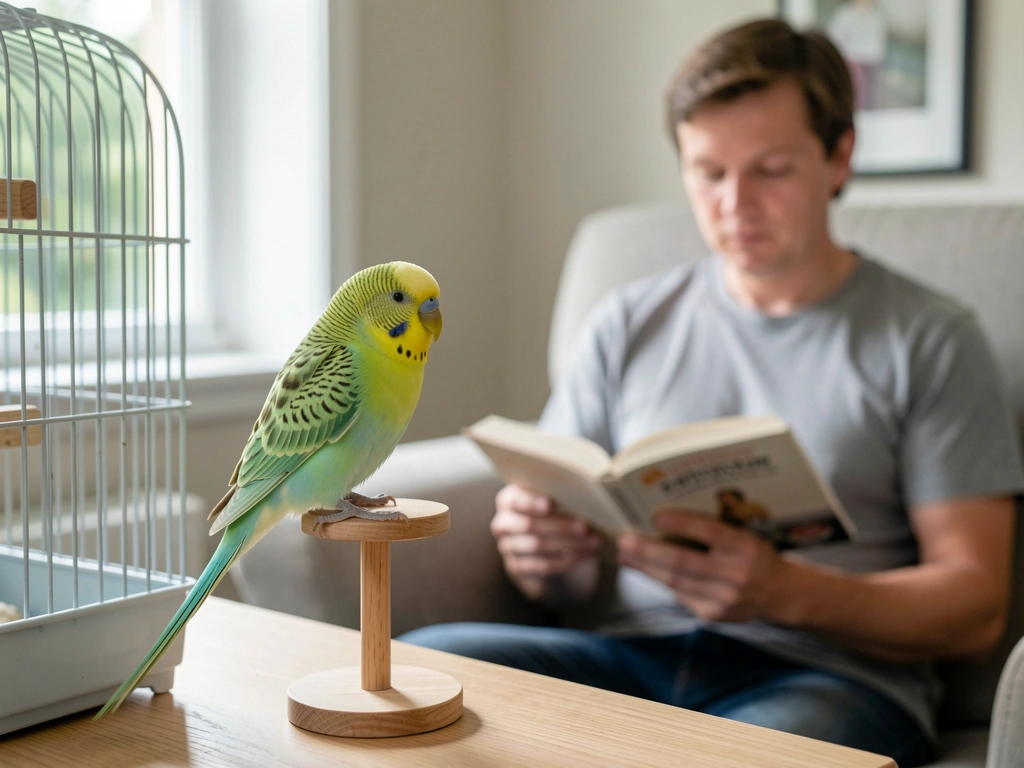
Place the cage away from high-traffic areas, drafty windows, and exterior doors. At the same time, your bird needs to be able to see family members going about their day. That social visibility helps the bird learn that humans are predictable and non-threatening without requiring direct interaction. A good position is along a wall or in a corner of a frequently used room, like a living room or home office, where the bird can observe but also retreat to the back of the cage if it feels overwhelmed. Having one solid wall or corner behind the cage gives the bird a psychological sense of security.
Keep the cage out of the bedroom if you can. Birds need consistent quiet time at night, and a cover over the cage helps signal "sleep time" and reduces overnight disturbances.
Routine is your most underrated tool
Birds are creatures of habit, and predictability reduces anxiety. Feed, clean, and interact at the same times every day. When a bird knows what's coming next, it doesn't have to be on high alert all the time. If multiple people live in your home, have the same one or two people handle feeding and interaction at first. Once your bird is comfortable with those people, you can gradually introduce others.
Outside the cage, the RSPCA recommends providing tabletop stands or perches in the room so your bird has safe places to land and rest while it's out. This gives the bird agency: it can choose to be near you or move away, and that choice is central to building real comfort. Don't assume a new bird will fly well right away either. Flight is a learned skill that may need time to develop, especially if the bird was clipped previously.
Build trust with presence, voice, and positive reinforcement
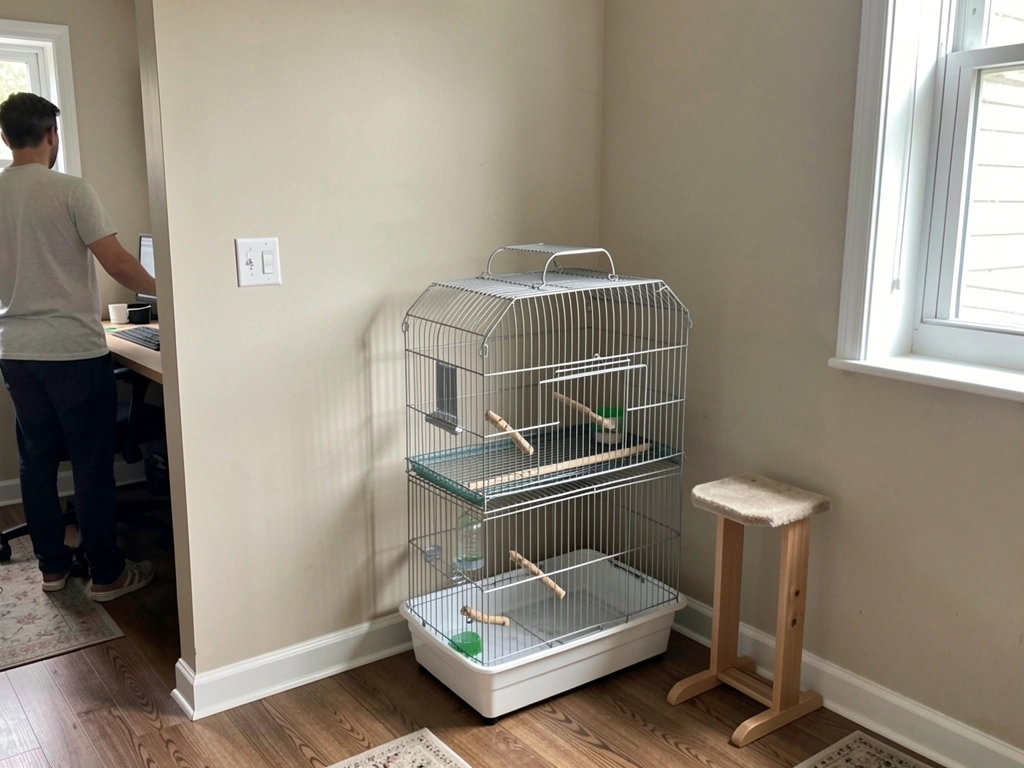
The single best thing you can do in the first days or even weeks with a new or fearful bird is simply exist near it without asking anything of it. Sit near the cage and read, work, or talk softly. Don't stare at the bird directly (direct eye contact can feel threatening to prey animals) but let it get used to your presence, your voice, and your movements.
Talk to your bird in a calm, low, even tone. It doesn't matter what you say. Read the news out loud, narrate what you're doing, or just say its name softly. Your voice is one of the most powerful trust-building tools you have because birds are highly auditory and will start associating the sound of your voice with safety and routine. Avoid loud sudden noises around the bird, especially in the early days.
The goal at this stage is for your bird to keep eating, vocalizing softly, or engaging in normal behaviors while you're nearby. As you do this, you will learn how to get a bird to trust you without triggering fear your bird to keep eating, vocalizing softly, or engaging in normal behaviors while you're nearby. That's positive reinforcement happening naturally: the bird is learning that your presence predicts good, normal things, not stress. Don't rush past this stage. Some birds need a few days; others need a few weeks. Watch the body language and let the bird set the pace.
Positive reinforcement is the foundation of everything that follows. This means that every time the bird does something you want (looking at your hand calmly, moving toward you, not flinching when you raise your arm), something good follows. That "something good" is usually a favorite treat, but it can also be a gentle word of praise, the sound of a clicker, or access to a favored toy. The key is timing: the reward needs to come within a second or two of the behavior, or the bird won't connect the two.
Train step-by-step: from treating nearby to accepting touch and handling
Think of trust-building as a ladder with clear rungs. You don't jump from rung one to rung five. Each step needs to be solid before you move to the next. Here's how that progression looks in practice.
- Comfortable with your presence at a distance: The bird eats, plays, or vocalizes normally while you're in the room. You're not interacting directly yet.
- Comfortable with your approach: You can walk toward the cage without the bird becoming fearful or fleeing to the far side. The bird may watch you with curiosity instead of alarm.
- Comfortable with your hand near the cage: You can place your hand near (not inside) the cage bars and the bird stays calm or approaches to investigate.
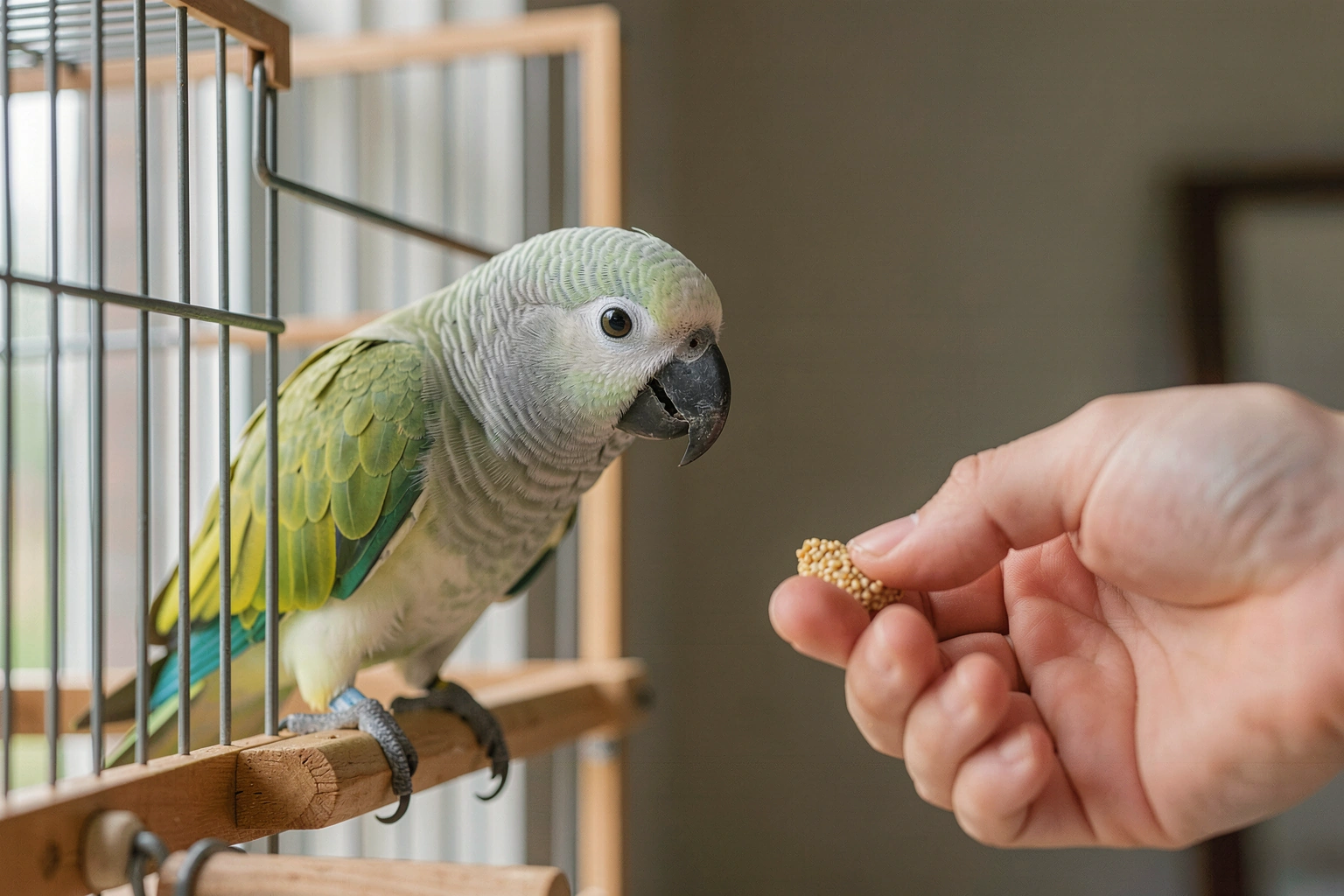
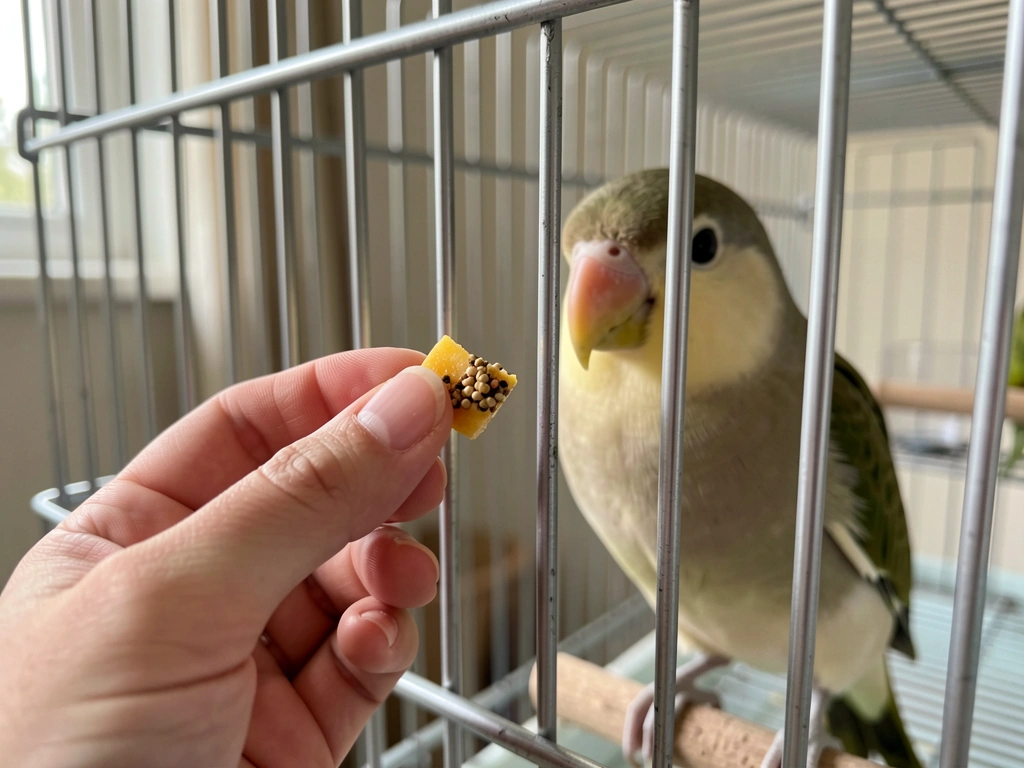
- Takes a treat from your hand through the cage bars: The bird is willing to eat from your fingers while still inside the cage. This is a big milestone.
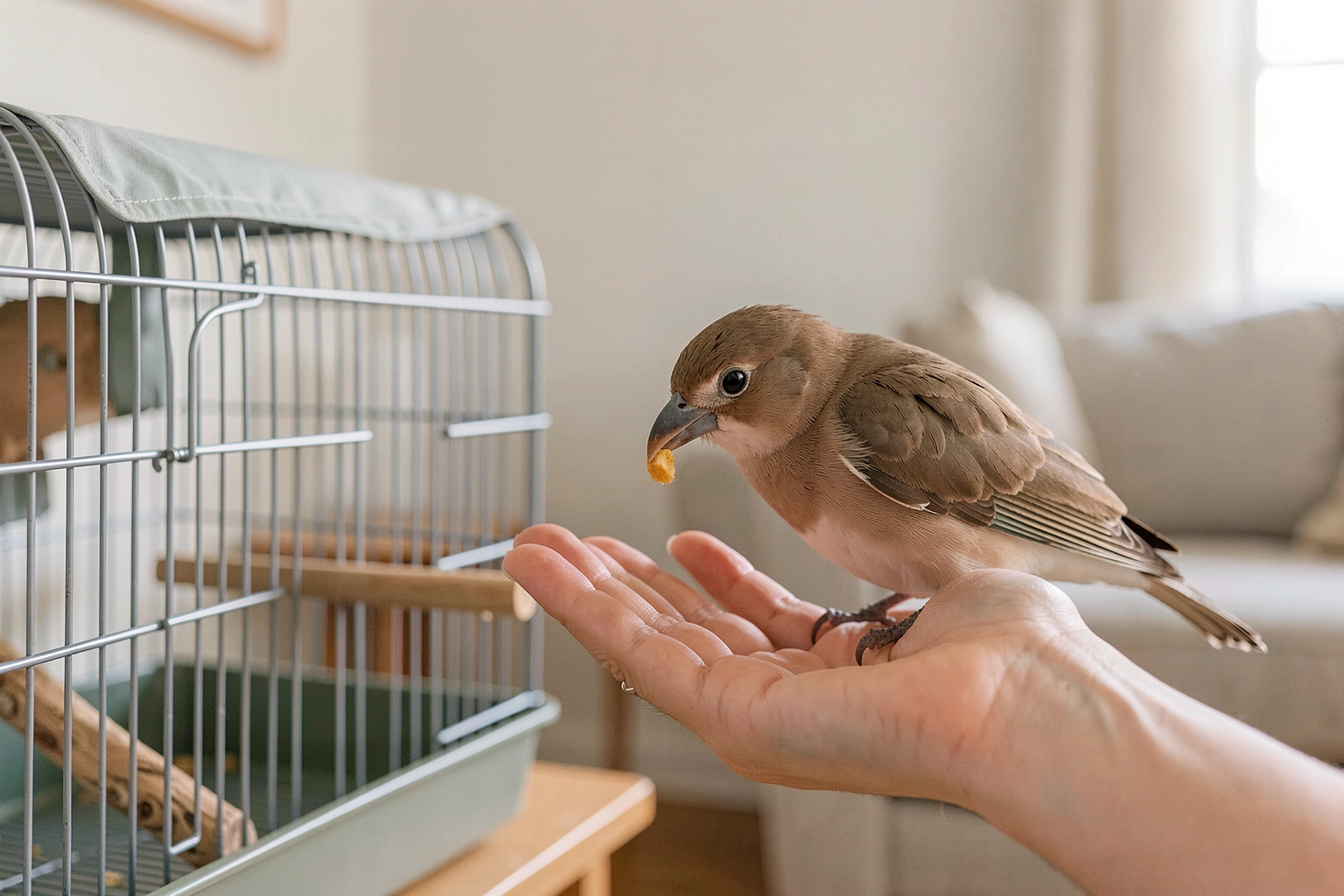
- Takes a treat from your hand with the cage door open: The bird approaches your hand voluntarily to take food while having the option to move away.
- Steps onto your hand voluntarily: Using a treat as motivation, the bird steps up onto your finger or hand without fleeing, lunging, or biting.
- Accepts gentle touch: After step-up is reliable, you introduce brief, gentle head scratches or touch on the beak area, building duration slowly.
- Accepts handling in different contexts: The bird is comfortable being picked up, moved to different rooms, and interacting with other people.
The step-up specifically deserves attention because it's one of the most useful behaviors you can teach. Position your finger or hand just above the bird's feet and apply light pressure to its lower belly while offering a treat. The natural response is to step forward and up. The moment the bird puts a foot on your hand, reward it immediately. Once that's reliable, gradually increase the duration before rewarding and start moving the bird short distances. Only begin moving the bird out of the cage once step-up is consistently comfortable inside the cage.
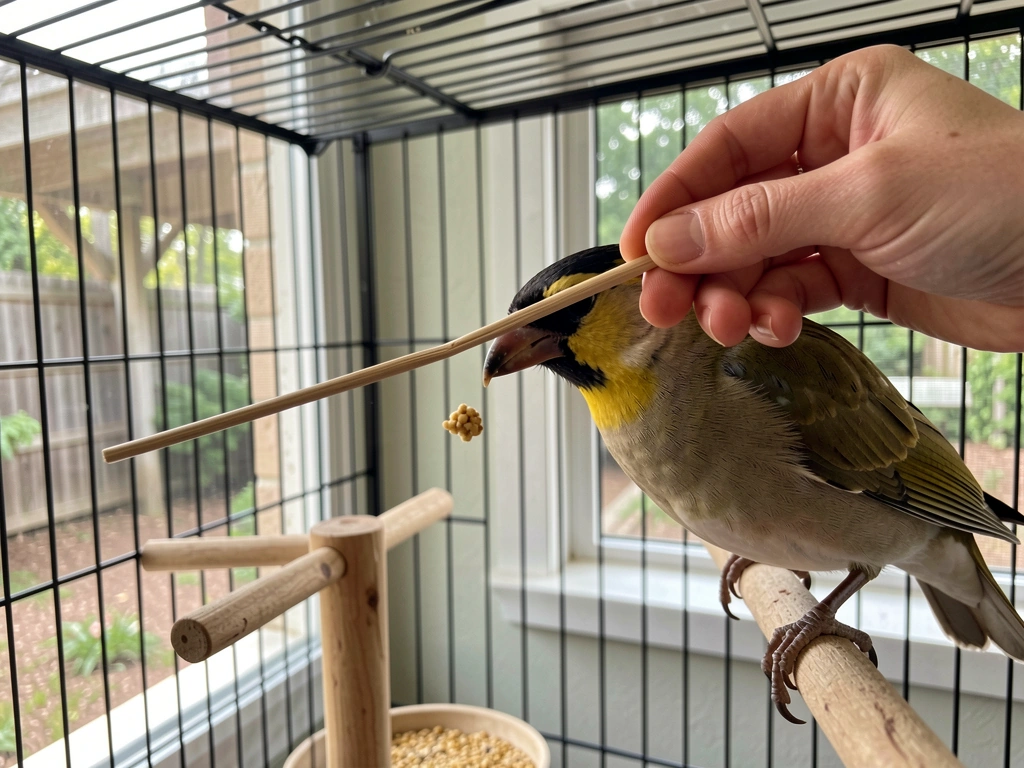
A good intermediary step before touch or step-up is target training. You present a target (a chopstick, the end of a pencil, or a commercially made target stick) and reward the bird when it touches the target with its beak. This gets the bird moving toward things voluntarily and gives you a way to guide it without physical pressure. It builds confidence fast and can set up step-up and other behaviors naturally.
Using treats and timing effectively (desensitization approach)
Treats are your most powerful tool, but only if you use them strategically. First, figure out what your bird actually values. Some birds go wild for millet spray. Others prefer a sliver of almond, a bit of apple, or a specific seed they don't get in their regular diet. Test a few options and watch the reaction. The treat you use for training should be something the bird finds highly motivating, not something it can get anytime from its bowl.
Training sessions work best in the morning before breakfast when the bird is food-motivated. Keep sessions short: 3 to 5 minutes maximum. Birds have a limited attention span for formal training, and ending on a positive note before the bird gets frustrated or bored keeps the association with training positive. You can do multiple short sessions throughout the day, but give the bird rest between them.
The desensitization approach means you're systematically exposing the bird to things that would normally cause mild stress (a hand near the cage, a new person, a slightly louder noise) but keeping the exposure below the threshold that triggers fear. The goal is for the bird to have zero fearful response while the treat is being delivered. Over many repetitions, the previously scary stimulus starts to predict good things instead of bad ones. If your bird ever stops taking treats during a session, that's a reliable sign it's over threshold and needs a break or a step back to something easier.
One important rule about treats and vocalizations: don't offer a treat when the bird is screaming to get your attention. That teaches the bird that screaming works. Wait for a brief pause or a quieter vocalization, then reward. Consistency here matters a lot.
If you want to add a clicker to your training, it can sharpen your timing considerably. The click sound marks the exact moment the correct behavior happened, and then the treat follows. Clicker training for birds follows the same principles used in other species and is well-documented as an effective method for building complex behaviors over time.
Troubleshooting fear and aggression: biting, screaming, and hiding
Almost every owner runs into one of these three problems. Here's how to handle each one without making things worse.
Biting
Biting is almost always communication, not malice. It usually means the bird is telling you it's uncomfortable, overstimulated, or scared and you missed the earlier warning signs. Common warning signs before a bite include eye pinning, leaning forward, raising one foot, flattening feathers, or a rapid head bob. If you see those, back off immediately. Reacting to a bite by pulling your hand back fast, yelling, or dropping the bird can reinforce the behavior by teaching the bird that biting makes scary things go away. Instead, stay calm, set the bird down gently, and end the session.
If biting is frequent and intense and seems to come out of nowhere with no warning, get a vet check. Sudden-onset biting in a previously calm bird can signal pain, illness, or hormonal changes, especially in adult birds during breeding season.
Screaming
Some screaming is completely normal, especially contact calls in the morning and evening. Problem screaming usually develops when a bird learns that screaming brings you running. The fix is not to reward screaming with attention or treats. Come back into the room when the bird is quiet, even briefly, and reward that. Make your departures and arrivals low-key. If you react dramatically every time you leave or return, the bird's separation anxiety gets worse. Also make sure the bird has enough enrichment in the cage to keep itself occupied when you're not around.
Hiding or refusing interaction
A bird that consistently hides at the back of the cage or behind cage accessories when you approach needs you to go back to the very beginning: sitting near the cage without asking anything. Don't open the cage door, don't reach in, just exist nearby. Make sure treats are appearing near (but not requiring interaction with) your hand. Let the bird come to the front of the cage on its own timeline. Forcing a hiding bird into interaction almost always sets the process back significantly.
When to pause everything
Stop all formal training and handling if you see any of the following: open-mouthed breathing, panicked vocalizations that don't stop, physical signs of illness like fluffed feathers and lethargy combined, or a bird that completely refuses food during sessions for multiple days in a row. These are signs of serious stress or possible illness. In those cases, reduce all interaction to quiet presence only and consult an avian vet.
A daily practice plan and when to get expert help
Consistency over a short period beats occasional intensive sessions every time. Here's a realistic daily structure that works for most birds regardless of species or starting point.
| Time of Day | Activity | Duration | What to Watch For |
|---|---|---|---|
| Morning (before breakfast) | Short training session with high-value treats; work on the current step in the progression | 3–5 minutes | Bird taking treats readily, calm body language |
| Mid-morning | Sit near the cage, talk softly, let bird observe you; no demands | 15–30 minutes | Bird eating, vocalizing normally, preening |
| Afternoon | Second short training session or free-flight time with perches available nearby | 3–5 minutes (training) or 20–30 minutes (out time) | Bird choosing to land near you voluntarily |
| Evening | Quiet time near the cage; avoid loud TV or music close to bedtime | 10–20 minutes | Bird settling down, soft contact calls |
| Night | Cover cage, consistent lights-out time | — | Bird quiet and settled within a few minutes |
If you've been consistent for 4 to 6 weeks and you're not seeing any progress at all, something needs to change. First, honestly assess whether sessions are calm enough and whether you've been waiting for the bird to initiate rather than pushing. Second, look at the environment: is there a stressor you haven't identified, like a neighbor's dog, a new smell, or inconsistent caregivers? Third, consider whether you need outside eyes on the situation.
A qualified parrot behavior consultant or avian behavior specialist can watch your interactions in person or on video and identify exactly where the process is stalling. Look for someone who uses positive reinforcement exclusively and has experience with the specific challenges you're facing. Organizations like the International Association of Avian Trainers and Educators (IAATE) and Avian Behavior International emphasize voluntary participation and humane methods, so those are good starting points for finding qualified help.
See an avian vet (not a general small-animal vet, but one with actual bird experience) if your bird shows any signs of illness, if biting escalates suddenly with no behavioral explanation, if the bird seems in pain or distress during interactions, or if you're concerned about anything health-related that might be underlying the fear or aggression. Birds hide illness remarkably well, and a vet can rule out physical causes before you invest more time in behavioral work.
Building trust with a bird is genuinely one of the more rewarding things you can do as a pet owner, and it takes longer than most people expect, which is normal. If you have a lovebird, the same low-stress routine, calm presence, and positive reinforcement approach also covers how to make a love bird trust you. If you want a practical walkthrough, focus on low-stress routines, calm presence, and positive reinforcement to learn <a data-article-id="5AEC2677-8F89-42BC-A76C-4F310690586E">how to build trust with a bird</a>. The birds that end up being the most bonded, interactive companions are almost always the ones whose owners were patient enough to let them set the pace. Stick with it, stay consistent, keep sessions short and positive, and watch the body language. If you want a more specific plan for fear and trust, see how to make your bird not scared of you alongside these low-stress routine and positive reinforcement steps. Your bird will tell you exactly when it's ready for the next step.
FAQ
How long does it usually take for a bird to trust me?
Most birds show noticeable calm around you within days to a few weeks, but true comfort with step-up and handling can take 1 to 3 months. Faster timelines often happen when the bird is already eating well, taking treats near you, and you avoid eye contact, sudden movements, and cage door access early on. Track progress by specific behaviors, like approaching the front of the cage or willingly stepping onto your finger, rather than by “feeling” like they trust you.
What should I do if my bird takes treats from me but still won’t step up?
That’s common, and it usually means the bird feels safe with your presence but not with your hand near its feet or with brief restraint. Go back to target training until the bird confidently touches the target near your hand, then practice step-up with very light belly pressure and a treat right as a foot lands. If the bird startles or leans away, shorten the distance and reduce the amount of time you ask for before rewarding.
Can I speed things up by handling my bird more often?
Often, more handling slows trust. If the bird shows fear signals (slicked feathers, staring at an exit, leaning away) or you see progress stall, increase “nearby presence” and keep direct handling requests minimal. Use short sessions (3 to 5 minutes) and stop while the bird is still comfortable, ending on a success the bird can repeat easily.
My bird seems friendly, but sometimes bites out of nowhere. Why?
Even “friendly” birds can bite when overstimulated or when they have learned that a bite ends an unwanted interaction. Look for subtle buildup, like pinned eyes paired with forward leaning, rapid head bobbing, or sudden stillness before the bite. Prevent it by reading the pre-bite signals, backing off immediately, and resuming at the previous easy step on the next session.
Is eye contact always bad for birds?
You generally want to avoid direct staring, but it’s more about intensity than about seeing your bird. Many birds tolerate brief glances, as long as you are calm, keep your body relaxed, and don’t lean in from above. If your bird responds with fear signs when you face it, switch to side-on positioning and let the bird choose when to look at you.
What does it mean if my bird won’t take treats during training?
Refusing treats usually means you are above the bird’s stress threshold or the treat is not motivating enough. Check timing and distance, move the treat closer to the “safe” area the bird already uses, and reduce the challenge for that day (for example, reward only for staying calm near the cage). If refusal persists for multiple days or the bird also stops eating generally, treat it as a health concern and pause training.
Should I reward screaming with attention when my bird is calling for me?
No, rewarding attention during screaming often teaches the bird that noise is the quickest way to get you to react. Wait for a brief quiet moment, then offer a treat or calm interaction. Keep departures and arrivals low-key so the bird does not learn that your comings and goings are stressful events that require loud protest.
How do I introduce another person if my bird only tolerates me?
Have the new person follow the same routine you already use, with the same feeding times and predictable quiet presence. Start with the person in the room at a distance where the bird is comfortable, then progress to treat delivery near the cage without forcing interaction. Once the bird is willingly taking treats, have that person do a short training session, while you stay consistent and avoid changing multiple variables at once.
My bird hides at the back of the cage. Do I need to open the cage door to help them adjust?
Usually, you should not. Start with cage-side “existence” where you sit near the cage, avoid reaching in, and offer treats near but not directly requiring contact. Let the bird choose when to approach the front. Forcing a hiding bird into stepping onto your hand can reverse progress significantly.
What if my bird is clipped or struggles with flying during bonding?
Clipping can make the bird feel unsafe on perches and can increase stress during out-of-cage time. Provide stable tabletop stands at comfortable heights so the bird can choose to rest without risky jumps, and spend extra time on voluntary steps rather than lifting or chasing. The bird may also need gradual practice getting on and off your hand safely before step-up becomes reliable out of the cage.
When should I stop training and call a vet?
Stop and seek an avian vet if behavior changes include open-mouthed breathing, lethargy, persistent fluffed posture, failure to eat, panicked vocalizations that do not settle, or sudden aggression that appears out of character. Birds hide illness well, so if you see signs that could indicate pain, treat it as medical until proven otherwise.
Next Article
How to Get a Bird to Trust You: Step-by-Step Guide
Step-by-step methods to earn a wild or pet bird’s trust using body language, safe routines, treats, and targets.