Getting a bird "up" almost always means one thing in practice: teaching your bird to step onto your finger, hand, or a handheld perch on cue. Once your bird is comfortable stepping up on cue, you can start building toward safer progress with free flight training how to free fly your bird. That cue is called "step up," and it is the single most important skill a pet bird can learn.
How to Get Bird Up: Step-Up Training for Beginners

Maya Harris
18 May 2026
Once reliable, it lets you move your bird safely, handle it for health checks, and build the kind of trust that makes everything else in training easier. If you want to keep the process simple, focus on teaching the step-up cue first, then practice it daily until it is reliable how to make a bird easily.
If your bird is refusing, backing away, biting, or just not getting it yet, that is completely normal, and this guide will walk you through exactly what to do.
What "get bird up" actually means (and a quick note on the other meanings)
The phrase covers a few different situations depending on who is asking. The most common one, and the one this guide focuses on, is the trained step-up cue: getting your bird to step onto your hand or a handheld stick voluntarily. That is what pet owners, bird trainers, and rehabilitators mean most of the time.
A second meaning is getting a bird to physically move upward, whether that is up to a perch, into a carrier, or up off the floor. Both goals are handled here, because the training approach overlaps significantly. If you landed here looking for help with a wild or injured bird, skip ahead to the safety and legal section before doing anything else.
If you are dealing with an item asylum situation, this guide can help you understand when permits and professional guidance are required before handling a bird skip ahead to the safety and legal section.
One sibling topic worth flagging: if your real goal is keeping your bird from flying away once it is up and out, that is a related but separate challenge covered in free-flight and recall training. And if you are wondering whether your particular species is even ready to learn this, the short answer is that almost any bird can learn the step-up with the right approach and enough patience. If you are trying to pick the easiest bird to train, start with a species that is commonly receptive to hand-feeding and basic cue learning.
Why step-up training matters and what it looks like when it is working
Step-up is not just a party trick. It is genuinely life-saving in the right circumstances. A bird that steps up reliably can be moved away from a dangerous situation, taken to the vet without a toweling struggle, and brought in from an outdoor flight quickly. PetMD specifically notes that the step-up cue can be critical for medical treatment, which means it needs to be practiced regularly so it holds under stress, not just in calm moments at home.
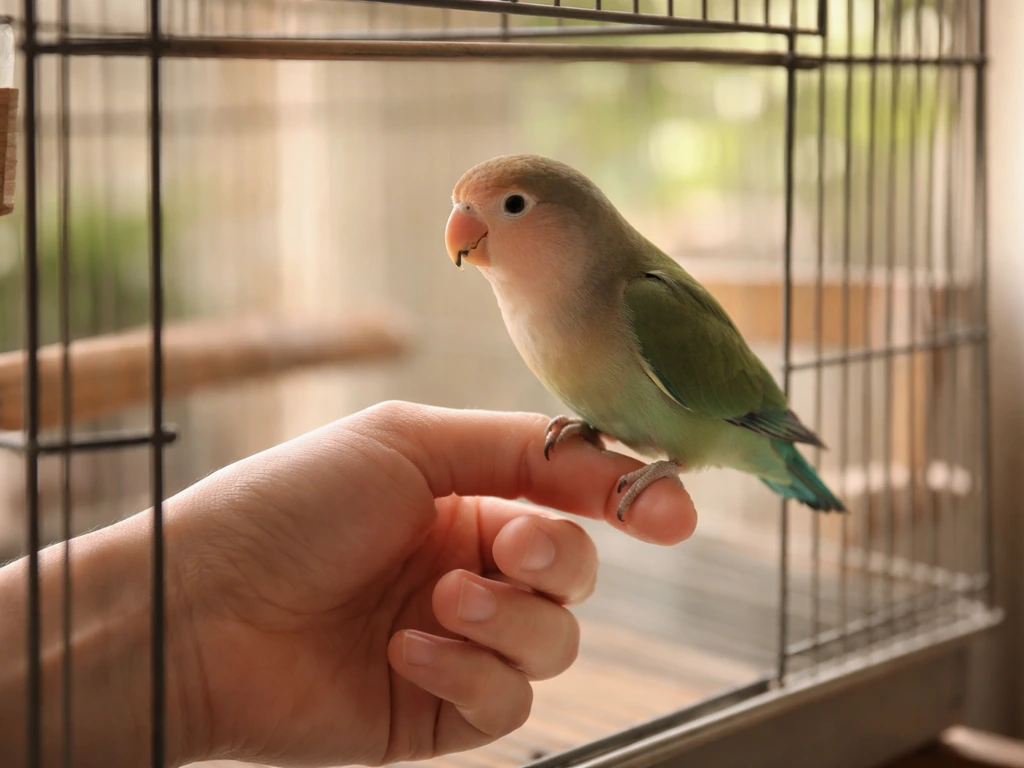
Success looks like this: you present your hand or a perch stick, say your cue word ("step up" or simply "up"), and the bird steps on within a few seconds without hesitation, backing away, lunging, or biting. It does not have to be instant on day one, but that is the goal. When you reach that point consistently across different locations and times of day, you have a reliable step-up.
Set up for success before you start training
Environment matters more than most people realize. Training in a loud, chaotic room with other pets nearby is going to make everything harder. Pick a quiet space with no open windows or ceiling fans on. Keep the session short, around 15 minutes maximum per session, which is enough time to make progress without tipping into overwhelm. Early sessions can be even shorter, just a few minutes.
For your tools, you need three things: a cue word, a treat the bird genuinely loves, and either your hand or a smooth wooden dowel or chopstick as a practice perch. For training and daily practice, these three essentials work together to make step-up reliable cue word, a treat the bird genuinely loves, and either your hand or a smooth wooden dowel. The treat should be something special, reserved only for step-up training and not scattered through the day.
That exclusivity makes it powerful. Common good choices include small pieces of nutrient-dense favorites like a bit of mango, a sunflower seed (for smaller birds), or a pine nut. Pair verbal praise in a soft, calm voice with every treat delivery.
Hand position matters too. When you present your hand or perch stick for the step-up, hold it slightly higher than the bird's current perch level. Birds naturally step upward, so this small height difference encourages the movement. Petco recommends holding the treat just above and in front of the bird while keeping your hand at that elevated position. Avoid coming in from above or from behind, both of which read as threatening.
- Quiet room, no distractions or loose pets nearby
- Sessions of 15 minutes or less (shorter for nervous or young birds)
- Special treat reserved only for this training context
- Soft verbal praise paired with every treat
- Hand or dowel presented slightly above the bird's current perch
- Calm body language and slow movements throughout
The step-by-step progression from nervous bird to reliable step-up
This is not a one-session process for most birds. Work through each stage at the bird's pace. If a bird seems distressed, back up one stage rather than pushing through. The RSPCA puts it simply: always go at their pace, and stop if the bird seems uncomfortable. That is not being soft, that is how you get lasting results.
Stage 1: Desensitize to your presence and hand
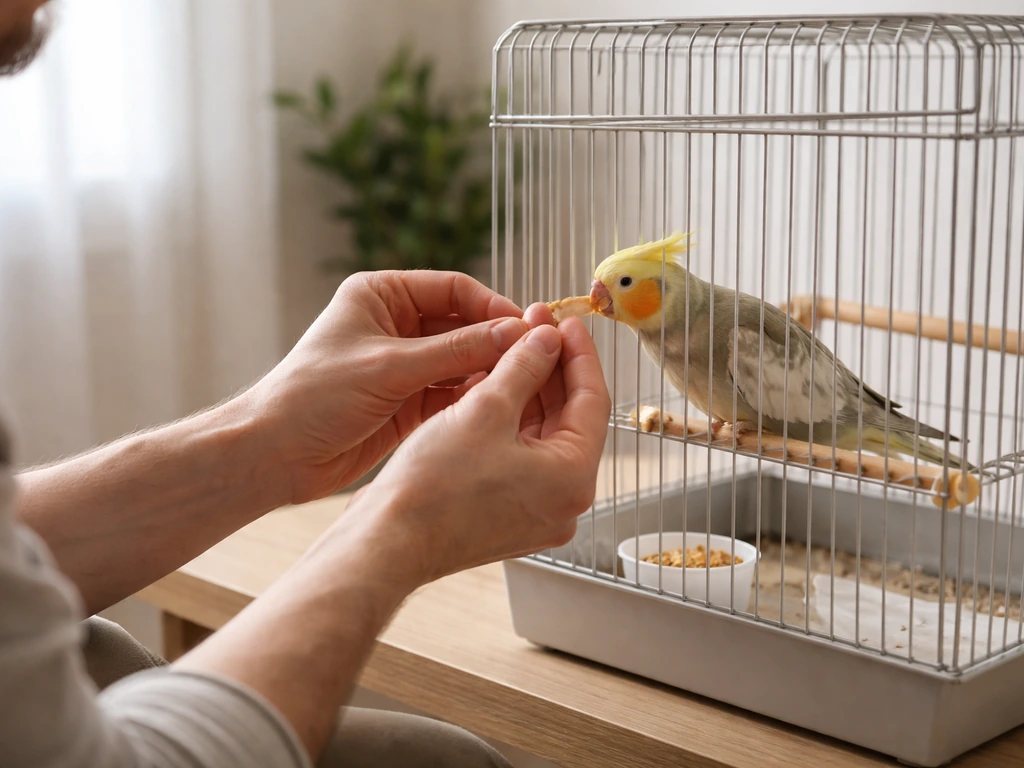
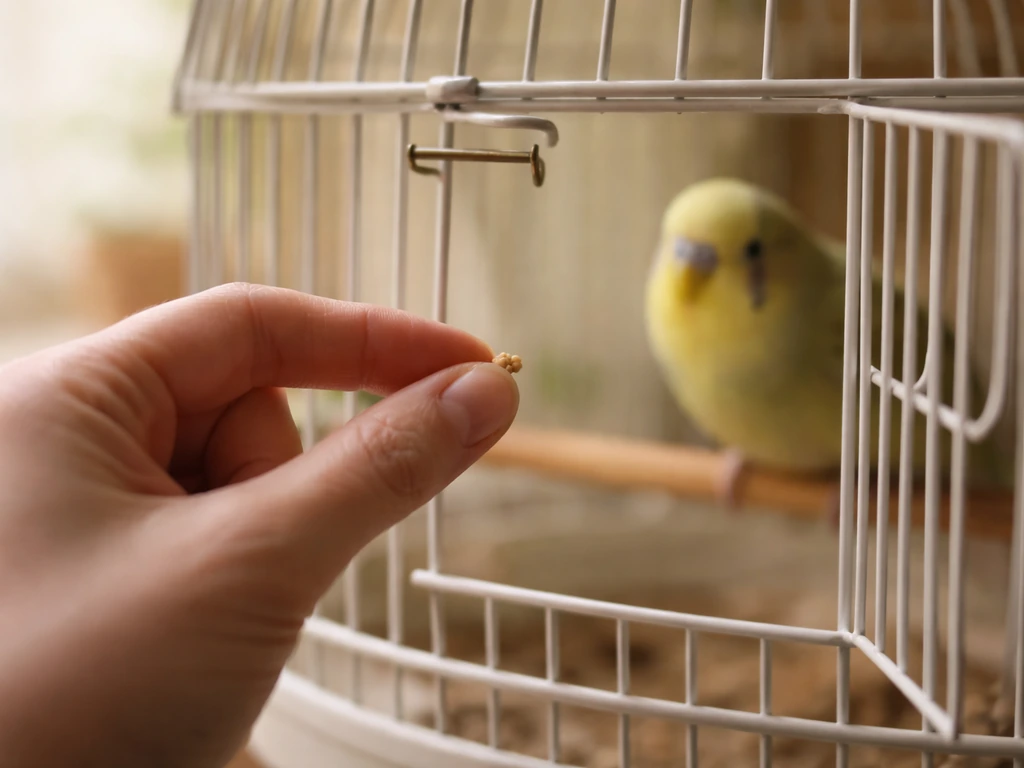
Start by simply being near the bird without asking for anything. Sit beside the cage, talk quietly, offer treats through the bars. Once the bird takes treats calmly from your fingers at the cage bars, you are ready to move on. For very nervous birds, place your hand inside the cage near the bird but away from it, without reaching toward it. Let the bird decide whether to approach. This can take several sessions and that is completely fine.
Stage 2: Introduce the dowel or hand as a non-threatening object
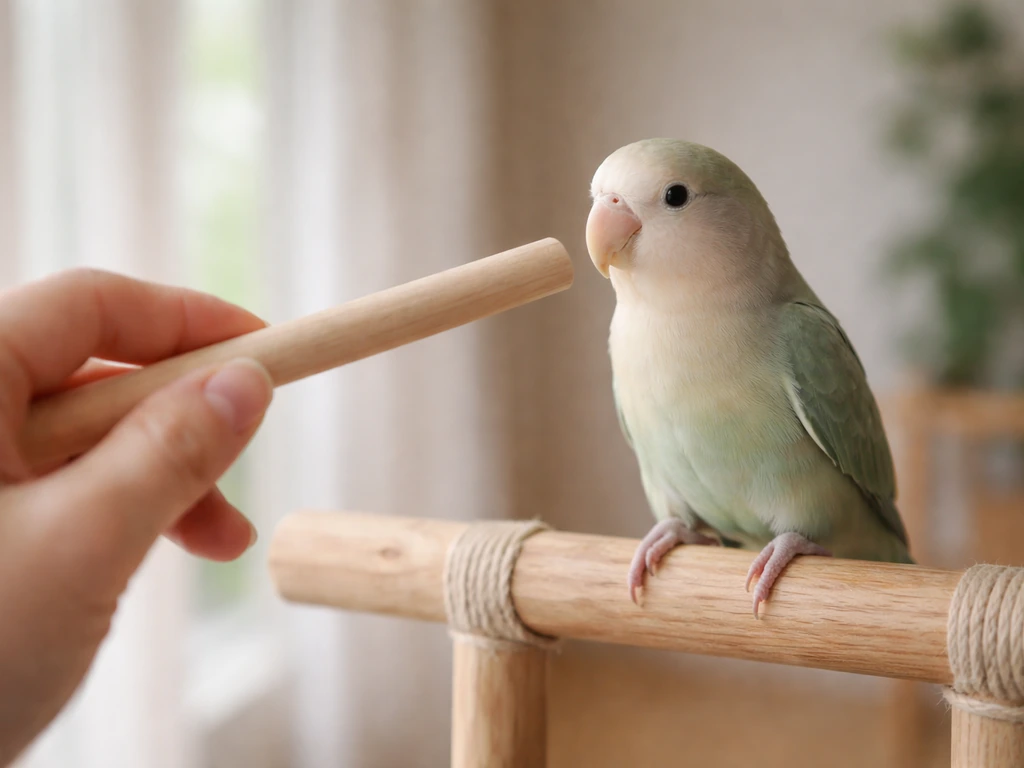
For hand-shy birds or those prone to biting, starting with a smooth wooden dowel rather than your finger is a smart move. Lafeber specifically recommends stick training as the first form of step-up training for birds that bite or are hand-shy. Present the dowel inside the cage, let the bird investigate it on its own terms, and reward any calm interaction with it. Your hand comes later, once the bird has confidence in the object itself.
Stage 3: Move to light touch and approach
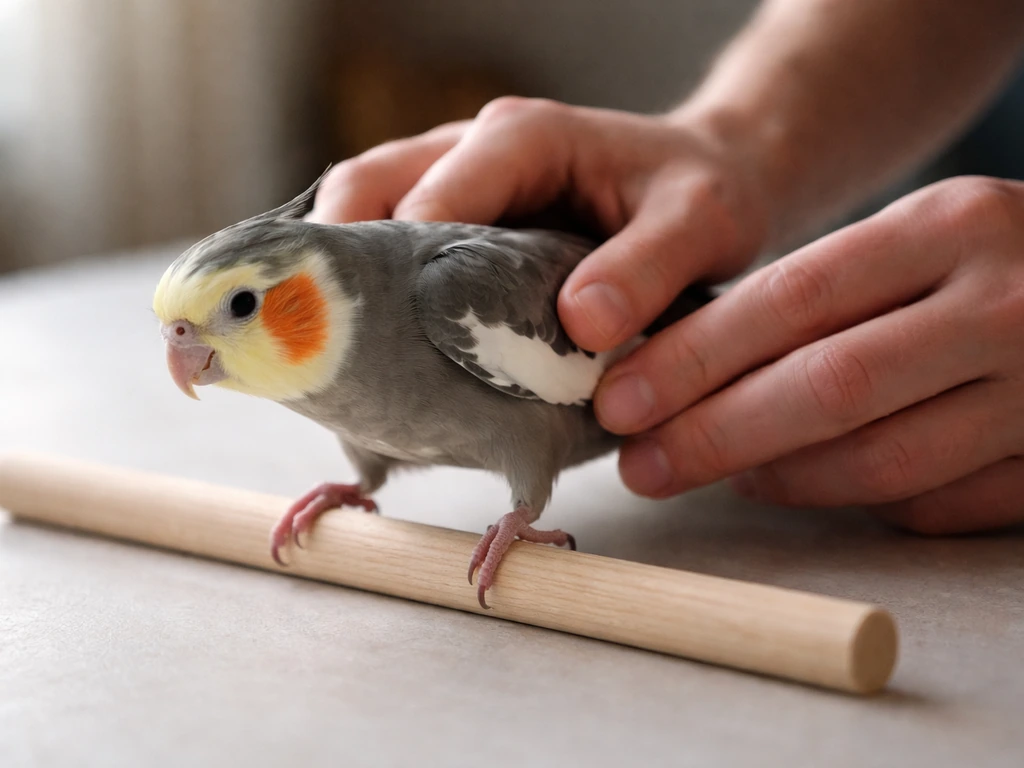
Once the bird tolerates the dowel or your hand nearby, begin gently pressing it against the bird's lower chest or legs, just above the feet. This light pressure on the lower body naturally prompts a bird to step up. The instinct to step onto something pressing there is strong. Do not force or grab. If the bird steps back, lower your pressure and wait. Reward any forward foot movement with a treat and calm verbal praise.
Stage 4: Add the cue word
Once the bird is reliably stepping onto the dowel or hand when you press it to the lower chest, it is time to add your verbal cue. Choose one word or phrase, either "step up" or simply "up," and use it every single time, right before you present your hand. GLAS advises picking one cue and sticking to it to avoid confusing the bird's associations. Say the word, present the hand at the right height, press gently to the lower chest if needed, and reward the step.
Stage 5: Transition from dowel to hand (if you started with a stick)
Once the bird steps onto the dowel reliably on cue, begin shortening the stick session by session, gradually replacing it with your actual finger or hand over multiple sessions. Most birds transfer without much trouble at this stage because the anxiety around your hand has already been reduced through the dowel work.
Stage 6: Practice in new locations and situations
A step-up that only works inside the cage is not reliable enough when you actually need it. Once the bird steps up consistently in its home cage, begin practicing outside the cage in the same quiet room. Then try other rooms, different times of day, and eventually with mild distractions present. Every new context is a fresh opportunity to reward and build trust.
When things go wrong: common problems and how to fix them
| Problem | Likely Cause | Fix |
|---|---|---|
| Bird backs away from hand | Hand is moving too fast or approaching from above | Slow down movements, approach from the side at beak height or slightly below |
| Bird refuses to step, just freezes | Not comfortable enough with the hand yet | Go back to Stage 1 or 2, spend more time on desensitization before adding pressure |
| Bird bites when hand approaches | Fear or previous negative experience with hands | Use a dowel first (Stage 2), reward calm body language near the hand before any touch |
| Bird steps up then immediately jumps off | Step-up is not yet positively reinforced enough | Shorten the session, reward immediately on stepping up, and end the session there |
| Bird chases or lunges at hand | Territorial behavior, hormonal phase, or learned hand-aggression | Avoid hand-in-cage interactions during hormonal periods, use target training to redirect |
| Bird panics or feather-fluffs dramatically | Overstimulation or a threshold has been crossed | End session immediately, give bird time to calm down, restart next session at an earlier stage |
| Bird was stepping up fine but suddenly refuses | Possible pain, illness, or foot/perching discomfort | Check for injury, contact an avian vet before resuming training |
A note on biting specifically: birds that bite during step-up training are usually communicating fear, not aggression in the human sense. Avian Behavior International points out that refusal and escape behaviors get reinforced when the bird learns that a bite or lunge successfully ends the training session. The fix is not to push harder or punish the bite; it is to back up to a stage where the bird is comfortable so that escape stops being the more rewarding option. The World Parrot Trust is clear: no physical punishment, ever. Hitting or shouting does not teach the step-up and it permanently damages trust.
If the bird suddenly stops stepping up after reliably doing it for weeks or months, that is a red flag worth taking seriously. SpectrumCare notes that sudden refusal can signal pain when perching, foot problems, or changes in health. Look for other signs like favoring one foot, falling, changes in droppings or breathing, or loss of appetite. When those show up alongside a training regression, call your avian vet first and pause training until the bird gets a clean bill of health.
Safety, welfare, and legal considerations (especially for wild birds)
Handling safety for pet and captive birds
Never grab a bird by its legs or wings. The Psittacine Disaster Team explicitly warns that grabbing legs or wings can cause multiple fractures, even in larger parrots. Restraint around the body must never compress the chest because birds breathe by expanding their chest wall, and squeezing it can suffocate them surprisingly quickly. If you ever need to towel a bird for an emergency vet visit, the towel should wrap loosely around the wings and body without restricting the chest.
Leather gloves might seem like a good idea for a biting bird, but they are actually counterproductive. The Psittacine Disaster Team notes that gloves impair your pressure perception and make it much harder to judge how tightly you are holding the bird, increasing the risk of injury. They also do not reliably protect against a strong bite from a larger parrot. Skip the gloves and use a dowel stick instead if biting is the concern.
Special guidance for wild, injured, or rehab birds
If the bird you are trying to handle is wild or injured rather than a pet, the rules change significantly. In the United States, most wild birds are protected under federal law (the Migratory Bird Treaty Act). Keeping, handling, or transporting a wild migratory bird without a permit is illegal, even with the best intentions. USGS guidelines exist specifically to ensure that any capture or handling of migratory birds is done humanely and by authorized people.
For an injured wild bird, the practical advice is: do as little as possible yourself. Place the bird gently in a ventilated cardboard box in a dark, quiet space to reduce stress, and then contact a licensed wildlife rehabilitator immediately. The Raptor Trust specifically advises that for larger birds with sharp talons, like hawks, owls, or herons, you should call a licensed rehabber or local animal control rather than attempting capture yourself. Sharp talons and panicked birds are a serious injury risk even for experienced handlers.
Restraint of any wild bird should be the absolute minimum necessary and should last as short a time as possible. The priority is minimizing stress, protecting the bird's ability to breathe freely, and getting it to professional care. Training methods designed for pet birds do not apply to wild birds in acute distress.
How to make the step-up reliable fast: a daily practice plan
Consistency beats duration every time. Short, daily practice sessions build reliability faster than occasional long ones. Keep sessions to 15 minutes max, end on a positive repetition (not on a refusal), and use the same cue word every time. If you also want to make the step-up easier and faster, a short daily practice routine is the next best step to follow. Within two to three weeks of daily practice most tame or semi-tame pet birds reach a reliably consistent step-up, though nervous or previously mishandled birds may take longer.
Target training is also worth adding to your toolkit. Teaching your bird to touch a target stick with its beak (a technique detailed well by both Kaytee and the World Parrot Trust) gives you a low-pressure way to guide a bird toward your hand, into a carrier, or up to a perch entirely by choice. It is an excellent complement to step-up training, especially for birds that have a strong history of hand-avoidance.
Daily practice checklist
- Choose a consistent time of day when the bird is calm and moderately hungry (not right after a big meal)
- Set up in a quiet room with no ceiling fans, open windows, or loose pets
- Prepare your special step-up treat in advance so the session flows without interruption
- Start each session with a brief warm-up: a few moments of calm talking near the bird before asking for anything
- Present hand or dowel slightly above current perch level, say your cue word once, wait 3 to 5 seconds
- If the bird steps up: deliver treat immediately, praise softly, and repeat 3 to 5 more times then end
- If the bird does not step up: do not repeat the cue multiple times; back up one stage and try again next session
- End every session on a success, even if that means asking for something easy like a beak touch or a target tap
- Keep a simple log (even just a few words) of what stage the bird is at and what worked
- If the bird shows any signs of stress (feather-fluffing, panting, wide eyes, repeated backing away): stop immediately and give it time to settle
Quick reference by bird type and experience level
| Bird Type / Situation | Starting Point | Expected Timeline | Notes |
|---|---|---|---|
| Young, hand-raised pet parrot | Stage 3 (light touch) | Days to 1 week | Usually already comfortable with hands; focus on adding the cue and reliability |
| Adult tame pet bird (no prior step-up training) | Stage 2 or 3 | 1 to 3 weeks | Use treats the bird is excited about; short daily sessions |
| Adult hand-shy or previously mishandled bird | Stage 1 (desensitization) | 3 to 8 weeks or more | Go slowly, never push through fear; consider dowel as intermediate step |
| Semi-tame rehab bird being prepared for release | Stage 1 only (minimal handling) | Not applicable for full step-up | Goal is minimal handling; contact licensed rehabber for guidance |
| Wild or injured bird | Do not train | Not applicable | Contact a licensed wildlife rehabilitator immediately |
One final thought: the step-up is a relationship skill, not just a trick. Every time your bird steps up and gets a treat and a kind word, it is learning that you are safe and worth cooperating with. That trust compounds over time. Birds that step up reliably tend to be more relaxed during vet visits, more willing to try new training behaviors, and easier to live with overall. Start today, stay patient, and let the bird set the pace.
FAQ
My bird refuses step-up after a few good reps, what should I do in that moment?
Keep the session short, then change one variable at a time, usually the distance or your hand height. If the bird pauses, backs away, or freezes, you are past its comfort level, so step back to the last stage where it accepted treats or touched the perch stick calmly, then try again after a brief break (for example, 5 minutes).
How do I stop my bird from stepping up only when it sees the treat?
For step-up on cue, don’t use a treat as a “lure” every time. Instead, reserve the best treat for the instant the bird completes the behavior, then present the cue and perch and wait for the step. If your bird only steps when it sees food, start practicing with the treat delivered from the side or just after the step, so the cue becomes the trigger.
My bird steps up but keeps missing or takes too long, how can I make it more reliable?
If you are consistent with cue and hand position, but the step-up is sloppy, use shorter sessions with more practice repetitions. Also check footing quality, because unstable perches, slick surfaces, or a finger placed too low or too far from the body can cause hesitation. A smooth dowel and a stable, non-slippery surface usually improve reliability.
My bird bites during step-up, does that mean it is aggressive?
Never punish or “reset” with a firm hold. Instead, interpret the bite as a communication of fear, then move back one training stage and reduce your intensity, like using the dowel first and only light lower-chest pressure. If biting happens every time you present your hand, pause finger training and rebuild confidence with stick training until approach is calm.
What if my bird suddenly stops stepping up after weeks of progress?
If your bird used to step up and then suddenly won’t, treat it as a potential health issue and pause training until you assess. Look closely for signs like favoring a foot, changes in droppings, unusual breathing, reduced appetite, or reluctance to perch, and call an avian vet if you see anything concerning. Continue only the easiest, lowest-pressure form of step-up once cleared.
Can I use “come,” “up,” and “step up” interchangeably?
Choose the cue word you will keep forever, then pair it the same way each time: say cue, present the hand or perch at the training height, then wait. If the bird is confused, stop adding new words like “come” or “up here,” and go back to using only one cue while you rebuild the association.
How do I transition step-up to a new location or a different room without losing trust?
Yes, but only after the bird reliably steps from its current perch to your hand or dowel in the same room. Start with a nearby perch, keep the environment quiet, and use the same cue and hand height each time. If the new distance causes backing away, return to the closer setup first, because context changes can trigger fear.
Is it better to practice longer to speed up progress?
Train in short bursts with a consistent cue, then end on an easy success. Avoid increasing session length when the bird is struggling, because longer sessions often reinforce avoidance. A practical rule is to stop after a few correct reps even if you could do more.
What should I do if my bird is biting and I need to handle it for the vet soon?
Gloves and towel restraint tend to reduce your ability to feel how much pressure you are applying, which can unintentionally make the bird more panicked. If biting is the issue, prioritize stick training and using light, brief pressure that prompts stepping rather than grabbing. For emergencies, use loose wrapping that does not compress the chest, and get veterinary care as soon as possible.
My bird shows discomfort when I try the step pressure, what’s the safest adjustment?
If your bird seems to have pain at the feet or is unwilling to step, do not press to the lower chest to “force” a step. Instead, pause step-up, observe perching and foot use, and switch to non-contact confidence building (treats through the bars, calm talk) until you can evaluate health with your avian vet.
How can I use step-up training to make carrier time less stressful?
If you plan to transport or move the bird, teach a separate “step into” behavior using the same target concept, and practice it when the carrier is present but not threatening. This prevents surprise handling, because the bird learns a predictable option, step-on by choice, before you need it under stress.
Next Article
How to a Bird Easy: Gentle Handling, Bonding, Training Steps
Humane, step-by-step bird handling and bonding plan with positive reinforcement, stress tips, and safety for common spec