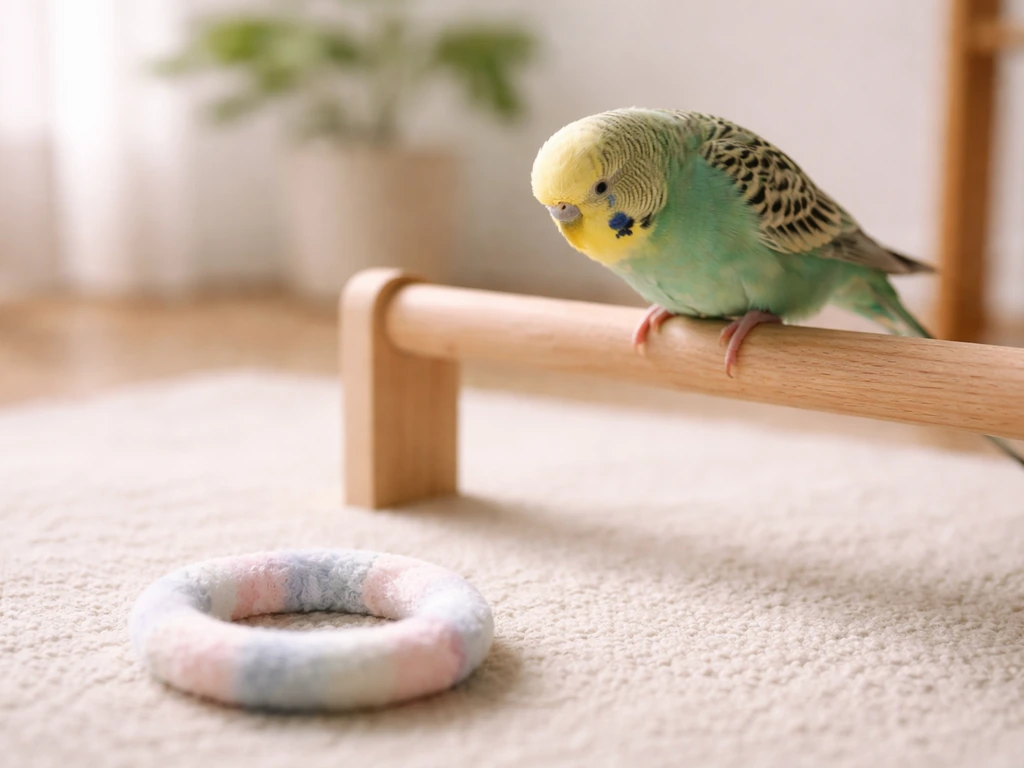
Yes, you can train almost any bird to come when called, and you can start today. Whether you have a parrot, a cockatiel, a dove, or a semi-wild bird you're rehabilitating, the core process is the same: build trust, introduce a clear cue, reward the behavior, and expand distance gradually. The whole approach rests on positive reinforcement, meaning the bird chooses to come to you because good things happen when it does. No force, no chasing, no grabbing.
How to Train a Bird to Come When Called Step by Step

Maya Harris
11 Apr 2026
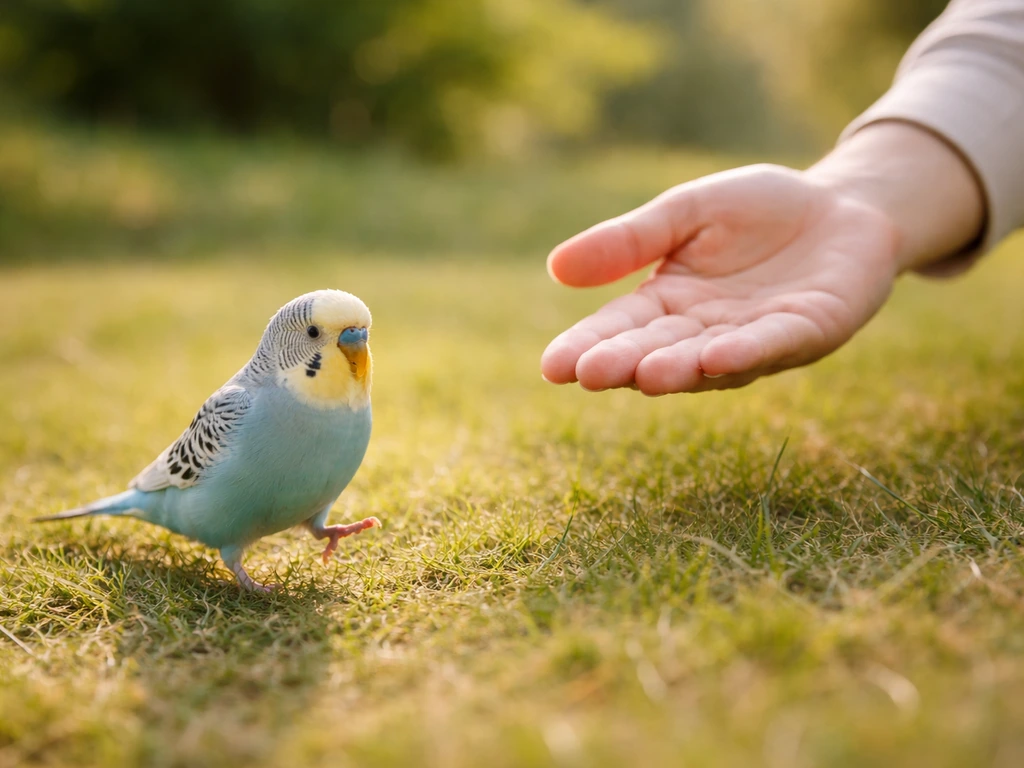
What 'come when called' actually means for birds
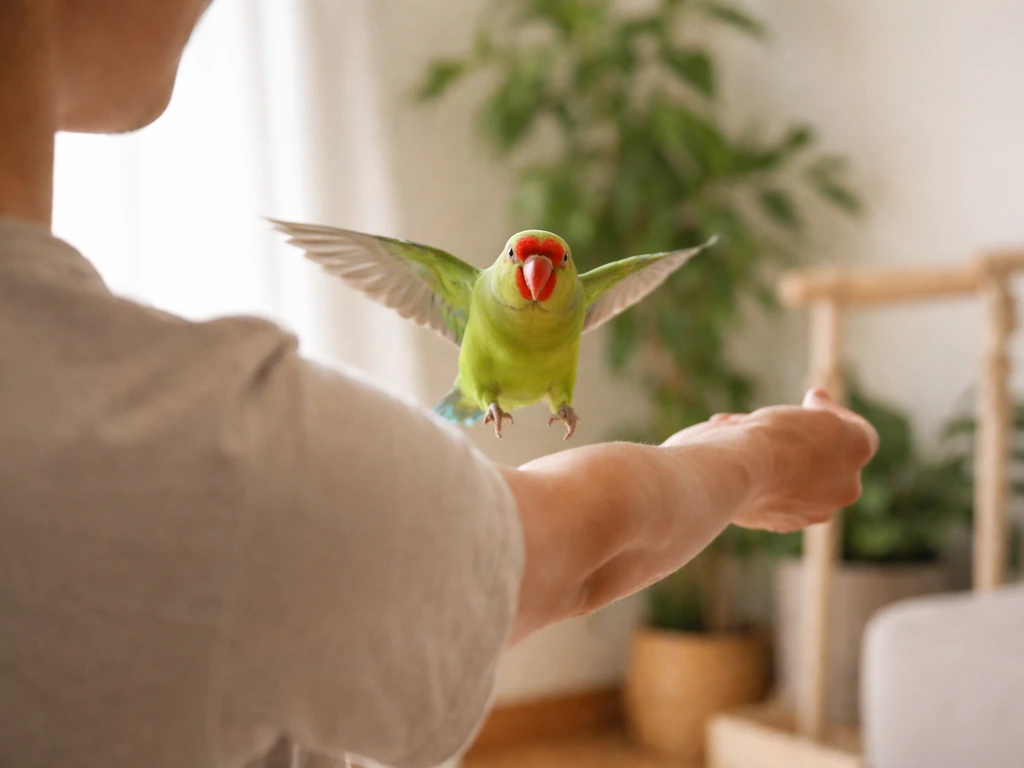
In bird training, this behavior is called a recall. A solid recall means your bird hears a specific cue (a word, a whistle, or a hand signal) and flies or moves directly to you or a designated perch, reliably, even when there are mild distractions. That last part matters. A bird that comes to you in a quiet room but ignores the cue outdoors or around strangers doesn't yet have a solid recall. The goal is reliability, not just occasional compliance.
It's worth being clear about what success looks like at each stage. Early on, success means your bird takes one step or hop toward you on cue. Later, success means flying across a room. Eventually, for more advanced trainers, it means responding on cue in different rooms, with different people, and in new environments. You measure improvement by tracking how often the bird responds correctly across varied conditions, not just by whether it worked once. If you want to dig deeper into what a complete recall program looks like from start to finish, how to recall train a bird covers the full arc in detail.
Setting up the right environment before you start
Where you train matters as much as how you train. For indoor recall work, you need a bird-proofed space every single time. That means closing all doors and windows, covering mirrors and large glass panels (birds can't perceive these as barriers and can collide with them at speed), turning off ceiling fans, removing hot liquids, and making sure other pets like dogs and cats are completely out of the room. These aren't optional steps for beginners. They're permanent safety standards.
For your gear, you need very little to get started: a clicker or a consistent verbal marker like the word "yes," high-value treats cut into tiny pieces, and a perch or T-stand your bird already accepts. A target stick is helpful too, especially for birds that aren't yet flying to your hand. If your bird is clipped, never toss or drop it to force movement toward you. That's frightening for the bird and will damage the trust you're trying to build. Work only at distances the bird can confidently manage with its current wing capability.
For outdoor or free-flight work, you need much more preparation and a much more reliable recall before you ever try it. If you're working toward outdoor flight, read up on how to flight train a bird before taking that step, because the safety and progression requirements are significantly different from indoor recall.
Build the foundation before you introduce the cue
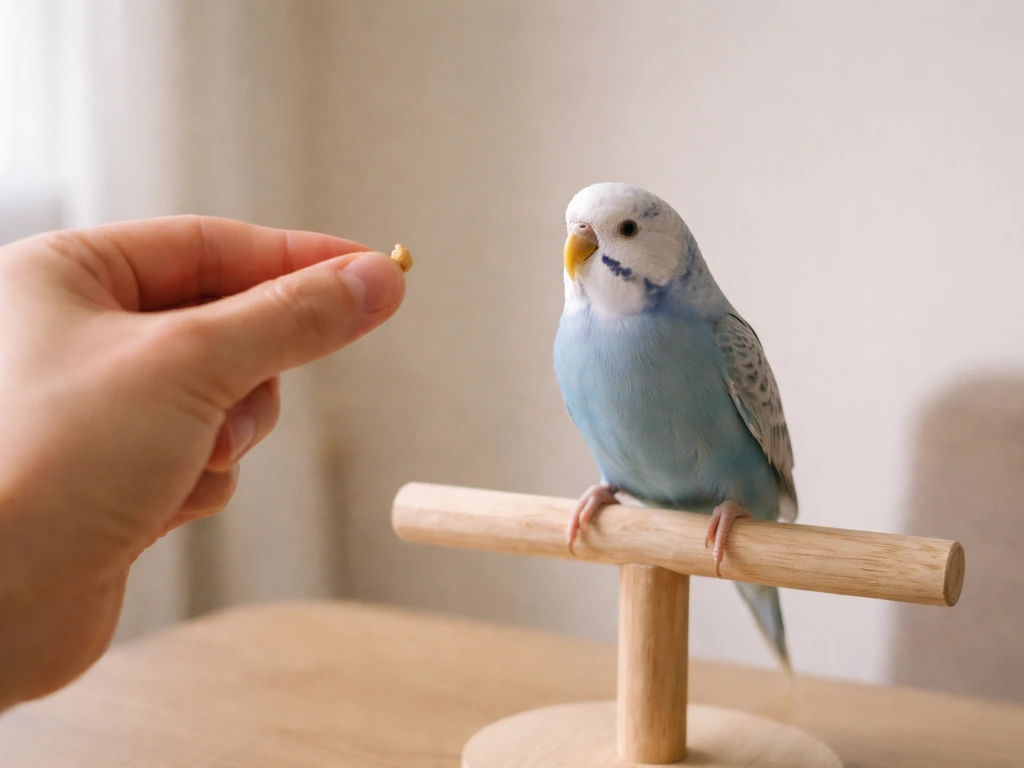
A recall only works if you've already built a reinforcement history with your bird. That means your bird has already learned that interacting with you produces good outcomes. If your bird is new, nervous, or hasn't been handled much, you need to spend time here first before adding any recall cue.
The foundation skills you need in place before recall training makes sense are: taking a treat calmly from your hand, stepping up onto your hand or a perch without stress, staying relaxed when you're nearby and when you produce your marker sound, and ideally following a target for a short distance. If any of those are shaky, work on them first. How to clicker train a bird is a great place to start if your bird hasn't learned a marker yet, because the clicker becomes your most powerful timing tool throughout recall training.
Target training is also worth building in early. A target stick gives the bird something concrete to move toward, which makes the early steps of recall training much easier. Once your bird understands the target, you can use it to guide movement toward you before transitioning to a verbal or whistle cue. How to target train a bird walks through that skill in full, and it's one of the most useful things you can teach before recall.
Teaching the recall cue step by step
Step 1: Choose your cue and introduce it carefully
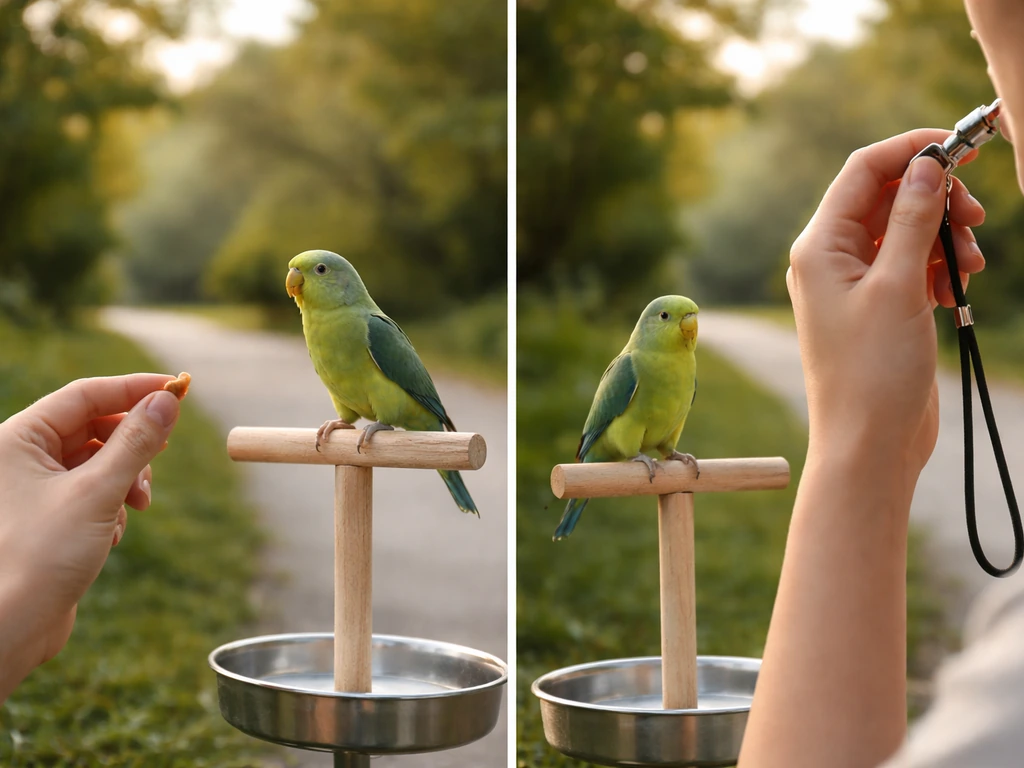
Pick one cue and keep it consistent. A short verbal word like "come" works well, or a single whistle pattern, either one short blow or one long one. If you use a whistle, check first that your bird is comfortable with the sound. Some birds are startled by new sounds. If yours is, pair the whistle with a treat before using it as a cue: produce the sound softly at a distance, then immediately give a treat. Build up volume gradually over a few sessions until the bird shows no stress response to it. Only then does the whistle start to mean "come here."
Step 2: Start at the shortest possible distance
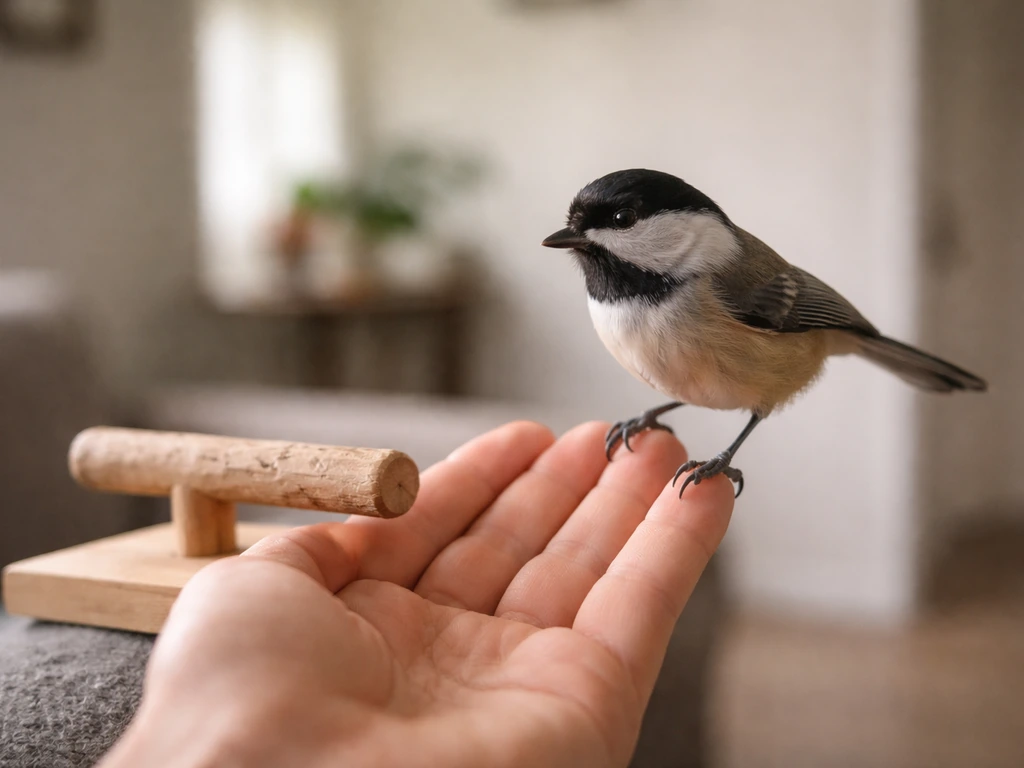
This is where most people go wrong: they start too far away. Begin with the bird right next to you. Hold out your hand or a perch, say your cue once, and the moment the bird steps or moves toward you, mark with your clicker or "yes" and immediately deliver a treat. One step counts. One hop counts. Reward it. Keep sessions short, around five minutes, and aim for a high success rate. If the bird is hesitant, shorten the distance again. Training should feel easy more often than hard.
Step 3: Shape the behavior outward in small increments
Once the bird is reliably moving to your hand at close range, increase distance slightly. A few inches at first, then a foot, then two feet. Stretch your arm out a bit further each session. When the bird is on a perch or T-stand, move just far enough away that it has to take a small hop or one or two wing-beats to reach you, then wait. Don't repeat the cue. If the bird doesn't come within about 10 seconds, calmly move back closer and try again. When it finally makes the leap to reach you, give a jackpot reward: several treats in a row, real enthusiasm, and a pause before the next repetition. That leap is a big deal.
Step 4: Build to longer distances with back-and-forth repetitions
Progress by practicing short "laps," sending the bird back to its perch or stand after each recall, then calling it back to you. This back-and-forth structure gives you many repetitions without fatiguing the bird and helps it understand that recall ends with a return to base, not the end of freedom. Over days and weeks, you'll be working from across a room. Once that's reliable indoors, you have the foundation needed before ever considering outdoor free-flight work.
Rewards: what works, what doesn't, and when to stop
Your treats need to be small (to avoid filling the bird up quickly), safe for your species, and genuinely high value to that individual bird. Seeds and nuts work well for many species as recall rewards, used in small quantities. Find out what your bird will work hardest for and reserve that treat specifically for recall training. Don't use it for other things, or it loses its power.
Timing is everything. The marker (clicker or "yes") must happen the instant the bird arrives, not a second later. Then the treat follows within a few seconds of the marker. If you're fumbling for the treat while the bird is already wandering off, your timing is off and the bird is learning something different from what you intend. Practice getting treats out smoothly before your session starts.
Two mistakes to avoid with rewards: first, repeating the cue. Say it once and wait. Saying "come, come, come" trains the bird to ignore the first two repetitions. Second, training when the bird is already full, overexcited, or distracted. A bird that's just eaten a big meal has low motivation. A bird that's wound up from play is difficult to focus. Short sessions before a meal, when motivation is naturally higher, tend to produce better results.
When things go wrong: troubleshooting real recall problems
The bird won't move at all
If your bird just sits there when you give the cue, the distance is too far, the reward isn't motivating enough, or the foundation skills aren't solid yet. Go back to shorter distances and higher-value treats. Also make sure you've actually paired the cue with the behavior. If the bird has never experienced the cue predicting a reward, it has no reason to respond to it.
The bird shows fear or avoidance
Avoidance (turning away, moving to the back of the cage, crouching down, panting, frantic flapping) is a signal to stop and reassess. Fear behavior is being reinforced by the fact that avoiding the situation makes the stressful thing go away. If you keep pushing, you're adding stress on top of fear, which makes things worse and can prolong the problem. Pause the session, reduce all demands back to something the bird can do comfortably, and spend more time simply sitting near the bird without any training expectations. Fear in training is a training design problem, not a personality flaw in the bird.
The bird runs or flies away instead of coming
Do not chase it. Chasing reinforces the bird for moving away and makes you into something to flee from. Instead, return to your spot, wait calmly, and when the bird settles, start over at a shorter distance. If this happens repeatedly, your training environment has too many competing reinforcers (things more interesting than you) or the bird has learned that flying away is an effective strategy. Manage the environment more tightly and reduce distractions.
Recall works in one room but not others
This is a generalization problem. The bird has learned the cue in one specific context but hasn't learned it as a general rule. This is completely normal and expected. You have to teach the recall in each new environment as if starting from scratch, but it will go faster each time because the bird already understands the concept.
The bird only recalls for one person
Same principle: if you want the bird to come to multiple people, each person needs to build their own reinforcement history with the bird. Have other household members run short, easy recall sessions from very close range and gradually build up. Don't assume the training transfers automatically.
Flock dynamics and distraction from other birds
If your bird lives with other birds, recall in the presence of the flock is significantly harder. Start recall training with one bird at a time, separated from flockmates. Once recall is reliable alone, you can slowly introduce mild flock presence in the background, rewarding heavily for responding to the cue over the competing social draw.
Making recall work everywhere, with everyone, every time
Generalizing a behavior means teaching it across different locations, distances, people, and times of day until the cue reliably predicts the response in any reasonable context. Plan to practice recall in at least three or four different rooms or areas before considering it reliable. Vary the time of day. Vary who gives the cue. Vary where you're standing in the room.
As distance and reliability increase, you can begin working toward more advanced applications. For birds heading toward outdoor training, the step-up to harness work is often useful before free-flight attempts. How to harness train a bird is a practical next step for owners who want to take their bird outside safely before free-flight recall is fully established.
Stick training is another skill worth layering in during generalization. Teaching a bird to fly to a handheld perch on cue, rather than directly to your arm, gives you more flexibility in multi-person households and in public environments. How to stick train a bird covers how to build that behavior alongside your existing recall.
Track your progress concretely. After each session, note the distance you were working at, how many recalls were attempted, and how many were successful. A success rate above 80% means you can start increasing difficulty. Below 80%, hold the current level or make things easier. This keeps you from over-facing the bird and gives you real data instead of guesswork.
A quick comparison: verbal cue vs. whistle cue
| Feature | Verbal Cue | Whistle Cue |
|---|---|---|
| Carrying distance outdoors | Limited, especially in wind or noise | Carries much farther and cuts through background noise |
| Consistency across people | Varies with speaker's voice, tone, and accent | Easier to keep consistent; less variation between users |
| Ease of introduction | Natural, no extra equipment needed | Requires pairing process if bird is unfamiliar with the sound |
| Use indoors | Works well in calm, quiet spaces | Works well; check bird is comfortable with the sound first |
| Best for | Beginners, indoor-only birds, single-person households | Advanced recall, outdoor work, multi-person or rehabber contexts |
Either cue works fine for indoor pet birds. If you're working toward outdoor or free-flight recall, a whistle cue is worth the extra setup time because it carries farther and stays consistent regardless of who's using it. Pick one and stick with it from day one.
Where to go from here
If you follow this process, most birds will show noticeable progress within a week or two of daily five-minute sessions. Some take longer, especially birds with fearful histories or very limited prior training. That's fine. The timeline doesn't matter as much as the quality of the foundation you're building. A bird that comes reliably to you from across the room, every time, is worth every slow session it took to get there.
Once your indoor recall is solid, the natural progression is toward more advanced flight work. All About Birds (Cornell Lab) discusses advances in blank" rel="noopener noreferrer">bird-safe glazing, including UV-reflective-patterned glass approaches and examples of commercial products and testing. The skills you've built here, a consistent cue, a bird that knows coming to you pays well, and a clear back-and-forth pattern, are exactly what you need as a launchpad. When you're ready, how to flight train a bird will show you how to take those same principles into longer distances and more complex environments safely.
FAQ
What if my bird only comes when I have the treat in my hand?
That usually means the bird is responding to your visible cues, not the recall cue. Start practicing with your hands empty or behind your back, and keep treats prepared so you can deliver quickly without displaying them. Also reward the recall even if the treat is not visible, otherwise the bird will learn “come when I see food,” not “come when called.”
How do I handle recalls when my bird is flighty or won’t approach?
If the bird freezes, retreats, or skirts away, don’t escalate the distance. Reduce to the closest starting point (often one hop away), confirm that the bird has solid step-up and calm treat-taking, and consider using a target to make success more achievable. If you see avoidance signals, pause, sit nearby with no demands, and rebuild reinforcement before trying the cue again.
My bird ignores the cue outdoors, even though it works indoors. What’s the fix?
Outdoors adds stronger distractions, and birds effectively need a fresh “context training” stage. Rebuild reliability at the shortest workable outdoor distance where your success rate stays above about 80%, then gradually increase. Also keep sessions short, avoid windy or high-noise days when possible, and consider switching to a whistle cue for consistent delivery.
Should I call my bird more than once if it doesn’t come immediately?
No, repeating the cue trains the bird to wait out the first repetitions. Say the cue once, then allow up to about 10 seconds. If it does not come, calmly return to a shorter distance and try again later, so the bird learns that the first cue predicts reinforcement.
How do I prevent my bird from getting overexcited during recall training?
Use tiny treat portions and cap sessions to around five minutes. Train when motivation is high but before the bird is hyped up from play, and choose a calm start routine (sitting nearby quietly, then one easy recall). If the bird starts frantic flapping or frantic movement, immediately reduce demands back to something it can do comfortably.
What if my bird runs to me but then won’t step onto my hand or perch?
That suggests recall is working, but the next “landing” behavior needs separate reinforcement. After the bird reaches you, reward quickly for arrival, then add a short step-up or target phase as a second criterion (for example, arrival to a T-stand first, then step to your hand). Keep the criteria easy at first so the bird doesn’t feel trapped or rushed.
Can I train multiple birds in the same room?
You can, but it’s easy to create competing reinforcers. Start with one bird at a time, separated from flockmates, and only reintroduce mild flock presence after recall is reliable. When training with more than one bird, reward heavily for correct responses while keeping distractions low, and consider separate times or barriers to reduce crowding.
How do I choose a “high-value” treat for recall?
Pick something your bird will work for repeatedly, in tiny pieces, and reserve it for recall. If the bird turns away, takes a treat slowly, or gets full quickly, it is not the right reward or the pieces are too large. A quick test is to observe which treats increase engagement during training when compared to normal daily foods.
How long does it usually take, and when should I change the plan?
Many birds improve within one to two weeks with short daily sessions, but fearful birds or low prior handling can take longer. If you are getting success consistently above about 80%, progress by increasing distance slightly. If success stays below 80%, hold the difficulty steady or reduce distance and strengthen foundation skills instead of pushing forward.
Do I really need to cover mirrors and glass panels, even for a quick session?
Yes, because birds can accelerate toward you and misjudge reflections as open space. Even short sessions can end with a collision, which can set back trust and recall. Treat bird-proofing as a non-negotiable safety routine every time until you are confident the bird can reliably perceive barriers.
Can I train recall for a bird that is clipped?
You should not force movement by tossing or dropping the bird. Work only at distances that fit the bird’s current wing capability, and build success from short steps, hops, or small wing-beats. If recall failures increase at a given distance, return to a closer starting point and use a target or perch to keep progress safe and stress-free.
How do I know if I’m rewarding the right moment?
The marker must happen instantly when the bird arrives, not when it pauses afterward. A practical check is to rehearse how you will mark and deliver before the session, and deliver the treat right after the marker within a couple seconds. If your bird is drifting away immediately, your timing may be late.
Next Article
How to Teach a Bird to Fetch Step by Step Guide
Humane, step-by-step training to teach your bird to fetch safely, with targets, rewards, troubleshooting, and gradual re