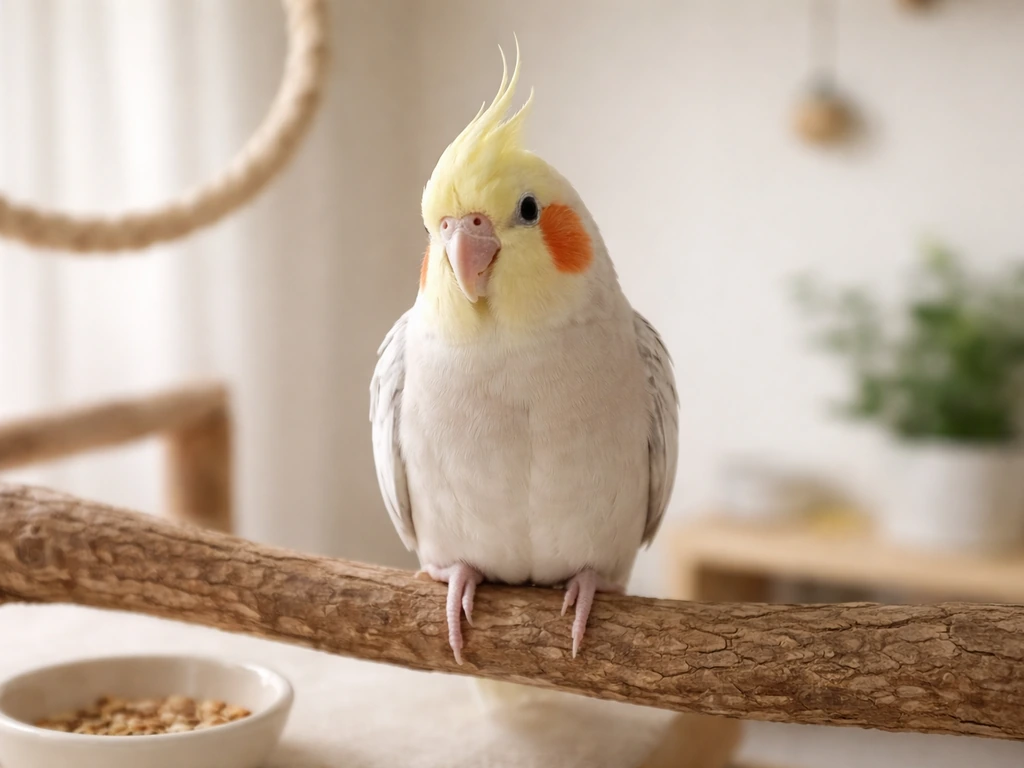
You can't physically turn into a bird, but if what you're really after is a genuine, close, bird-like connection, you can absolutely get there. This guide is about achieving exactly that: real closeness with a bird, where you move at their pace, earn their trust, and share experiences that feel surprisingly mutual. That's the closest thing to "becoming" a bird that's actually available to us, and honestly, it's more rewarding than any fantasy version.
How to Turn Into a Bird in Real Life: Humane Steps
Maya Harris
4 Apr 2026
Reality check: what "turn into a bird" can actually mean
Let's be straightforward: human-to-bird transformation isn't biologically possible. Birds have hollow, lightweight bones, a unique respiratory system with lungs plus air sacs, streamlined feathered bodies, and muscle structures tuned specifically for the energetic demands of flight. Human muscle power and skeletal structure simply can't replicate that, no matter how much you want it. Even at the genetic level, the traits that make a bird a bird (feathers, beak, avian anatomy) are encoded across millions of years of evolutionary development. There's no shortcut.
On the wildlife side, there's a serious legal dimension too. In the U.S., migratory birds are protected under federal law, which makes it illegal for the general public to take, possess, or keep them without authorization. If you find an injured wild bird, you cannot legally take it home, even with good intentions. You need to contact a licensed wildlife rehabilitator, who must hold both a federal migratory bird rehabilitation permit and any applicable state permit. Each state has its own requirements: Massachusetts, Washington, South Carolina, and New York all require this dual-permit system. The takeaway is simple: if a wild bird needs help, your job is to call a professional, not handle the bird yourself.
So what CAN you do? Quite a lot. You can become a bird person in the truest sense by building a real relationship with a pet bird through patient, welfare-first training. You can volunteer with licensed rehabilitation organizations. You can study bird behavior so deeply that you start thinking in their language. The rest of this guide covers exactly how to do that.
Humane ways to get a real bird-like experience
The most meaningful "bird experience" comes through genuine bonding and trust, not restraint or novelty. Here are the practical paths available to you today.
- Adopt a pet bird (budgie, cockatiel, parrot, or similar) and invest in relationship-building through positive reinforcement training.
- Volunteer with a licensed wildlife rehabilitation center, where you can work legally and learn handling skills under supervision.
- Take a bird behavior or avian training course to develop the skills rehabilitators and experienced bird keepers use daily.
- Pursue a wildlife rehabilitation permit if you're serious about long-term work with wild birds (it takes time, mentorship, and both state and federal permits).
- Spend time birdwatching and studying body language in the field, which builds the observational fluency that makes all hands-on work easier.
Positive reinforcement training is the gold standard across all of these paths. blank" rel="noopener noreferrer">Instead of forcing a bird to tolerate you, you teach it that interacting with you produces good outcomes, usually food rewards, calm handling, and consistent, predictable behavior from your side. This consent-based approach is what separates welfare-first bird keeping from the old "dominate the bird" methods that cause lasting behavioral damage. If you want to act like a bird person from day one, start by learning to read bird body language before you ever reach into a cage.
Species-specific taming and trust-building steps
Trust-building is not one-size-fits-all. A budgie, a cockatiel, a cockatoo, and a crow all require different approaches and different timelines. The only reliable rule is: go as fast as the bird allows, and not one step faster. Voluntary approach, calm body language, and eating in your presence are the signals that tell you the bird is ready for the next step. Rushing because it's been "enough days" is one of the most common mistakes new bird keepers make.
Budgies and cockatiels (beginner-friendly)
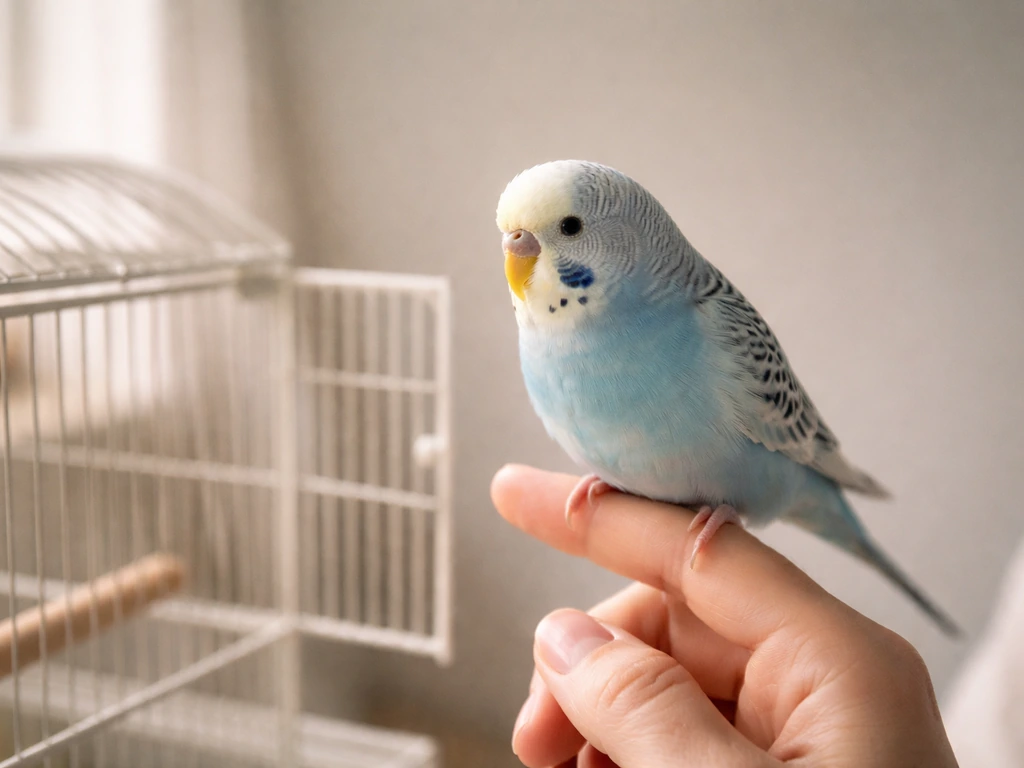
These are the best starting points for beginners. Set up the cage against a wall (not in the center of a room) in a quiet area away from drafts, direct sunlight, and high-traffic zones. This gives the bird a sense of security from behind. Spend time near the cage daily without trying to interact, just being a calm, predictable presence. Offer millet spray through the bars before you attempt any direct contact. Once the bird eats comfortably near your hand through the bars, you can begin target training inside the cage.
Parrots (intermediate)
Parrots are highly social and highly sensitive. Start with the same "calm presence" phase, then introduce a target stick (a chopstick with a small ball on the end works fine as a low-cost tool). Target training, where the bird learns to touch the end of the stick with their beak for a treat, is the gateway skill that unlocks almost every other cooperative behavior. Once the bird reliably targets, you can transfer that onto your hand and begin step-up training.
Never skip the target phase with parrots; it builds the foundation of voluntary cooperation that makes everything else sustainable. Target training and other positive reinforcement approaches are used in peer-reviewed macaw research to teach voluntary cooperative behaviors that support procedures [voluntary cooperation](https://pubmed. ncbi. nlm.
nih. gov/23409437/).
Larger or rescue birds (intermediate to advanced)
Birds with trauma histories or strong fear responses need a slower ramp. Work entirely at the bird's comfort level, sometimes spending weeks just sitting near the cage before any training begins. Some rehabilitated or rehomed parrots have learned that hands mean capture, not interaction, so you'll need to rebuild that association from scratch using positive reinforcement only. Document your sessions: what worked, what the bird's body language looked like, and what you changed. This kind of systematic tracking helps you avoid repeating the same approach that isn't working.
Handling, safety, and welfare basics
Handling a bird safely protects both of you. The most important rule for pet birds: if a bird tends to bite, keep it at chest level or below for the shortest caregiver in the household. Never let a bird climb higher than shoulder level toward anyone's face. Bites near the face and eyes are the most serious injuries in bird keeping, and they're almost always preventable with this one positioning rule.
For wild birds, the rule is simpler: don't handle them without professional guidance. Federal guidance is explicit that you should not attempt to capture or transport an injured wild bird on your own. If you find an injured bird, keep people and pets away, note the bird's location, and contact a licensed wildlife rehabilitator immediately. Your state's fish and wildlife agency or a quick web search for your state plus "wildlife rehabilitator" will get you to the right contact.
| Context | Who can handle? | Legal requirement | Your action |
|---|---|---|---|
| Pet bird (captive-bred) | Owner, trained caregiver | None for legal pet birds | Learn positive reinforcement handling |
| Injured wild migratory bird | Licensed wildlife rehabilitator only | Federal + state permit required | Call a licensed rehabilitator; do not handle |
| Wild bird (apparently healthy) | No one (observe only) | Migratory Bird Treaty Act applies | Watch from a distance; do not disturb |
| Rehabilitating volunteer work | Volunteers under rehabilitator supervision | Covered by rehabilitator's permit | Volunteer with a permitted organization |
Inappropriate handling and restraint are among the most common causes of lasting fear and aggression in parrots. Forced restraint increases avoidance behavior, generalizes fear to the handler, and can create long-term behavioral problems that take months to undo. The welfare-first principle is simple: if a bird is struggling, stop. Reassess. Don't push through resistance.
Teaching bird-like behaviors: perching, step-up, targeting, and recall
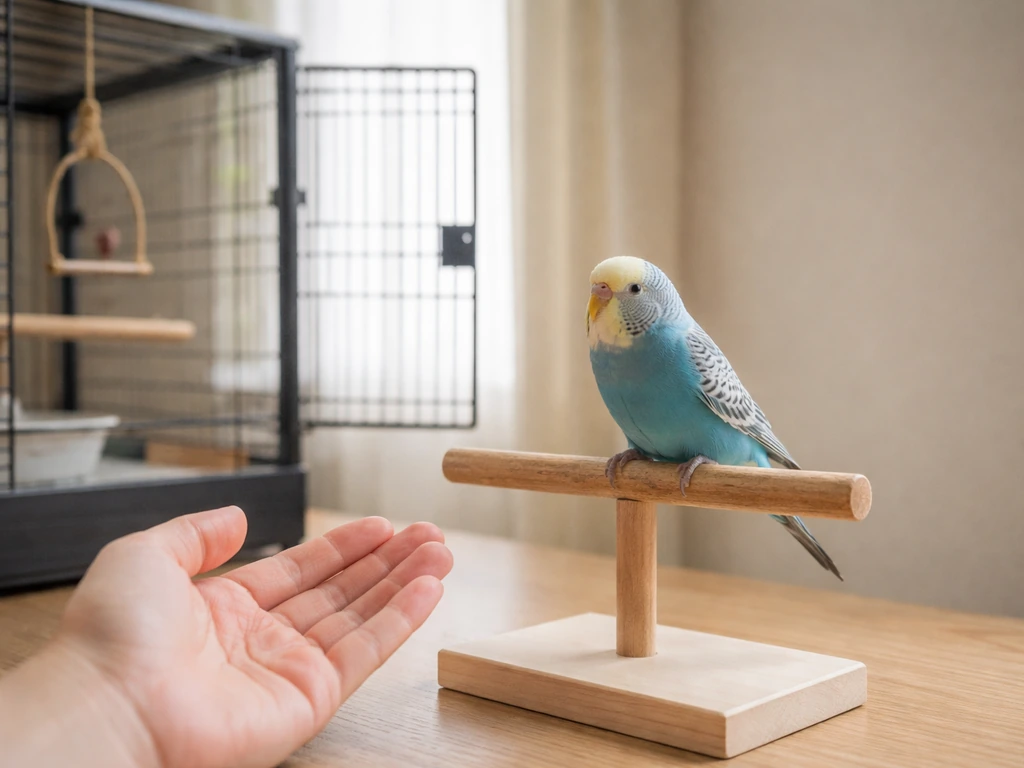
This is where the "turning into a bird" experience really lives. When a bird voluntarily steps onto your hand, flies to you on cue, or perches calmly on your shoulder, the interaction feels genuinely reciprocal. Here's how to build each of these behaviors systematically.
Target training (start here)
Target training is always the first skill to teach because it gives the bird a clear, low-stakes way to interact with you. Hold a target stick near the bird. The moment the bird investigates or touches it, mark the behavior (a clicker or a consistent word like "yes") and immediately offer a small treat. Repeat in short 3-5 minute sessions. Once the bird is reliably touching the target, you can use the stick to guide movement: toward your hand, to a new perch, or between locations. This one skill unlocks everything else.
Step-up and laddering
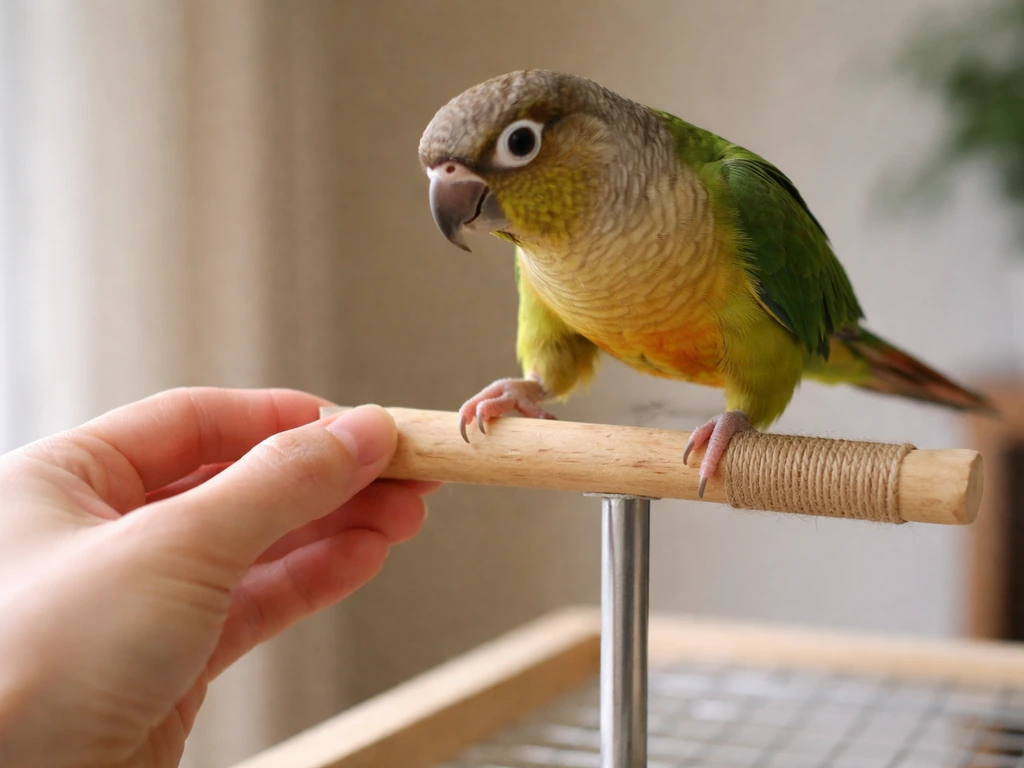
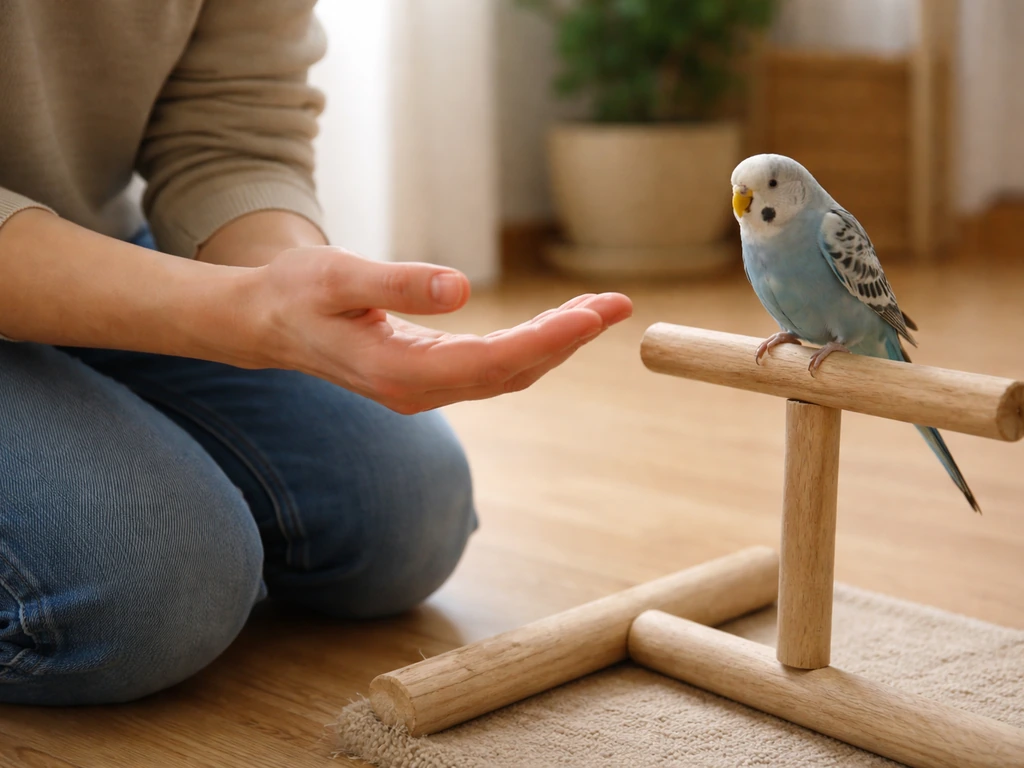
Step-up is the most important practical behavior you'll ever teach, both for safety and for your relationship with the bird. Start by teaching the bird to step onto a perch or stick, then transfer that to your hand using the same cue. The "laddering" technique builds on this: offer one hand for the bird to step up, then present the other hand slightly higher so the bird steps up again, and alternate.
This turns step-up into a movement game the bird actively participates in. The goal is a bird that steps onto your hand voluntarily every time, because it has learned that stepping up leads to good things, not capture. If you want to understand what consistent, voluntary perching looks like in practice, check out this guide on how to become the biggest bird person in the room by earning real trust rather than demanding compliance.
Recall and flight recall
Recall, where the bird flies to you on cue, is the most exciting behavior to develop and requires a solid step-up foundation first. Start indoors in a small, safe room. Call the bird from a short distance, offer the target stick or your hand as a visual cue, and reward immediately when the bird lands on you. Gradually increase the distance over many sessions. Flight recall should only be practiced with birds that are already comfortable flying freely indoors, in a fully bird-proofed space, with windows, mirrors, and ceiling fans addressed. Never attempt outdoor recall training unless you are working with a professional trainer and the bird has a reliable indoor recall and appropriate wing feather status.
Perch training and station behaviors
Teaching a bird to go to a specific perch or station on cue is both practical and enriching. Use the target stick to guide the bird to a designated perch, mark and reward. This becomes your "go to your spot" cue, which is useful for managing the bird during cleaning, visitors, or any situation where you need the bird contained without force. A bird that knows its station feels more secure because it has predictable, rewarded places to be. If you're looking to keep your bird physically and mentally active during these sessions, pairing training with enrichment activities is a natural fit: a fit bird learns faster and has a calmer baseline temperament.
Troubleshooting: fear, biting, stress, and aggression
Every bird keeper hits a wall at some point. The bird that was making great progress suddenly won't step up. The bird that seemed comfortable is now biting hard. Here's how to read what's happening and respond effectively.
Reading stress and fear signals
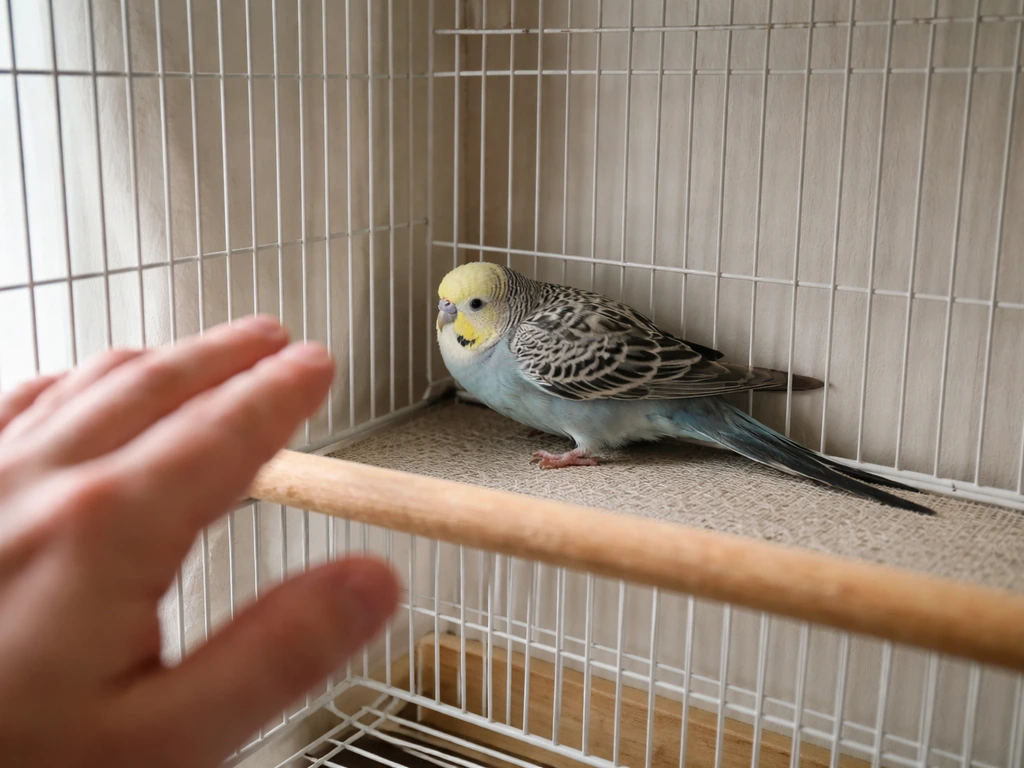
Stop any interaction immediately if you see: cowering or crouching, trembling, lunging, thrashing against cage bars, hissing, panting, raised head feathers, or wings held away from the body. These are not signs of a "difficult" bird. They are clear communication that the bird is overwhelmed. Pushing through these signals doesn't build tolerance; it builds a lasting fear association with you specifically. Back off, give the bird space, and revisit your training plan from an earlier, easier step.
When a bird bites
Biting is almost always a communication failure, not a personality flaw. The bird tried to tell you something was too much (through body language) and you either missed it or kept going. The correct response to a bite is not punishment. It's to calmly return the bird to its cage, leave the area, and let the bird settle for at least 20-30 minutes before attempting any further interaction. Punishment increases fear and aggression; a calm departure gives the bird the outcome it was asking for (space) without reinforcing biting as a reliable strategy. Managing a large or assertive bird effectively means learning to spot the pre-bite warning signs (pinning eyes, fanned tail, leaning forward) before the bite happens.
Screaming and overstimulation
Contact calls and some vocalization are completely normal. Screaming that escalates when you leave the room, or that seems frantic and non-stop, usually points to a bird that is either under-stimulated, over-bonded to one person, or has learned that screaming produces attention. The fix is consistent: never return to the bird or offer attention while it's screaming. Wait for even two seconds of quiet, then re-enter or acknowledge the bird. Over time, the bird learns that quiet, not noise, is what gets results. Some parrots are natural singers and mimics, and channeling that into learning to sing like a bird through training sessions is a genuinely rewarding outlet for both of you.
Regression and plateaus
If a bird that was progressing suddenly regresses, check for environmental changes first: new people in the house, a moved cage, changes in light or sound, seasonal hormonal shifts, or a health issue. Birds in pain or discomfort often look like "behavior problems." When in doubt about a sudden behavioral change, a vet check is your first step, not more training pressure.
Your plan for today: gear, first sessions, and when to get help
Here's how to move from reading this guide to actually doing something useful today, whether you already have a bird or are just starting out.
Gear to get (all low-cost or DIY-friendly)
- A target stick (chopstick with a small ball of tape on the end works fine for beginners).
- A clicker or a consistent verbal marker word like "yes" or "good."
- High-value treats specific to your bird's species (millet for budgies/cockatiels, small pieces of nutrient-dense food for parrots, species-appropriate options for others).
- A simple training log: a notebook or phone note where you track session date, duration, behavior practiced, and the bird's body language.
- A T-stand or tabletop perch for neutral-territory training sessions outside the cage.
Your first three sessions
- Session 1 (today): Sit near the bird's cage for 10 minutes without attempting any interaction. Observe body language. Note whether the bird is calm, alert, or stressed by your presence. That baseline tells you where to start.
- Session 2 (tomorrow): Introduce the target stick through the cage bars. Don't ask for anything. Let the bird investigate on its own terms. If it touches the stick, mark and reward. If not, that's fine too; just end the session calmly.
- Session 3 (day 3 or whenever the bird seems comfortable): Begin formal target training inside or near the open cage door. Keep sessions to 5 minutes maximum. End on a success, even a small one.
When to call in a professional
If you're dealing with a wild bird that appears injured or orphaned, don't wait: contact a licensed wildlife rehabilitator in your area right away. Your state wildlife agency's website (or a search for your state plus "wildlife rehabilitator") will give you a current list of permitted contacts. Do not attempt to house, feed, or treat the bird yourself.
For pet birds, seek professional help in these situations: a sudden, unexplained change in behavior (possible health issue), biting that is escalating despite consistent technique, self-destructive behaviors like feather plucking, or any sign of illness (fluffed feathers, lethargy, discharge, changes in droppings). For avian-specific veterinary care, look for a vet with avian medicine expertise through the American Board of Veterinary Practitioners' specialist directory, which allows you to filter by avian practice. A certified avian specialist is worth finding before you have an emergency, not after.
The whole goal here is a relationship built on the bird's terms, which is exactly what makes it feel real. When a bird chooses to step onto your hand, flies back to you across the room, or settles on your shoulder without any coercion, you've earned something that can't be faked or rushed. That's as close to "turning into a bird" as the real world gets, and it's genuinely worth working for.
FAQ
How long does it usually take before a bird will voluntarily approach or step up?
There is no universal timeline, but a useful decision rule is to progress only when you see consistent relaxed signals (eating near you, voluntary stepping to a perch you offer). If you cannot get to that baseline within a few weeks, slow down and revisit earlier steps like through-the-bar feeding and target training consistency, then consider an avian behavior consult.
What if my bird seems tame in the morning but aggressive later in the day?
Birds can become overstimulated as fatigue builds or schedules change. Try shortening sessions, training earlier, and tracking triggers like noise, visitors, hunger timing, or lighting changes. Also confirm basics like sleep length (many parrots need long, uninterrupted dark periods) because poor rest can directly increase biting and fear responses.
Is it safe to use my hand as the first “target” instead of a stick or target tool?
It can work for very confident birds, but for many parrots a target stick creates a safer, lower-stakes object than your hand, reducing the chance the bird associates your fingers with capture. If your bird rushes or bites at your hand during training, go back to the stick and transfer to your hand only once touching the target is reliably rewarded.
How do I handle it when my bird refuses treats during bonding?
First, rule out immediate issues like being too hot or cold, feeling unsafe, or training happening at the wrong time relative to hunger. Offer preferred foods, use very small rewards, and reduce pressure by only rewarding natural proximity or interest. If the bird continues to refuse food or shows fluffed, lethargic, or droopy behavior, treat it as a possible health problem and contact an avian vet rather than continuing training.
Can I train with my bird while it is inside the cage, or should I start only out of the cage?
Start inside the cage for trust building, especially for fearful or newly adopted birds. A cage can feel like the bird’s secure base. Once step-up and recall foundations are stable, you can practice in a safe, controlled room environment, but keep outdoor-free, capture-free movement until behaviors are solid.
What’s the safest way to prevent bites during step-up if my bird has a history of biting?
Use the positioning principle, keep the bird at or below chest level for the shortest caregiver in the household, and avoid reaching toward the face. Also use a perch or training stick to initiate step-up rather than “lifting” the bird. If the bird shows pre-bite signals, stop, give space, and return to an earlier step that is easier for the bird.
Should I punish biting to teach that it is not allowed?
In welfare-first training, punishment typically makes fear and aggression worse. A practical alternative is to remove yourself calmly, return the bird to its cage if needed, and wait before trying again. Pair that with earlier prevention, meaning you stop interactions at the first overwhelm signs and keep sessions short so the bird has frequent success.
My bird screams when I leave the room. Do I ignore it forever?
You should avoid reinforcing screaming with attention, but also build gradual, successful departures. Try brief exits, return immediately when you get even a short quiet window, then lengthen time slowly. If the bird escalates quickly or becomes self-destructive, investigate under-stimulation, sleep problems, and bonding imbalance, and consult an avian professional.
When is it appropriate to seek help from a trainer or behavior specialist?
Seek help if progress stalls despite consistent positive reinforcement, biting escalates despite correct technique, feather plucking increases, or you see persistent panic signals. A specialist can also help you rule out pain or neurological issues when “behavior” suddenly changes, especially after environmental or health-related shifts.
Can I help an injured wild bird by feeding it or placing it in a box at home?
No, not if you want to do it correctly and legally. Do not take it home, transport it yourself, or try to feed treat it. The safer steps are to keep people and pets away, note the location, minimize handling attempts, and contact a licensed wildlife rehabilitator immediately.
What should I do if my bird has a sudden behavior change that looks like fear or aggression?
Treat it as a possible health or environment issue before assuming training failure. Check for changes in people, cage position, sound or lighting, seasonal hormone timing, and any new stressors. If behavior change comes with fluffed feathers, lethargy, discharge, or changes in droppings, prioritize an avian vet evaluation.
Next Article
How to Become a Bird: Bond, Train, and Care Safely
Humane guide for building trust with birds: bonding, body language, safe handling, training, and daily routines.